Berlin-based, American artist
Erik Smith creates in his exhibition
Un-buildings an array of three spatial, installation-based works dedicated to the “dead space” of the gallery building and its peripheral, unused, unseen areas. Smith was invited to Krems by Galerie Stadtpark as a guest of AIR – Artist-in-Residence Niederösterreich from April to June 2021, which gave him the opportunity to engage intensively with the gallery building, indeed to establish a relationship with it. In the interplay of three sculptural interventions developed specifically for the Galerie Stadtpark site—a twenty-meter-long wall cut, a latex cast of a room, and a real-time audio transmission—the building is not only made legible and tangible in an altered way, but is transcended in multiple ways as well.
Smith explores in
Un-buildings the hermetic, inaccessible, and unseen volumes of the institutional building under the premise of spatial-archaeological investigation. In so doing, he not only calls into question the appearance of things, as well as accustomed ways of perceiving space, but also gives room to the building’s concealed, perhaps even “repressed” dimensions in the sense of aspects that are both present and absent.
In the first of three sculptural, spatial interventions, Smith makes a horizontal cut across the entire interior wall of the exhibition space, exposing the “real” wall underneath. Decades ago, to create a more evenly surfaced wall, the interior was covered with a double-layered sheetrock wall, presenting the viewer with a perfect wall, in effect the image of a wall. The gap—a five-centimeter-deep crevice between the sheetrock and the wall of the building—thus becomes a kind of silent witness to the staging of art. The outward appearance of the perfect wall, the perfect space, is deprived here of its credibility in a latent, unexpressed way, it becomes legible as a constructed thing, as part of a specific regime of the gaze, and a certain ideal of art perception.
Erik Smith is not concerned with a dichotomy of visible versus invisible, but with how they relate to one another, and even more so to the viewer. Through inversions, shifts, reversals, and superimpositions, he directs the attention toward inverse volumes, gaps, and otherwise concealed features, so that the viewer’s relationship to these spaces becomes a kind of independent material for his spatial-ontological investigations. Smith examines the effects and potency of these invisible aspects of the building or location. Perception in this case is not something limited, it does not stop at what is directly experienced but is revealed as a process in which the “sub” layers of consciousness and thought, i.e. memory and imagination, also play essential roles.
s
In his “uncoverings”—it is no coincidence that several earlier works are reminiscent of excavations—Smith pursues a form of spatial as well as institutional stratigraphy. The White Cube and the modernist gallery pavilion do not represent spatial structures, they function institutionally as dispositifs that organize and direct the body, the gaze, and visibility, and thus cater to a specific type of aesthetic presentation/staging and a certain ideal image of art. By penetrating the surface(s) of the art institution, Smith not only points to its constructional character, he also deconstructs things temporally, semantically. The typical thirty-to-forty-year purview of contemporary art yields to a supratemporal view, so that the earlier history of the building, place, and area are also part of the thematic focus. A scenario based on the perception of the immediate, present moment shifts to a meta-perception, to a more universal view that proceeds from the building to the institution, to its “location” in society, and ultimately even to the universal.
Smith’s examination of hidden spaces, negative forms, and unseen rooms addresses the individual perception and sensibilities of the viewer. Establishing a relationship to such spaces evokes a kind of mental, even imaginary topology that reaches far beyond mere physical space. In this space-transcending way of thinking, past, remembered, and imagined spaces also become potential protagonists. With Smith, the invisible is “revealed” in how it works its way into immediate perceptions in latent ways—more through mnemonic and affective means—and therefore plays an essential role in defining the location’s present-day manifestation. Smith therefore seeks not so much to make the invisible visible than to make its impact tangible and conscious.
The focus of Erik Smith’s second spatial intervention is a small, previously hidden space—located above the entrance to the main gallery—that for unknown reasons was originally bricked up and thus remained inaccessible for decades. The roughly two-cubic-meter “room,” which was “found” and opened up several years ago during renovation work, features, in the manner of a small domain, not only a window but also its own floor boards. Over weeks of process-intensive work, Smith created an “indexical” cast of the walls and floors of the hidden cube out of a composite of latex and multiple layers of canvas. The latex was applied to and then peeled off the walls, translating all surface phenomena into a flat, negative form. Discernable are brick textures, wood grains from the floor, as well as a high-gloss surface indicating the position of the window. After removing the interjoined wall casts, Smith laid out the blackish, apocalyptic-looking form flat onto the floor of the gallery space. The formerly bricked-up (two-cubic-meter) cube confronts the viewer as an almost ethereal entity, which is only remotely reminiscent of the self-contained, cubic space.
Translated into latex, the wall surfaces do not merely reproduce actual features, in some places they begin to evoke complex, micro-aesthetic landscapes that are indebted more to fantasy and the imagination than mere reflexive recognition. Quasi vegetal-like structures and formations are visible in the impressions, which in actuality are the result of liquid latex penetrating into concrete textures and interstices. The rigidity of mimetic representation gives way here to a field of free associations, allowing the viewer to imaginatively navigate this alien, abstract landscape.
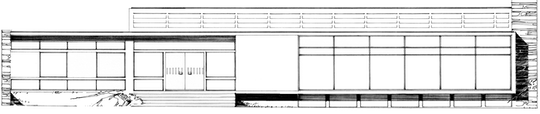
In the third work, a real-time audio transmission presented in the gallery building’s pavilion-like foyer, Erik Smith makes the basement of the building audible by means of piezo contact microphones affixed to its pipes and walls. The sound literally emerges from underground. Here, what’s unseen is made accessible and perceptible, similar to the wall cut in the main space, but is also translated medially. The basement of the institution is “revealed” to the viewer as a continuum of metallic, pipe-like sounds, intermittently interrupted by crackling, knocking, or short whistling noises. Here, too, in terms of the audible, Smith is concerned with the peripheral and indeterminate, in the moment of transition from information to disinformation, from sound to noise. The rather sonorous, drone-like reverberations oscillate between sound and noise. Its seemingly voice-like impression bestows the building not only with an imaginary register, but an animistic one, so that space here, akin to a being, even acquires a voice.
Erik Smith’s works demand a kind of perception from the viewer that transcends the immediacy of the site. The gallery building no longer serves as an (ostensibly) neutral container for presenting art but is instead the subject of aesthetic, indeed spatial-ontological and -archaeological reflection. In a series of momentary penetrations, of mental superimpositions, of variously activated temporal layers, the gallery becomes a kind of potential “time machine,” not in the conventional form as dispositif, where art from various periods is presented, but as a place in itself, in which its own “repressed” dimensions, its own history, are explored within a far broader temporal context.
Smith is concerned with the interrelationships and interferences between these various spatial aspects. Negative space is accorded a special status here; it
is not simple, but defined by its non-visibility, by a merely presumed absence. Negative space transcends what appears to exist spatially, of what is present. This precarious ontological status closely aligns negative space, such as gaps or rifts, with the non-linguistic, non-verbal, non-signifiable. It deftly resists conceptualization and more precise analysis, remaining semantically vague and diffuse, a projection surface that works more affectively and is seemingly more sensed than visible and observable.
Erik Smith always thinks about the wall behind the wall, the room behind the room. He makes non-forms visible by exposing or casting them, or audible by transcribing them acoustically. In Smith’s work, this kind of stratigraphic approach produces a kind of palimpsest-like layering and interrelating of a site’s various places and temporalities. The present-day place thus becomes a heterotopic place (Foucault), which is not only multi-layered but also heterochronic.
Smith’s spatial thinking reflects the interdependency, correlation, and intertwining of the most diverse aspects of space and place. For this reason, the three sculptural interventions in
Un-buildings are also not strictly separable semantically. Even if the aspect of deconstructing the dispositif of art, the aura of art, clearly references a semantic level, the artist is not at all concerned with context art or institutional critique. By the same token, a purely scenic or narrative reading, such as “hidden spaces,” would also sell the intention and signification of the works short. Smith is instead concerned with reciprocity, with the interaction and interplay between the three works and their referential-systemic, narrative, and metaphysical connotations.
Erik Smith’s artistic practice strives for a synesthesia of spatial “forms of being.” He is concerned with an expanded conception of space, one that consistently interrogates the temporality and temporal nature of the phenomenon of space. Whether building, place, or landscape, space is inseparable from its past, from what precedes it, but also from what is to come. Ultimately, in
Un-buildings, Smith confronts the selective, bundling, and condensing act of perception—as a dispostif of art also, or even especially, undertakes—with a form of transcendent spatial perception in order to effectuate an anthropological notion of place, in its interdependencies of perceptual, social, and ontological dimensions.
Text: David Komary
top