
Current
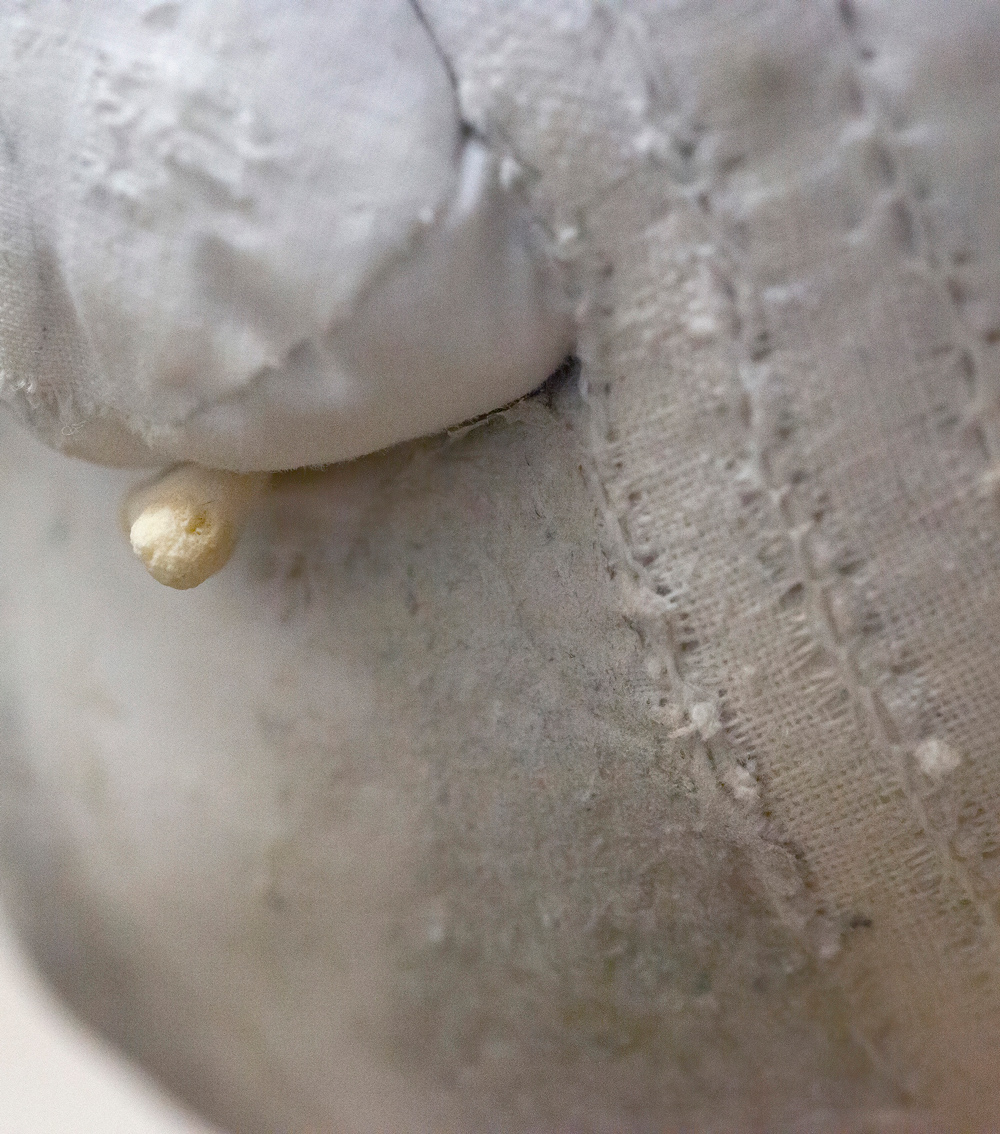
Claudia Losi, Like a Forest Garden #deer (detail), 2025
cotton jacquard fabric, wool embroidery, reflective thread; brass castings, Size: 130x144 cm
© Claudia Losi, Photo: Andrea Rossetti
cotton jacquard fabric, wool embroidery, reflective thread; brass castings, Size: 130x144 cm
© Claudia Losi, Photo: Andrea Rossetti
BEYOND THE GARDEN
CLAUDIA LOSI
Cooperation exhibition of Galerie Stadtpark
and AIR – Artist-in-Residence Lower Austria
Opening: 24 April 2026, 6.30 pm
Exhibition duration: 25 April–13 June 2026
Opening hours: Wed–Sat, 10.30–17.00 hrs
Claudia Losi’s aesthetic practice unfolds within the tension between the individual and society, as well as in the dialectic of subjective creation and intersubjectivity. Her works, which often incorporate participatory elements, feature various narrative levels—personal, cultural-historical, anthropological, and philosophical-existential—that are subtly interwoven. Losi works with a constantly expanding body of narratives, which she embeds in her reflections on nature and ontology and links together. Here, the individual subject does not stand isolated from others, but appears, articulating itself through the narrative, the imaginary, and the remembered, in relational connection with them.
In the multi-panel tapestry Like a Forest Garden, the artist interprets and distills thoughts and images gathered over the years from hundreds of interviewees regarding their conception of a “natural place.” In the process, not only does an intratextual dialogue of these narratives and descriptions take place, but the subject also transitions in a gentle, even natural way into the idea of a timeless collective, a community, an exemplary form of “humanity.” In the installation of the work, however, Losi does not simply present the results of her research, but rather integrates specific sections of the textile wall piece into a spatial-installative structure. This coalesces into a kind of biotope that seems to have grown rather than been created, forming a perceptually open rather than a fixed form. In analogy to the dialectic of subject and collective or society, Losi thus also creates, with regard to the exhibition form—the installation of the work—a subtle convergence with that central idea of forest, ecosystem, and the natural, which is implicit in her work.
_______________________________________________
CLAUDIA LOSI
Born in Piacenza, 1971.
Lives and works in Piacenza, Italy.
Graduated at the Academy of Fine Arts, Bologna, and at the University of Foreign Languages and Literature, Bologna, she was selected in 1998 for the Advanced Course in Visual Arts of the Antonio Ratti Foundation, in Como, Italy; in 2000 Italian shortlisted for the International Studio Program P.S.1-New York. She has been artist in residence at Studio Orta-Les Moulins (France), JCVA, Jerusalem (Israel), Art Omi International, New York (United States), NTU CCA (Singapore), Error-Lenguas hermanas, Mexico City
Selected exhibitions:
Monica De Cardenas, Milano (2026); Palazzo Ducale, Genova; La Strozzina, Firenze (2025); Palazzo Te, Mantova; Museo della Montagna, Torino (2024); Obrera Centro / ICC, Città del Messico; AssabOne, Milano (2021); MAMbo, Bologna (2020); Ikon Gallery, Birmingham (2019); Collezione Maramotti, Reggio Emilia; Hangzhou Triennial of Fiber Art (2016); Triennale Design Museum, Milano; MAXXI, Roma (2012, 2010); Royal Academy, Londra (2010); Sharjah Biennial 8 (2007); In 2021, she published The Whale Theory: An Animal Imaginary, Johan & Levi and Voce a vento, (Kunstverein Publishing). Her project Being There. Byond the garden won the Italian Council (9th Edition, 2020), promoted by the Italian Ministry of Culture, in 2022 the homonymous book was published by Viaindustriae.
In the multi-panel tapestry Like a Forest Garden, the artist interprets and distills thoughts and images gathered over the years from hundreds of interviewees regarding their conception of a “natural place.” In the process, not only does an intratextual dialogue of these narratives and descriptions take place, but the subject also transitions in a gentle, even natural way into the idea of a timeless collective, a community, an exemplary form of “humanity.” In the installation of the work, however, Losi does not simply present the results of her research, but rather integrates specific sections of the textile wall piece into a spatial-installative structure. This coalesces into a kind of biotope that seems to have grown rather than been created, forming a perceptually open rather than a fixed form. In analogy to the dialectic of subject and collective or society, Losi thus also creates, with regard to the exhibition form—the installation of the work—a subtle convergence with that central idea of forest, ecosystem, and the natural, which is implicit in her work.
_______________________________________________
CLAUDIA LOSI
Born in Piacenza, 1971.
Lives and works in Piacenza, Italy.
Graduated at the Academy of Fine Arts, Bologna, and at the University of Foreign Languages and Literature, Bologna, she was selected in 1998 for the Advanced Course in Visual Arts of the Antonio Ratti Foundation, in Como, Italy; in 2000 Italian shortlisted for the International Studio Program P.S.1-New York. She has been artist in residence at Studio Orta-Les Moulins (France), JCVA, Jerusalem (Israel), Art Omi International, New York (United States), NTU CCA (Singapore), Error-Lenguas hermanas, Mexico City
Selected exhibitions:
Monica De Cardenas, Milano (2026); Palazzo Ducale, Genova; La Strozzina, Firenze (2025); Palazzo Te, Mantova; Museo della Montagna, Torino (2024); Obrera Centro / ICC, Città del Messico; AssabOne, Milano (2021); MAMbo, Bologna (2020); Ikon Gallery, Birmingham (2019); Collezione Maramotti, Reggio Emilia; Hangzhou Triennial of Fiber Art (2016); Triennale Design Museum, Milano; MAXXI, Roma (2012, 2010); Royal Academy, Londra (2010); Sharjah Biennial 8 (2007); In 2021, she published The Whale Theory: An Animal Imaginary, Johan & Levi and Voce a vento, (Kunstverein Publishing). Her project Being There. Byond the garden won the Italian Council (9th Edition, 2020), promoted by the Italian Ministry of Culture, in 2022 the homonymous book was published by Viaindustriae.

