The work of Czech artist
Jiří Valoch (b. 1946) encompasses concrete and visual poetry, conceptual text works, artist books, and text-based installations, as well as minimalist happenings and interventions in nature. The exhibition
PRE-PICTORIAL presents a selection of early typograms, photographs, and a text installation whose form was not only radically reduced for the 1960s and 1970s, but which also employed a unique asemantic and visual-poetic language that both reflected and significantly shaped the emerging international forms of conceptual art, visual poetry, and, to some extent, land art.
As a conceptual artist, Jiří Valoch moves between the fields of literature, visual art, photography, sound, and happenings. He often described himself during this time as a poet, artist, and researcher. Such crossovers are typical of the post-avant-garde art of the 1960s and 70s. Valoch, however, embodied this role in the former Eastern Bloc, in particular in what is today Czechia, with remarkable consistency from a young age, making him a pioneer and a central figure of the Central European avant-garde. Under conditions of growing political repression and lack of freedom, especially after 1968, there was a subversive quality to his increasingly international, correspondence-based and networked artistic and exhibition-making practice. While not overtly political, it was inwardly free in a radically artistic sense.
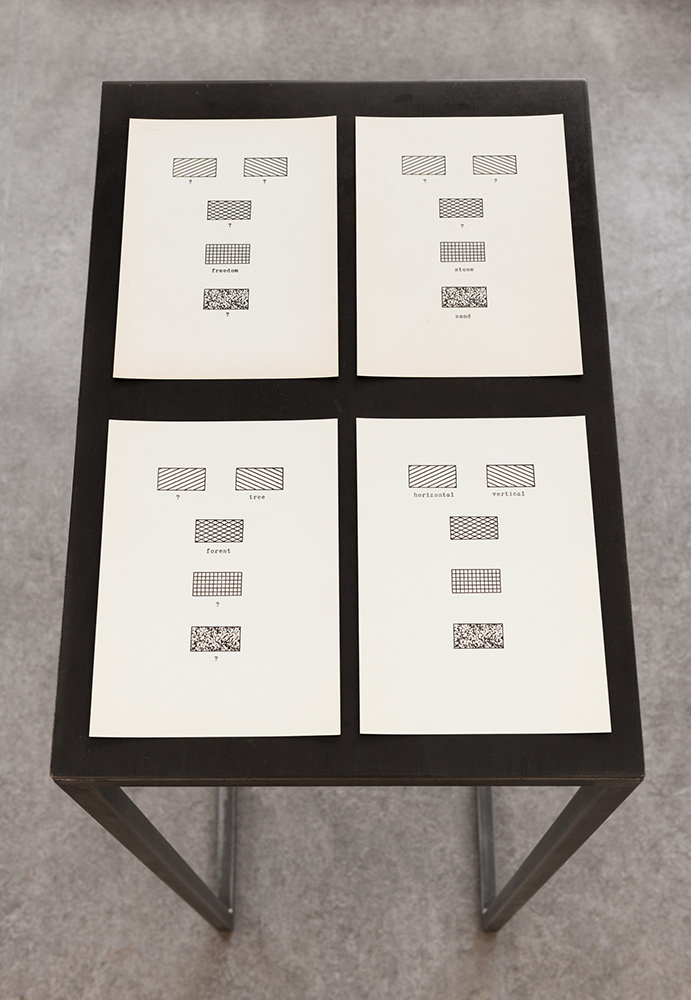
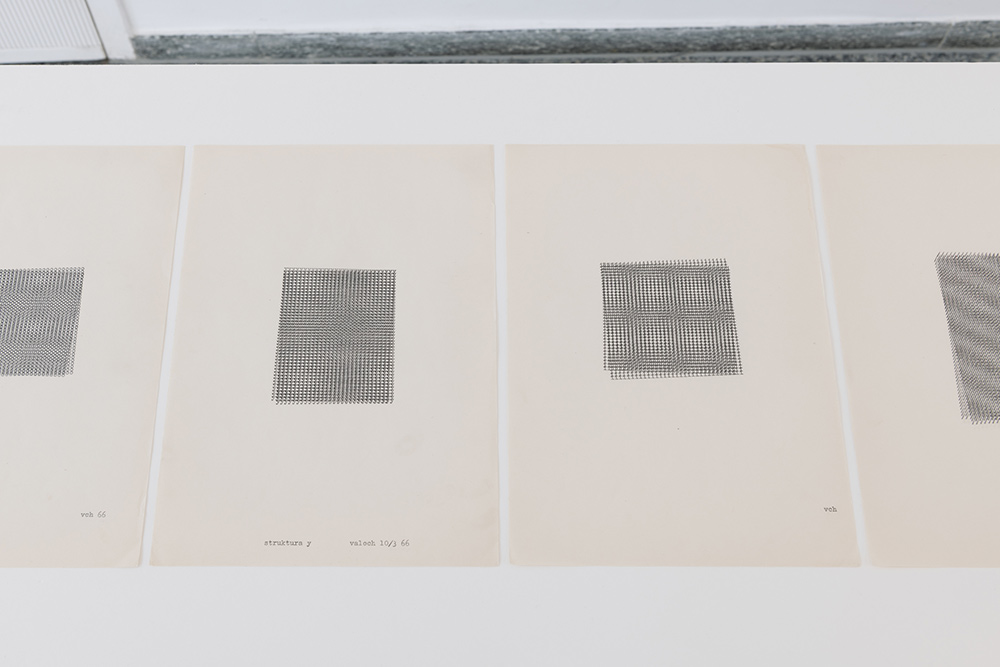
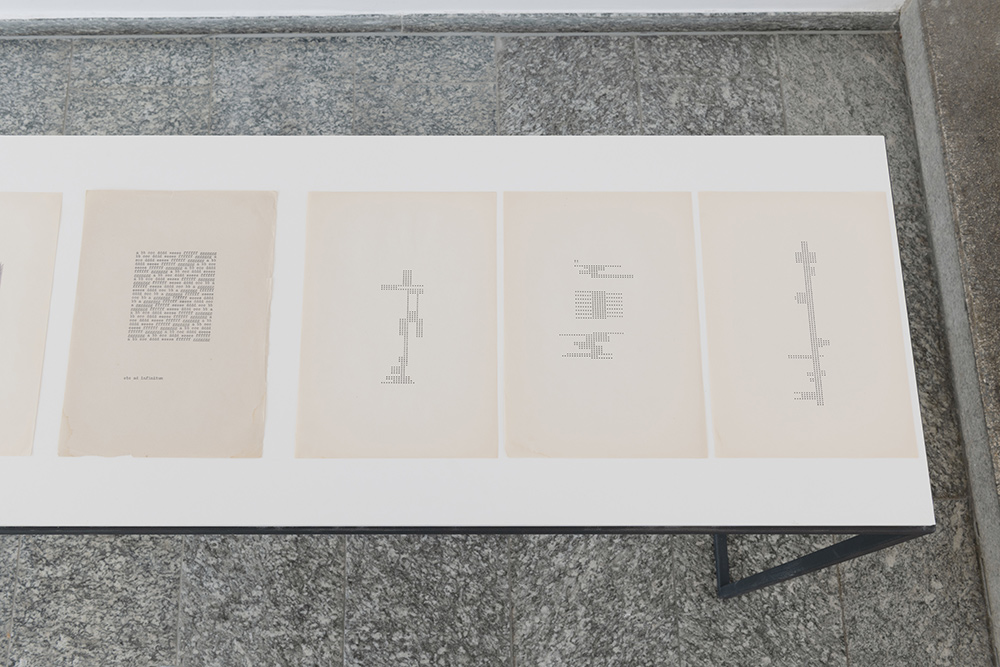
Jiri Valoch’s artistic approach is rooted in poetry and was initially linear and poetic, i.e. quite traditional, but soon developed into an experimental and concrete-poetic form. The early originals—the
Typograms or
Optical Poems presented in PRE-PICTORIAL, dating from 1966 and 1968—already feature radically asemantic poems. These works are increasingly defined by their visual appearance—the optical presence and interplay of graphemic structures produced by a mechanical typewriter. Through the repetition, displacement, and superimposition of sequences of signs, structures and spatial arrangements emerge that arise primarily in the eye of the beholder and lie far beyond the usual meanings of the “misused” letters and typewriter characters. Discernible here is a strong emphasis on visual and rhythmic–acoustic qualities, coupled with conceptual thinking. Valoch no longer focuses on the characters and their intrinsic content, but instead subverts, undermines, reverses, and even negates this. The characters become graphic building blocks of an autonomous and abstract nature, of pure, concrete material.
While the
Typograms give rise to a semiotic-semantic effect—some grapheme structures appear to condense into geometrically structured signs, a kind of meta-sign—the
Optical Poems evoke moiré-like, two-dimensional spatial effects. The structural interplay of repeated, partially overlapping sequences of signs opens up a kind of space within the drawing surface, more precisely, a pictorial space condensed from layers and structures. Meaning now emerges inter-pictorially, simultaneously “pre-linguistically,” solely through the reduction, arrangement, and superimposition of signs. The focus shifts from content to form—a fundamental principle of concrete poetry.
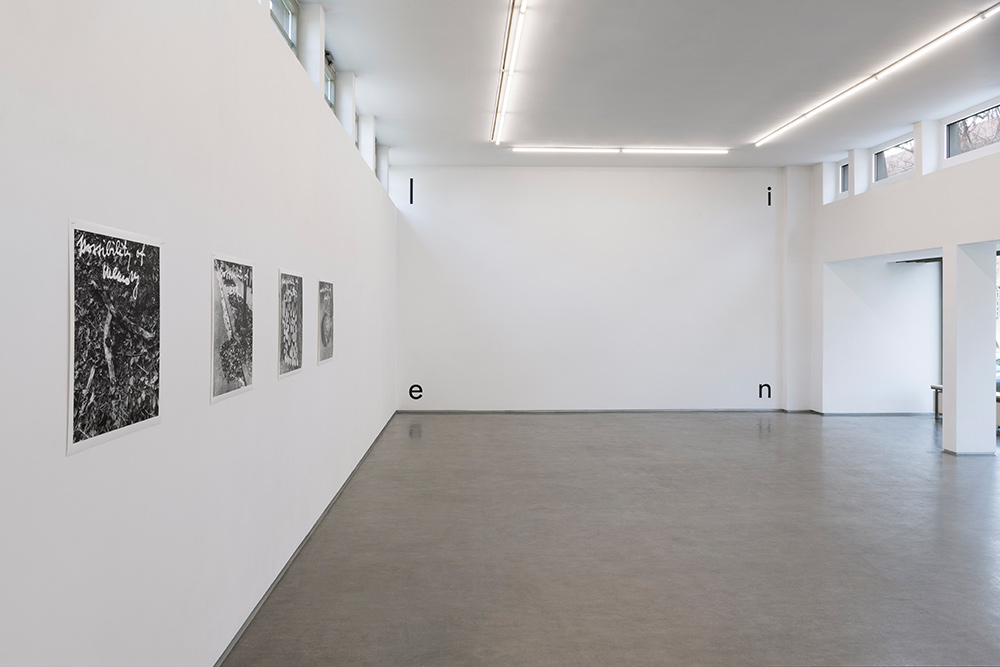
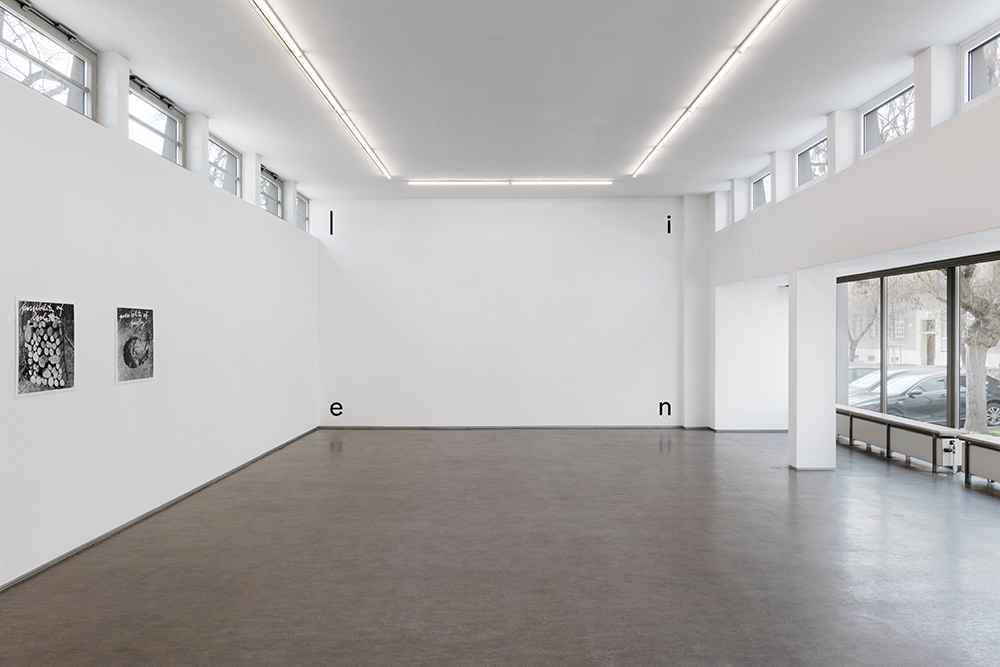
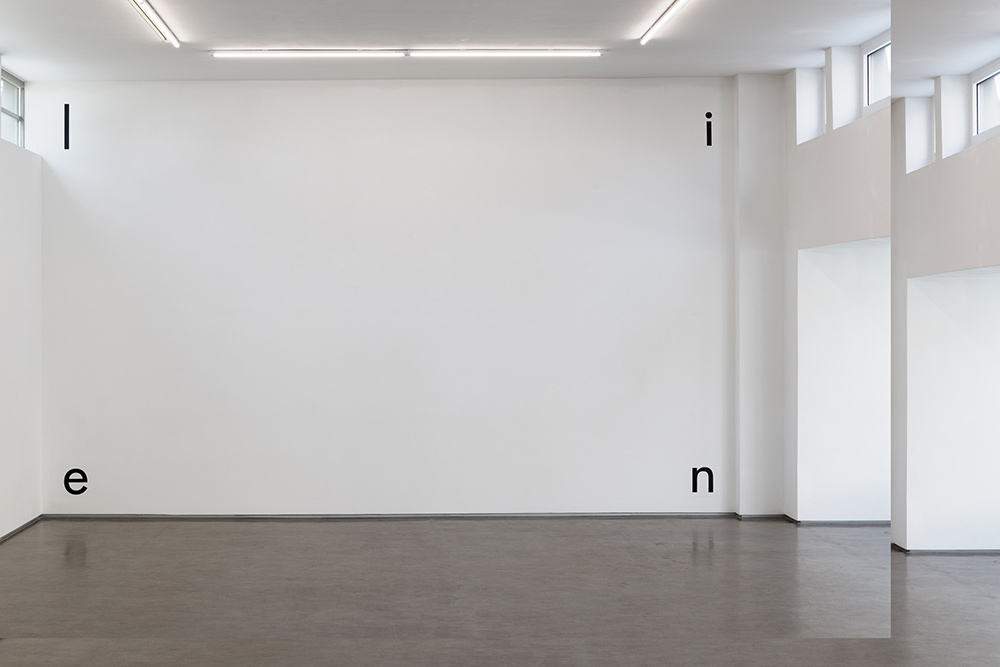
As a counterpart to the small-format typewriter works of the 1960s and ’70s, the exhibition also features a comparatively later, highly tautological text work with a pronounced spatial presence. In the text installation
Line, based on a design created by the artist, the letters l, i, n, and e appear in the form of 50 cm tall adhesive versions affixed to the corners of the gallery’s far wall. Valoch reduces and dissects the word so radically in this text installation that it remains virtually atomized in empty space or pictorial space. The reduction does not produce a semantic emptiness, but rather represents a condensation of “other,” potential meanings. This draws attention to the language itself, as well as to its reception and recipients.
The viewer can quickly grasp the literal meaning, but the letters placed clockwise at the outermost corners of the wall are not read in (two) lines, but circularly. The line form that emerges during decoding collides with the non-linear form of circular reading of the letters that are displaced from the center of the wall. Content and form, as well as conception and perception, are interrelated here, yet also exist in conflict and a kind of dissonance. Valoch confronts the viewer with a space that deviates between text and image, eye and mind, even if this appears as a kind of fractured tautology at first glance. Neither the eye nor thought can rest here. Both senses are highly activated and must work. They rub against each other, ultimately leaving the viewer in a somewhat unsettled state, one nevertheless underscored by a contemplative quality.
The increasing importance of the visual sense, the iconic, the act of viewing, but also of ordering, designating, and describing, is further enhanced in Valoch’s work through the integration of photographic means. In 1969, Valoch used black-and-white photography for the first time to explore and give space to an expanded form of poetic thought and perception. During this period, the influence of his father’s work and social environment on Valoch is made evident. From 1961 to 1976, his father was one of the leading archaeologists directing the excavations of prehistoric finds in the Kůlna Cave in the Moravian Karst.
Even before embarking on his independent artistic career, observing and contemplating nature and landscape played a significant role in Valoch’s life. From his teenage years on, he worked intensively on his father’s excavations during summers in high school and throughout his university studies. Valoch’s work therefore reflects ways of observing and classifying nature and artifacts that, from an aesthetic point of view, exhibit a certain monotony and detachment in their apparent adoption of archaeological principles. For many of his photographs, he used a Flexaret camera his father had given him.
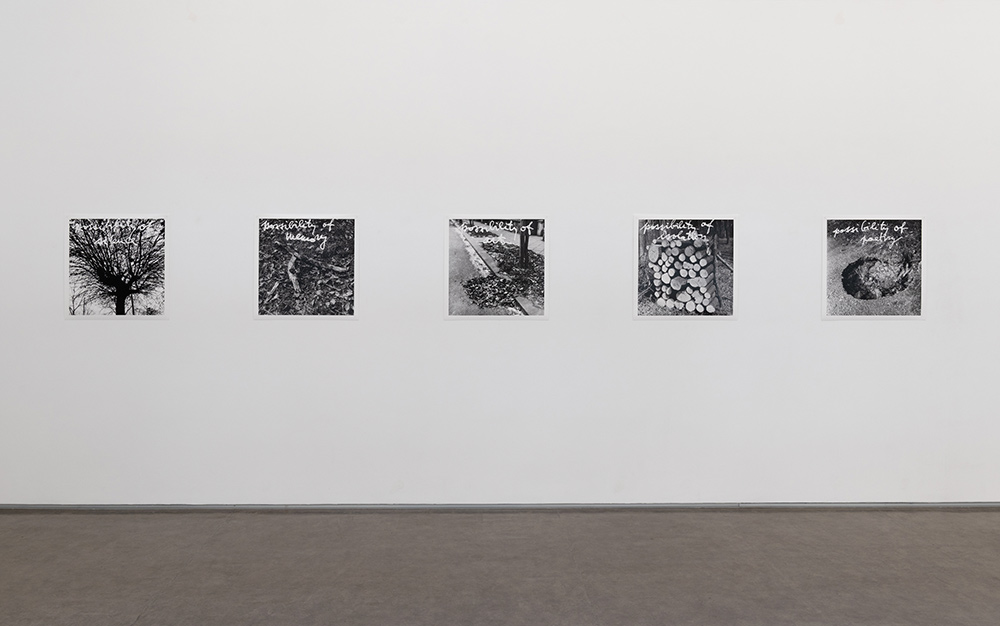
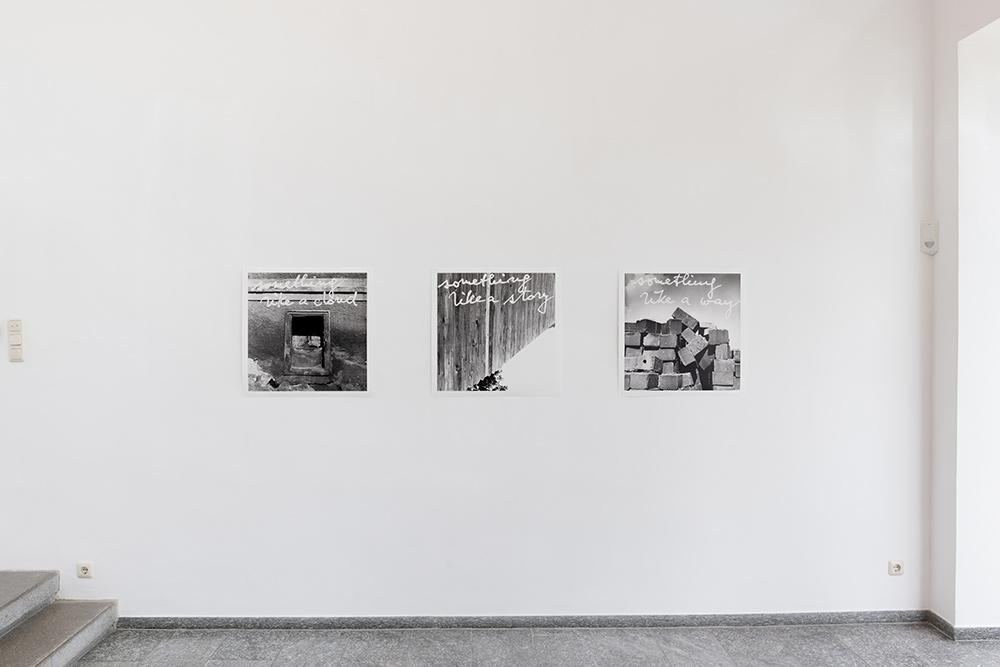
The photographic series
Observing the Landscape I and
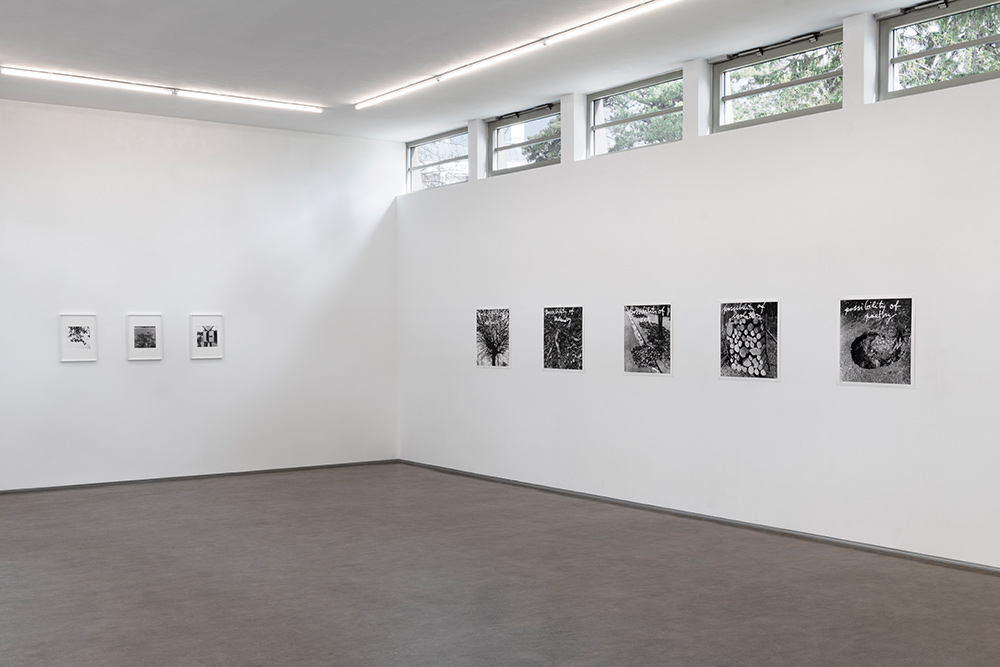
II, like virtually all of Valoch’s photographic series, are connected to the landscape of the Moravian Karst, the archeological site where his father worked. But beyond the documentary feel and effect of the images, Valoch intervenes in both series by marking the negatives by hand. After years of de-semanticization, a semantic use of language re-emerges, albeit in a simple, almost abstract way. Each motif is juxtaposed with a personal note or text fragment—once again, a modular-structural approach from earlier text works is evident—which immediately begins to label, semanticize, and transform what is shown. Legible on the images is the phrase: “Possibility of silence, art, dreaming, freedom, love, etc.” The photographs, in turn, depict a woodpile, forest floor, a hole in the ground, a treetop, and so forth. The effect of text on image turns the visual poems into a kind of poetic searching. In so doing, image and text condition an individual process of mutual activation and semanticization in the eye and mind of the viewer.
In
Observing the Landscape I, Valoch creates a kind of poetic fulcrum with the phrase “possibility of x (love/freedom/time etc.).” He suggests that what is alluded to—dreaming, freedom, love, etc.—might be possible. At the same time, however, he also points to major, even existential, themes that are not “simply possible” or easily found. The “possibility” and “something-like” series thrive on a dialectic, a tension between purposelessness and meaning, substantive weight and poetic-associative lightness. And yet, this is seemingly a matter not of a semantic deconstruction of one thing or another, of what is seen or designated, imagined or felt, but rather of a subtle approach, a mutual search, a seeing and searching for the one in the other. It is precisely the “medium” of nature, the realm of the natural—what we commonly understand as existing, growing, and being in and of itself—that serves as the space onto which Valoch projects what is expressed in words. The grand, indeed philosophical and existential concepts and themes such as memory, time, art, and love find resonance and their meaning enhanced through this nature-aesthetic counter-reading. The three-word sentences do not merely evoke affinities or praise the nature depicted. This is by no means a matter of mere reciprocal intensification or poetic-semantic play, but rather of activating a “new sensitivity” of perception, as Valoch himself described it in his writings of this period—a deeper, multisensory perception, far removed from the strictly defined categories of mere text and image.
At this point, we can no longer speak of perception in the sense of external, registrational seeing or of such reading and conceptual thinking. With these visual-poetic works, Valoch aims instead at an inner seeing that precedes seeing. It is a pre-pictorial sense, a sensitive, tactile, more holistic form of seeing that generally comes before seeing. Seeing here means neither distance, measurement, mapping, the naked eye, nor reading, decoding, or ordering, but rather the entire register of perception, as well as an entanglement and reciprocity of the sensual and the mental, the spiritual. The purely visual gaze gives way to a kind of ontological seeing that, beyond mere meaning and symbolism, is directed toward a being, a coherent whole, a profoundly poetic one.
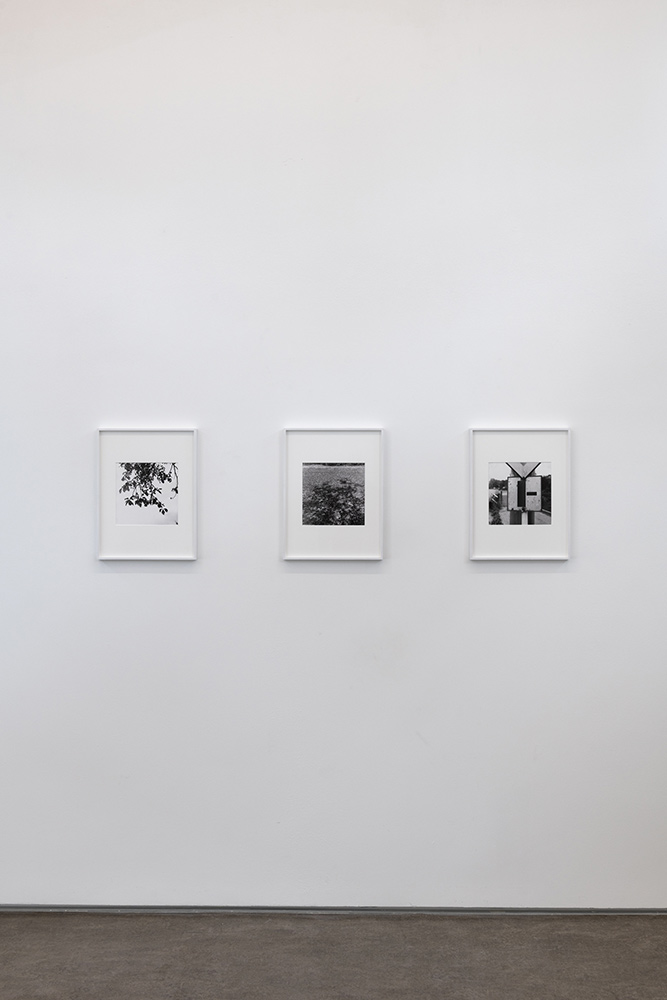
Beyond these transformations of the pictorial through the linguistic and vice versa,
Haiku III ultimately reveals a decidedly visual-poetic approach. The triptych of three equally sized photographs shows a chronological sequence of shots taken by Valoch along a path through a forest. The images can be equated to a searching through what’s seen, entirely without words. They live solely through their visual correspondences, through their invisible connections, which reflect a casual, unintentional searching while walking, translating, and transmitting it poetically, beyond the boundaries of the image and across time. In this loose configuration, in the juxtaposition of these pictorial “lines,” a fleeting moment condenses, an atmospheric state that speaks of nature without ever explicitly mentioning it by name. In this radically poetic, nonverbal form of visual poetry, Valoch succeeds in transcending not so much image and text as image and space, and space and time.
In various strands of work from these early years, Valoch decouples letters from words, images from words, and even works with images without images. And yet, ultimately, beyond aleatoric and deconstructive elements, a profoundly poetic, contemplative, and sensitizing dimension emerges in his work. It points to a penetrating vision beyond binary oppositions such as text-image or image-space and time. His works not only transgress and expand the boundaries of signs and genres. Rather, Valoch strives for a careful mode of seeing that is not only intimate, but in a radical sense, ontologically connective and relational. Thus, in Valoch one can discern not only an early, explicitly interdisciplinary position not only in formal and medial terms, but also with regard to the differing ontological and aesthetic qualities of what is shown.
top