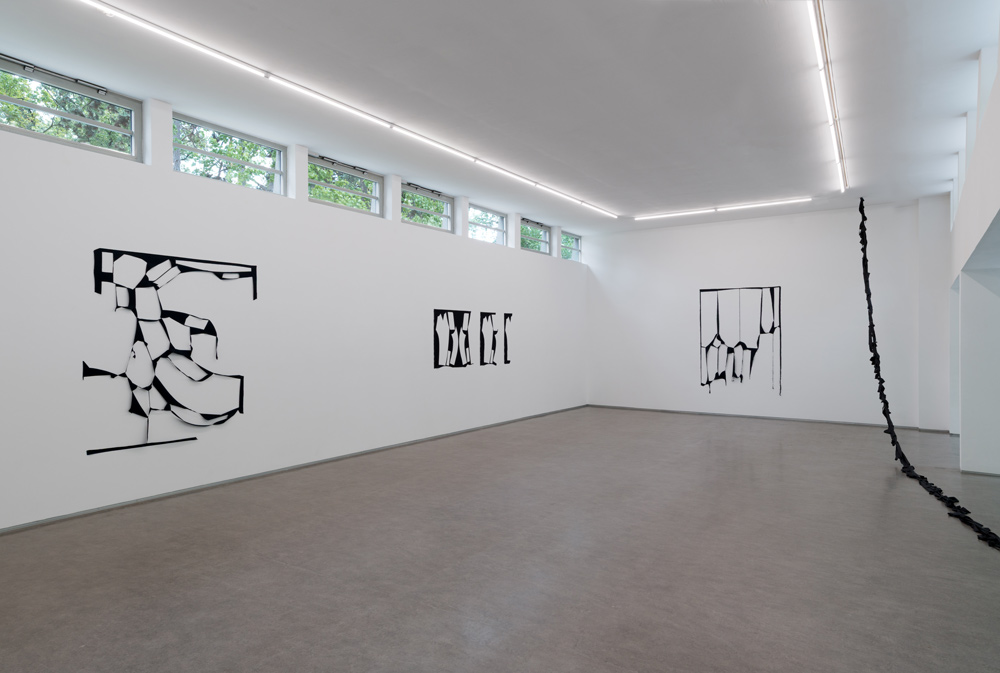
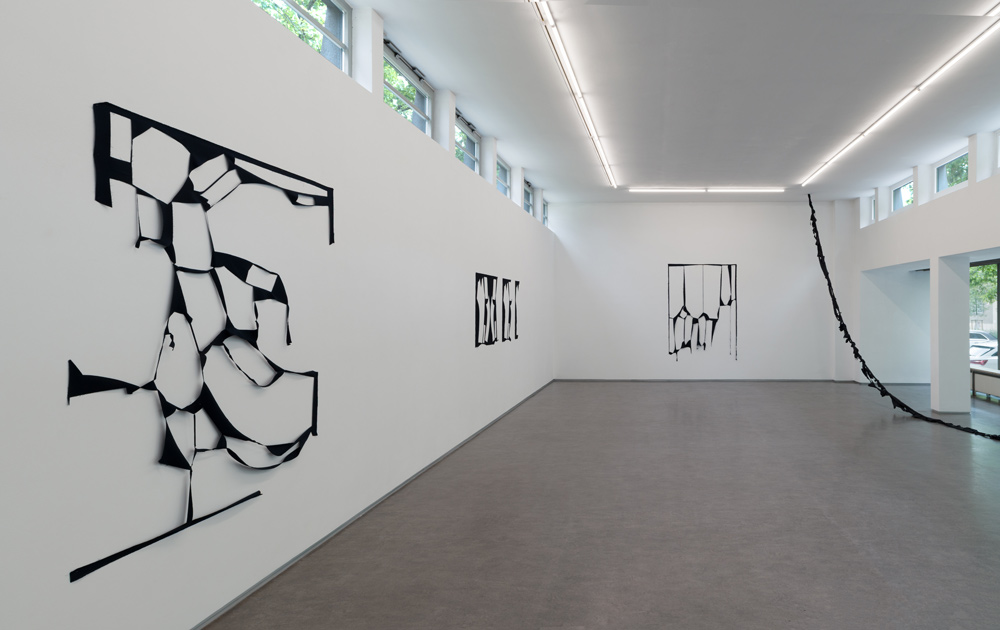
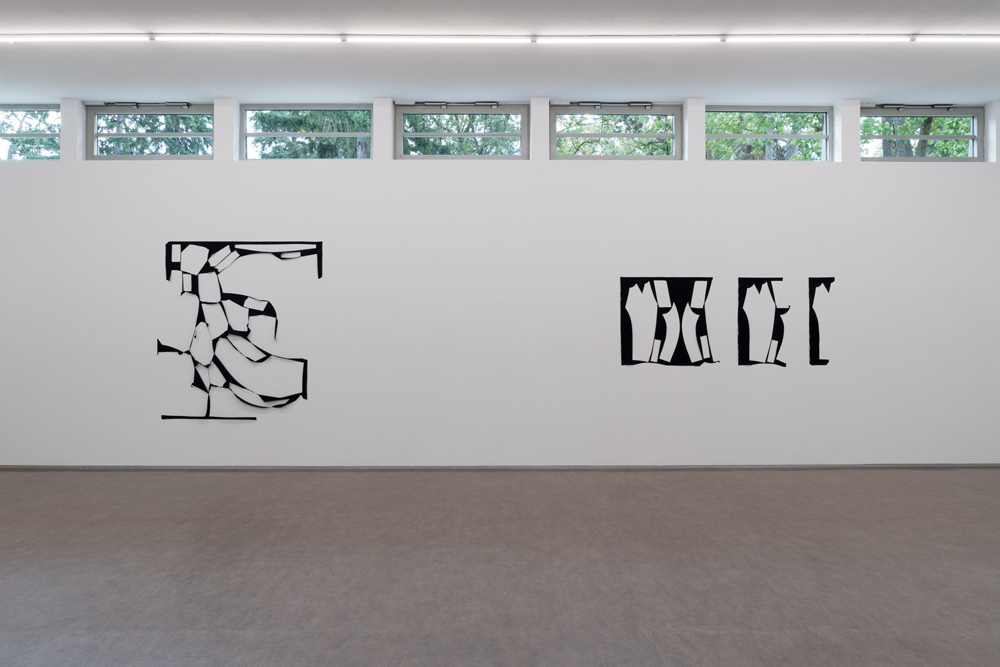
The exhibition DÉCHIQUETÉ—SQUARCIATO centers on two groups of works by Romanian artist
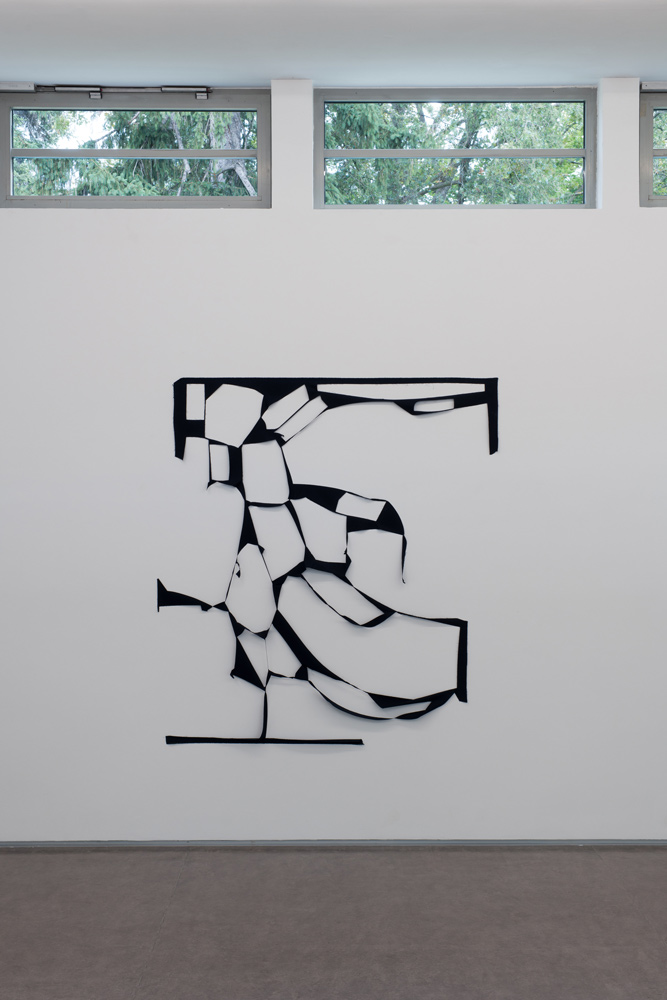
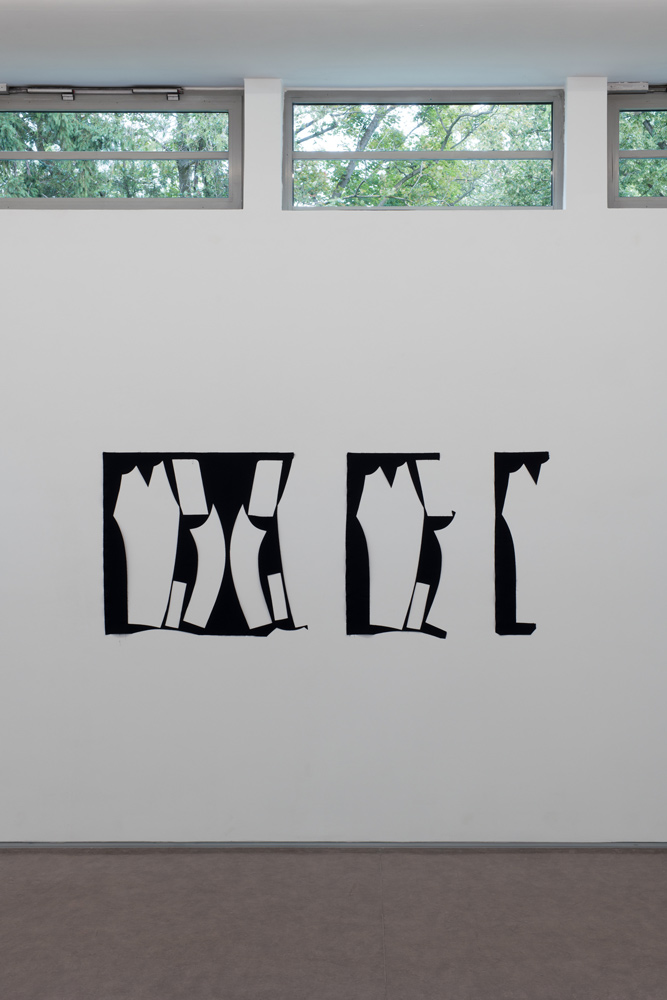
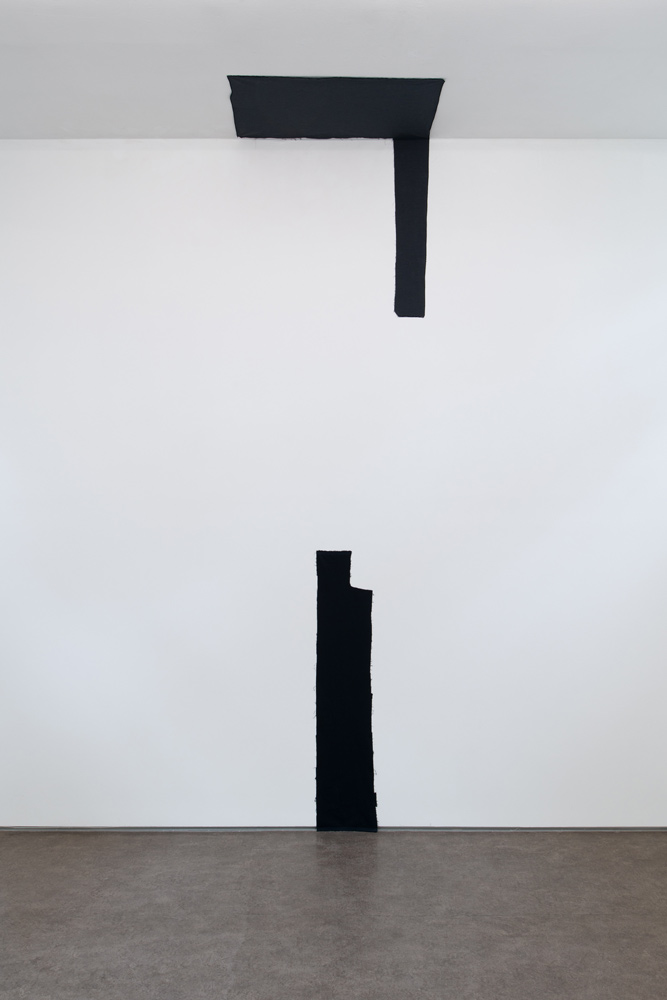
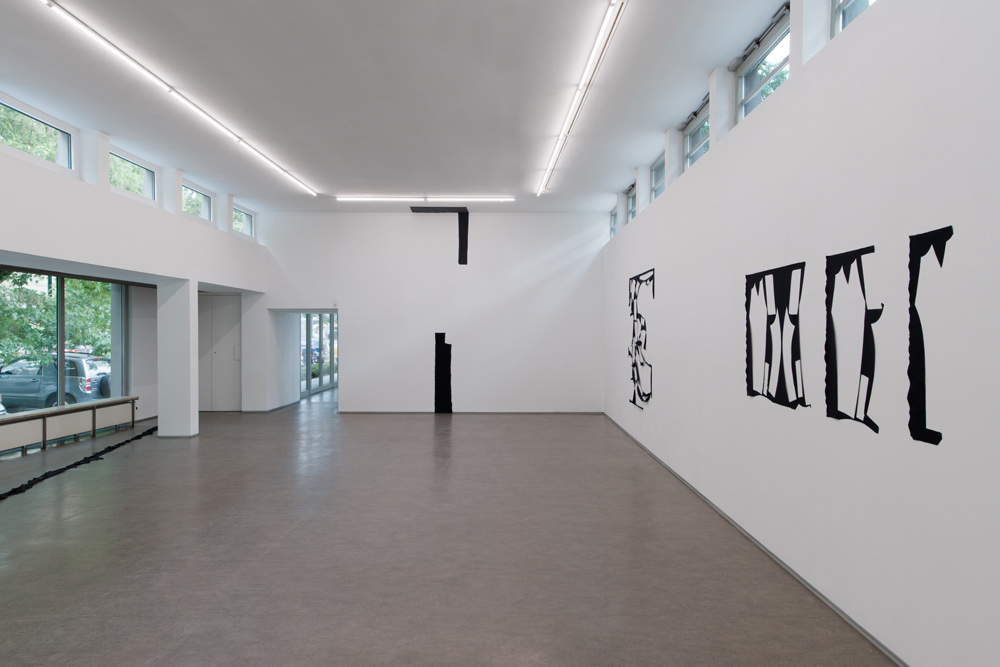
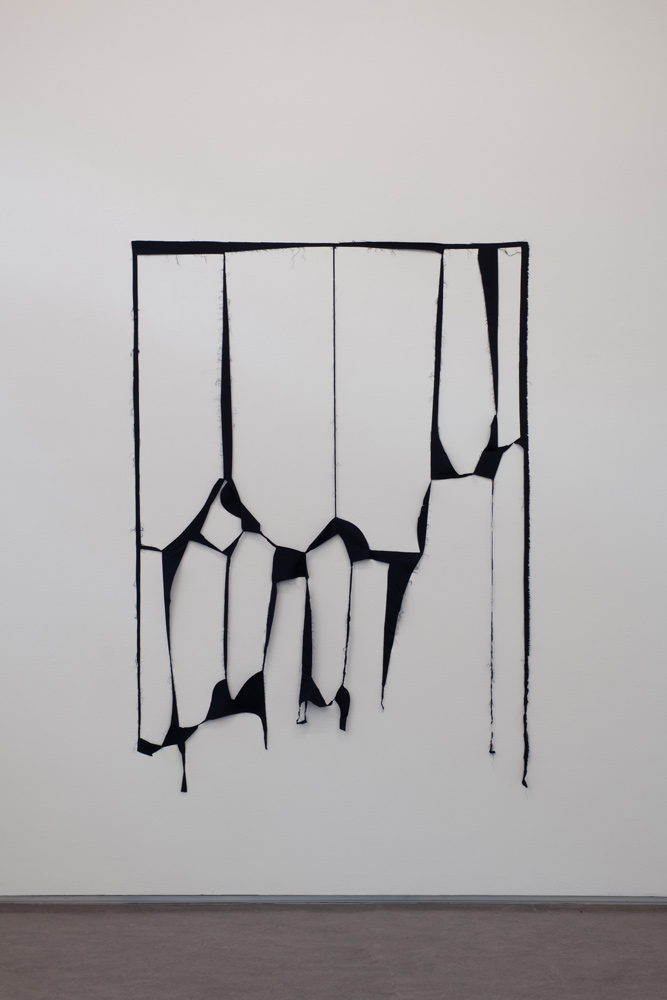
Marion Baruch , (b. 1929). On view are intricate, geometric spatial sculptures from the 1960s and textile works from the past ten years. In the latter works, developed since 2012, Baruch utilizes production scraps from the textile industry. Making use of offcuts, she creates fragile, seemingly precarious works that transcend the status of found material, of what is cut up and shredded, without negating such qualities. Baruch’s fabric configurations are formally dialectic, occupying a kind of dual status. They are object-trouvé, mere material, but also achieve—through how they are interpreted and presented, hung and tensioned—the status of a pictorial formation, characterized by strong contrasts and negative forms, asserting an autonomous presence with a graphic, quasi-gestural intensity. Beyond their aesthetic appeal, Baruch’s fabric formations always harbor a poetic-narrative dimension. Each work is given a unique title, which plays an integral role in defining its sphere of conceptual-semantic signification. The pictorial and spatial-aleatoric presence is thus matched by a visual-poetic one, without deemphasizing or overwriting the physical, kinesthetic, and tactile dimension of the cut remnants, the tension of what’s torn (
squarciato).
Marion Baruch’s aesthetic practice reflects the significant biographical turning points she has experienced throughout her life. Her work echoes the fundamental themes of the twentieth century: communism, capitalism, consumer society, mass production, language conflicts, and ideologies. Baruch was born in 1929, between the First and Second World Wars, in Timișoara to Hungarian parents, at a time when the city was no longer Hungarian but already part of Romania. She began her art studies in Bucharest in 1948, but the classes were already heavily influenced by Stalinism and increasingly restricted. In 1949, she took the opportunity to study in Israel with Mordecai Ardon, a student of Paul Klee. In 1954, Baruch received a scholarship to study in Italy, which then became her home for many years. In the late 1960s, she turned away from painting. During the construction of a modernist house in Gallarate, which she planned with her then husband, textile designer Aldo Cuccirelli, she began developing her first spatial works. These outdoor sculptures address the body in subtle, albeit explicit ways and already clearly exhibit a ludic dimension—both aspects that are also characteristic of her textile works from recent years.
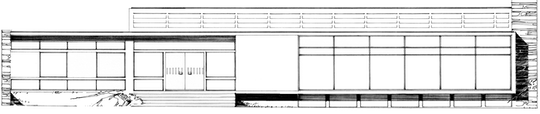
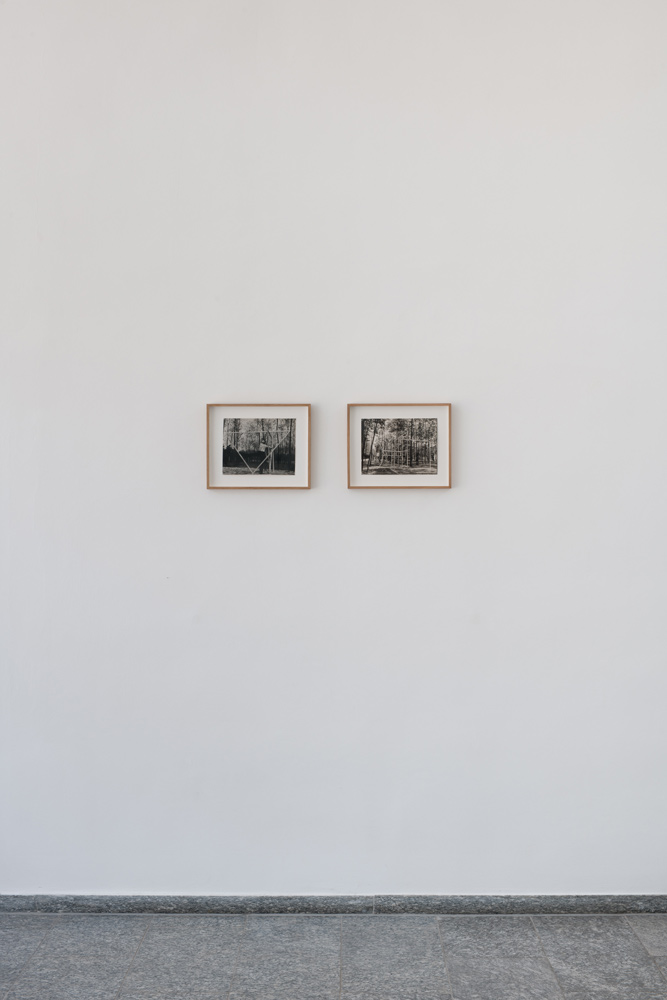
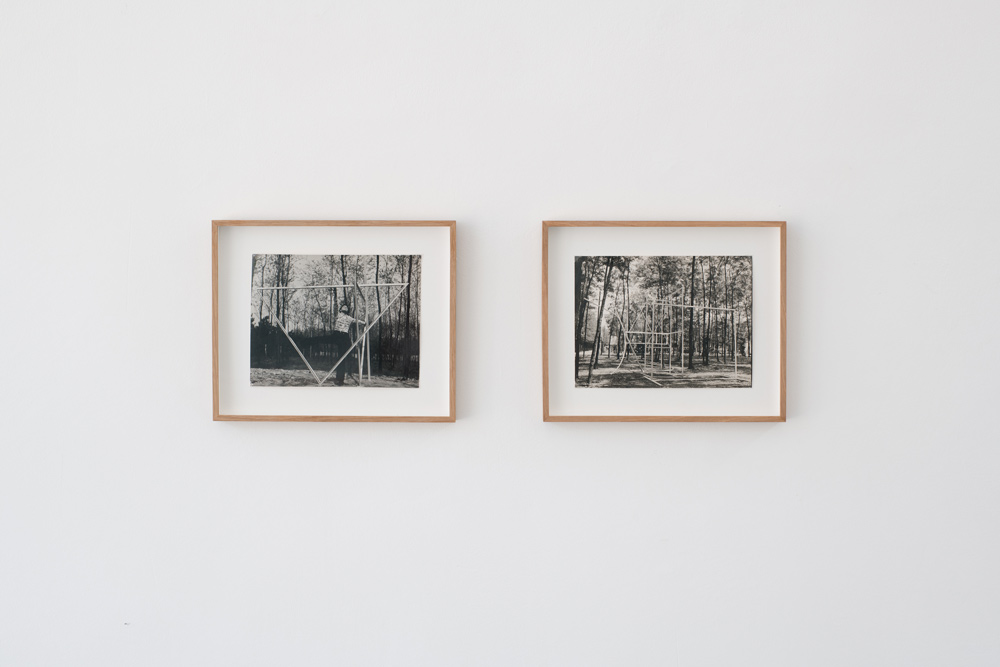
On display in the foyer of the gallery building are photographs of two of these early, minimalist-conceptual steel sculptures.
Un Albero and
Title unknown (1967) can be described as geometrically intricate steel structures that oscillate between minimalist sculpture and a climbing structure.
Un Albero appears fragile, like an elegant drawing, suggestive of movement (like a mobile), yet also solid and substantial. The intricate, geometric framework of transparent partitions forms an open, yet simultaneously protected space—a kind of translucent “dwelling,” perhaps a kind of tree house. Encountered here is one of Baruch’s fundamental themes: the idea and question of dwelling—albeit less in a purely material sense and more in that of a model, as a questioning of the relationship between humankind and the external world, indeed to the world itself.
The geometric, abstract sculptural structures can be read as spatial, playful dispositifs. They address the body, inviting interaction, climbing, and physical engagement. In this way, they direct the gaze and the body, prompting reflection on one’s own position, one’s relationship to the surroundings, to external reality and ultimately—by extension—to society and the world. They also connect inner, mental, imaginary, and utopian aspects with the outside, thus allowing art and artistic thought to remain not solely in the realm of the imaginary or pictorial, but to propel them into life, into the world. Space and spatial action are not abstract here, but conceived as relational, emphatic, and social per se.
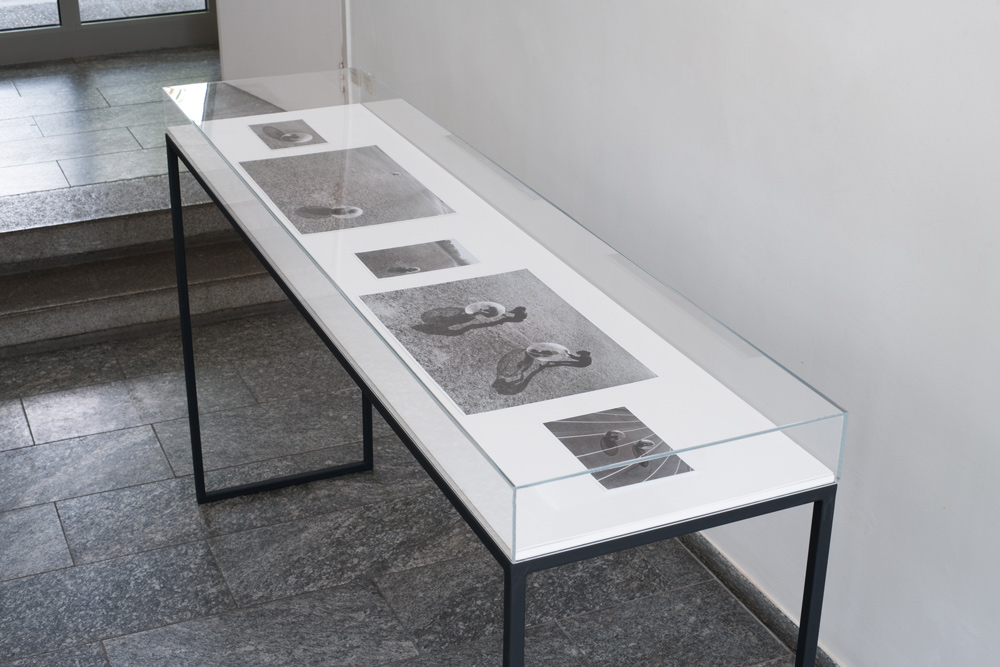
The human body forms another significant connection between the outdoor sculptures and textile works. The ludic quality mentioned above reached a utopian, even futuristic, peak in 1970 in a collaboration with designer and architect AG Fronzoni. For
Contenitore Ambiente (1970), Baruch and Fronzoni developed the prototype for a mobile, moving “sea machine” in the form of a Plexiglas sphere that completely encloses the occupant within. The sphere protects the individual but also makes them transportable and mobile. The transparent yet protective glass spheres suggest a radical liberation of the body through a specific form of individualized mobility. This work also plays with categories of inside and outside, as well as the reversal of standpoint and viewpoint. Evident at the same time is Baruch’s interest in unusual and new materials. At that time, Plexiglas and polyester embodied the hope of democratizing modern design and, simultaneously, the futuristic promise of creating previously unimaginable forms. This reveals Baruch’s early reflections on the relationship between individual and mass phenomena, on conditions of production, forms of distribution and dissemination.
Marion Baruch has worked with fabric remnants since 2012. Her son, who is employed in the textile industry, regularly supplies her with offcuts from design studios and tailoring workshops. Baruch regards these cut-outs—the “ready-resti,” as she initially called them in reference to Duchamp’s ready-mades—as random compositions she intentionally does not alter or add anything to them. The only aspect she determines is where they are positioned on the wall or in the space. Baruch’s approach is entirely intuitive and experimental. This, however, is no coincidence: the artist works with elemental physical forces and conditions such as gravity and tension. Through hanging and tensioning, the fabric remnants take on a unique performative quality, articulated in the present moment, i.e. in a way that is contingent upon the specific setting, where the artistic decision fixes or “freezes” them in place. The power of these works lies precisely in the lightness of their arrangement and their interpretation as specific aesthetic forms. The discovery of a particular remnant that, when hung on the wall or tensioned in the space, begins to “speak” to the artist as a form, constitutes the essential artistic gesture.
Baruch’s textile works are fundamentally shaped by dialectical oppositions such as inside/outside, front/back, figure/ground, form/void. The viewer is challenged to actively interpret what they see. The works dynamize the gaze, effecting a shift not only spatially and phenomenologically, but also mentally and ideationally. Grounded in a playful yet deliberate openness, the works actively invite the viewer’s engagement. Object and subject stand in a thoroughly open, latently permeable relationship to one another. The emphasis lies less on the final form than on interpretation, reading, and poetic appropriation. What is unseen—kinetic, mutable, and energetic aspects in particular—form an essential part of the works’ aesthetic effect.
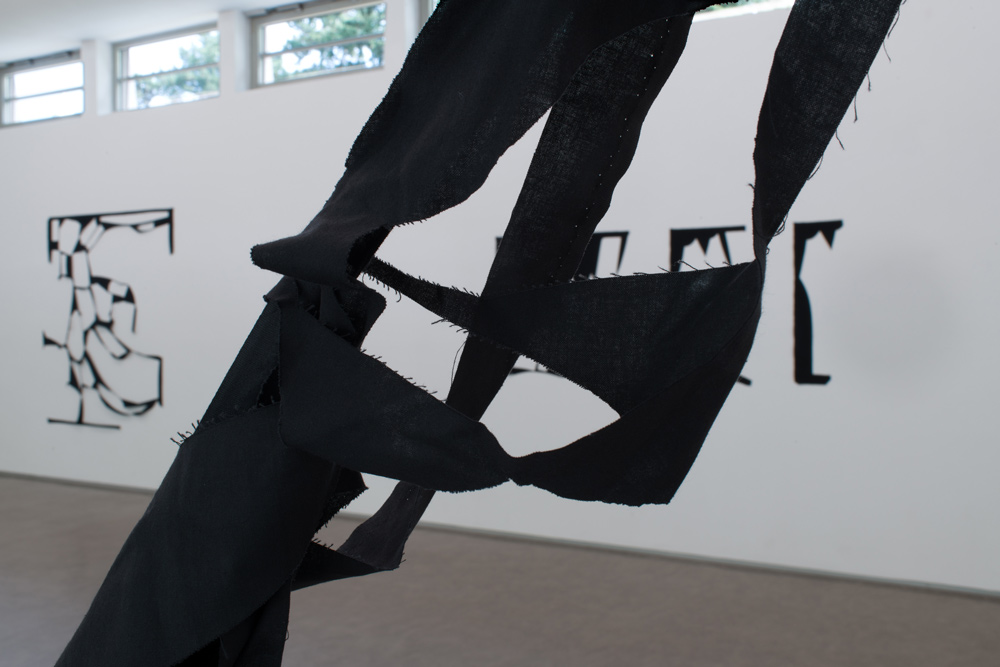
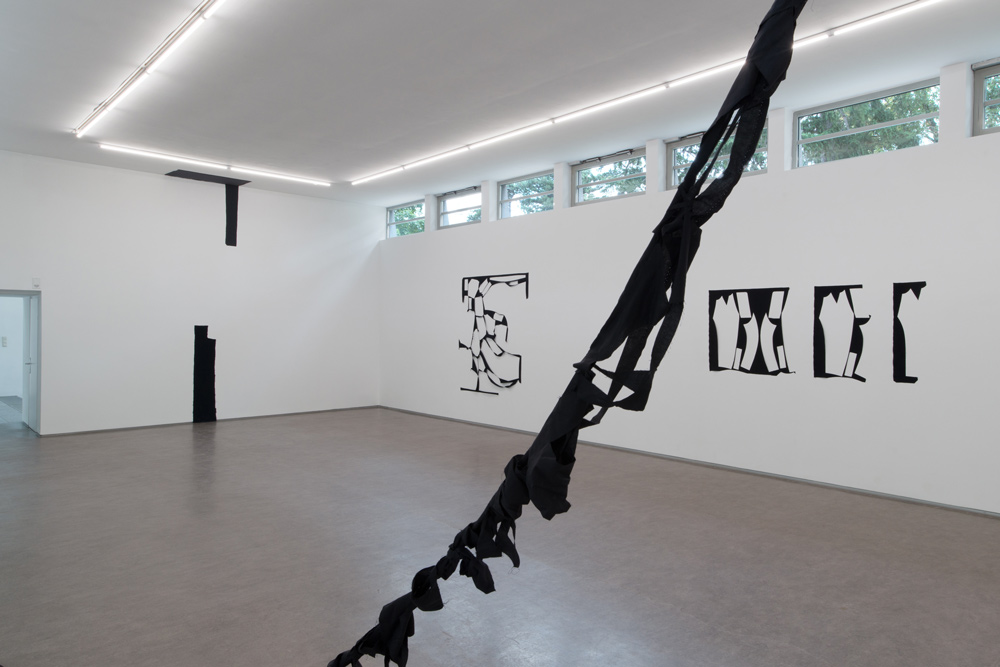
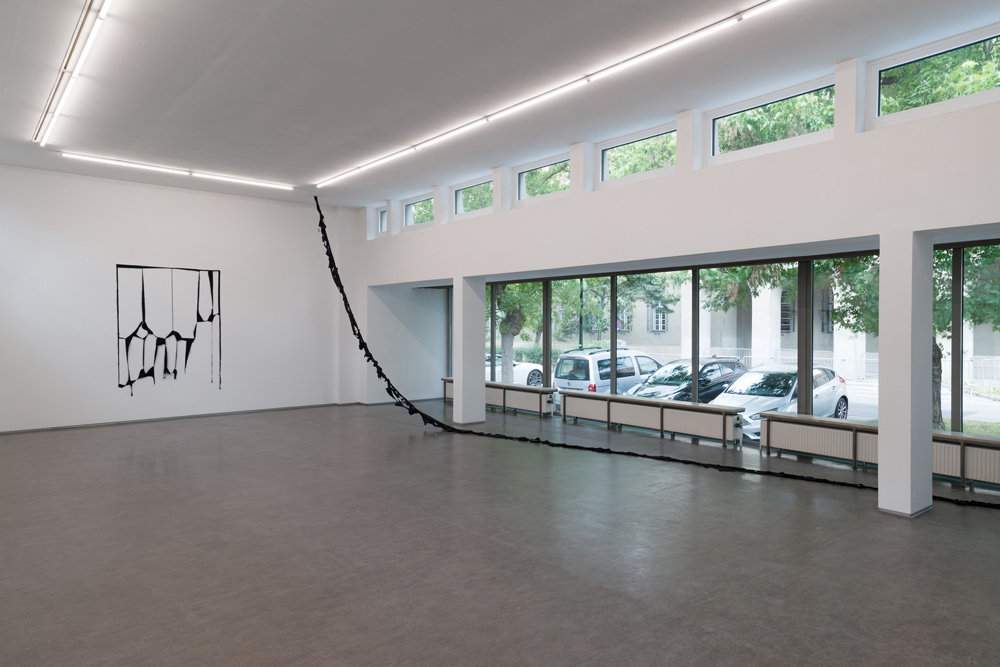
While the early fabric works (from 2012 onward) still appear compositionally self-contained—i.e., square-like—Baruch’s works have become more open and permeable to the surrounding space over the years. The negative space of the fabric formation began to increasingly merge with the white of the surrounding wall or the emptiness of the surrounding space. Here, different forms of emptiness and absence encounter each other. For Baruch, emptiness is not merely a formal theoretical figure or a compositional reference field; rather, her concept of emptiness—already evident in her steel works of the 1960s—is spatial in nature, a form of emptiness in the context of inhabited space, fundamentally relational and oriented toward human experience. The emphasis on the architectural empty space is particularly apparent in free-hanging works such as
Traiettorie (2019–2025): here, space is kinesthetic in nature and invites visitors to enter and explore it.
Baruch’s fabric formations can be read in two ways. On the one hand, they address the viewer’s sense for the pictorial and the abstract, operating on a Gestalt-theoretical, compositional, and even gestural level. Beyond this visual and perceptual dimension, however, they can also be understood—through the medium and topos of fabric— in an intersubjectively connective and socially relational sense. Everyone is familiar with and requires fabric. Through the necessity of clothing oneself, fabric becomes a unifying medium. It is no coincidence that Baruch describes weaving as a “first form of writing.” Moreover, fabric is made by humans for humans—by no means natural, but manufactured. Textile and social aspects are thus always interrelated, forming an inseparable cultural-historical connection.
Marion Baruch regards fabric not only as something that connects people, but as a kind of continuum. “For me, fabric is something living and pulsating. I feel,” says the artist, “the grandeur of its breath or its pull, a continuous pull that also correlates to that of society as a whole.” The cut-out shapes draw on a language of form that is familiar to humans, intuitively legible and easily relatable. Baruch uses a language we all speak, albeit unconsciously. Fabric can thus also create imaginary connections. The artist strives, as is also evident in her collaboration with her assistants in the studio, to collectively activate this “language space”—its associative, mnemic, and projective aspects. The titles of her works often reflect this dialogically developed associative level. Baruch seeks to give voice to the material and to wrest specific elements of the imaginary and memory from this lingua universalis. Here, material and language form an inner, inseparable connection, one of a deeply philosophical and existential nature.
Language plays a significant role in Baruch’s aesthetic thinking. Baruch, who was made to migrate several times at an early age, speaks several languages, “without belonging to any nation,” as the artist emphasizes. “I feel at home everywhere and with everyone.” Her childhood and youth were fundamentally shaped by the rivalry, even hatred, between Hungarians and Romanians. “It was then that I understood with amazement the power of expressive form, and this is why my work has always been oriented toward a form of expression yet to be discovered.” Against this background, Baruch’s rejection of any hermeticism and absoluteness of form and content is understandable. Her works always seek invitation, activation, and aesthetic dialogue. They address the sense of sight (graphic, pictorial), the entire register of kinesthetic action, and always also the sense of the imaginary and the projective. For Baruch, eye and mind, and thus body and spirit, cannot be separated; rather, they form inherently interrelated “senses.”
For Baruch, language always represents something living, fluid. It is a medium of approach, not of appropriation or of sovereign knowledge, a field of exchange and openness, not of determination. Different languages do not merely coexist in Baruch’s work; they form an open, permeable field of polysemous exchange. For the title of the work DÉCHIQUETÉ — SQUARCIATO, which also serves as the title of the exhibition, the artist juxtaposes the French word (torn, jagged, fissured) with its Italian equivalent (slashed, torn, ripped, cut open), as if seeking to draw attention to the space of difference between languages: a space in which the semantic specificities of languages, certain untranslatabilities, but also their individual aesthetics are brought to the fore. It is no coincidence that the title,
Innerer Raum Der Leere Wo Neues Kommt, Für Manchmal (Inner Space of Emptiness Where Something New Emerges, 2018), is written in broken German. For Baruch, there is a special poetic potential in the lack of linguistic mastery in approaching a language or linguistic space. Afterall, a search for the proper words and images in a language we haven’t entirely mastered appears more immediate, unfiltered, less pretentious. In these moments of apparent lack and uncertainty, Baruch finds a form of aesthetic openness and polysemy in which the childlike-exploratory, the ludic-associative, and the philosophical-existential encounter one another as a matter of course.
Text: David Komary
Translation: Erik Smith
top