
EXHIBITIONS

UP TO AND INCLUDING
Helen Grogan

December 2018 - March 2019  
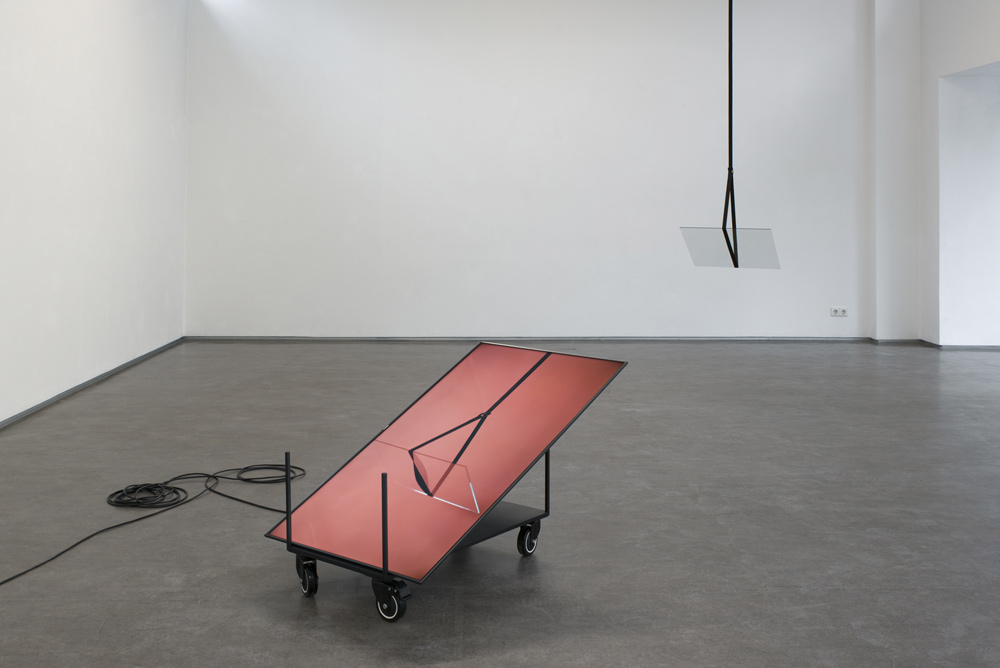
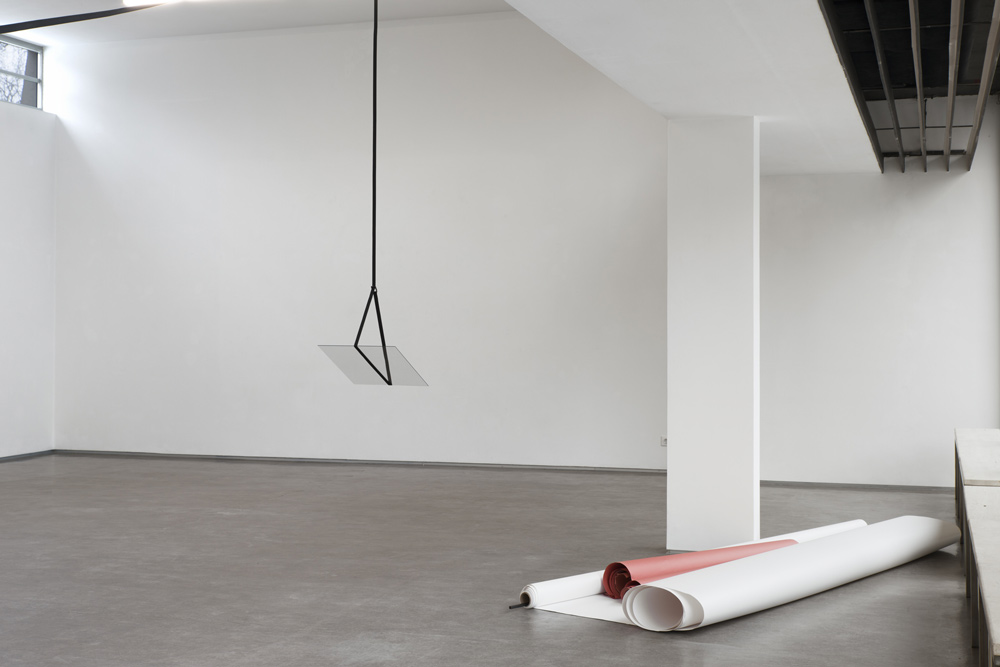
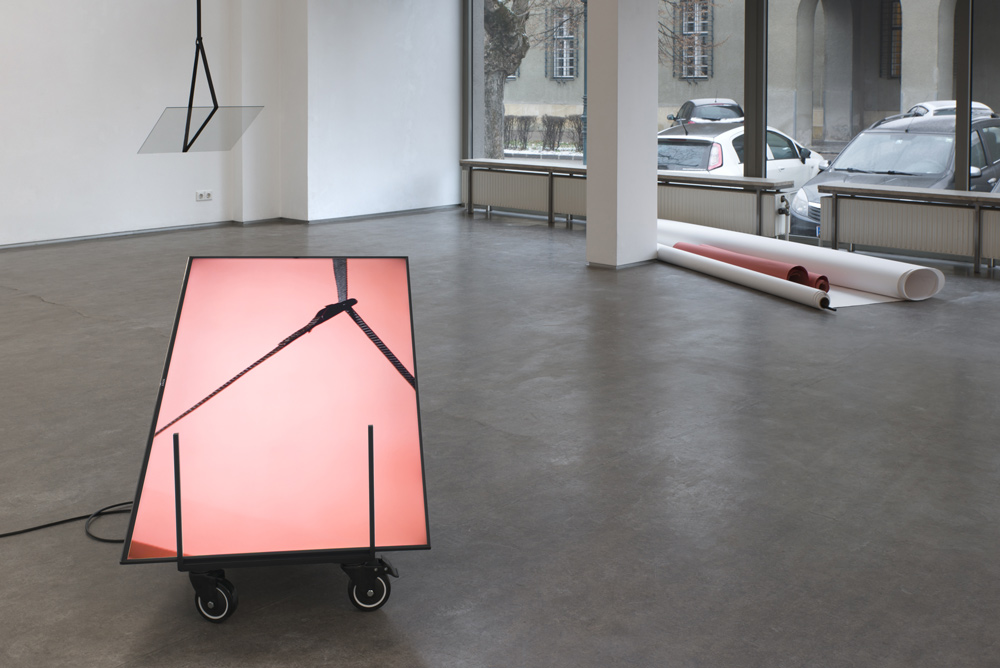
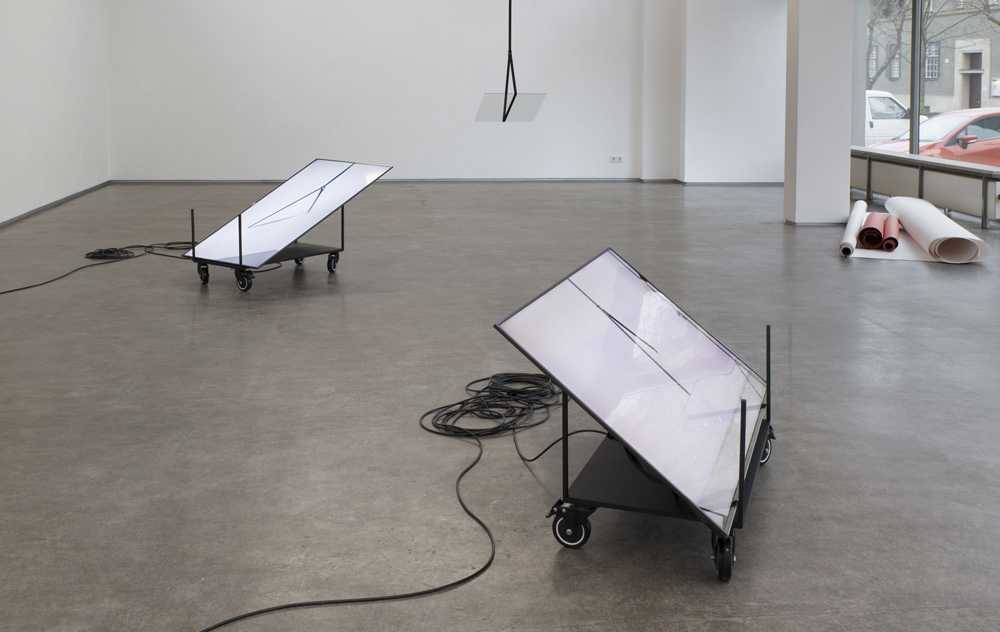
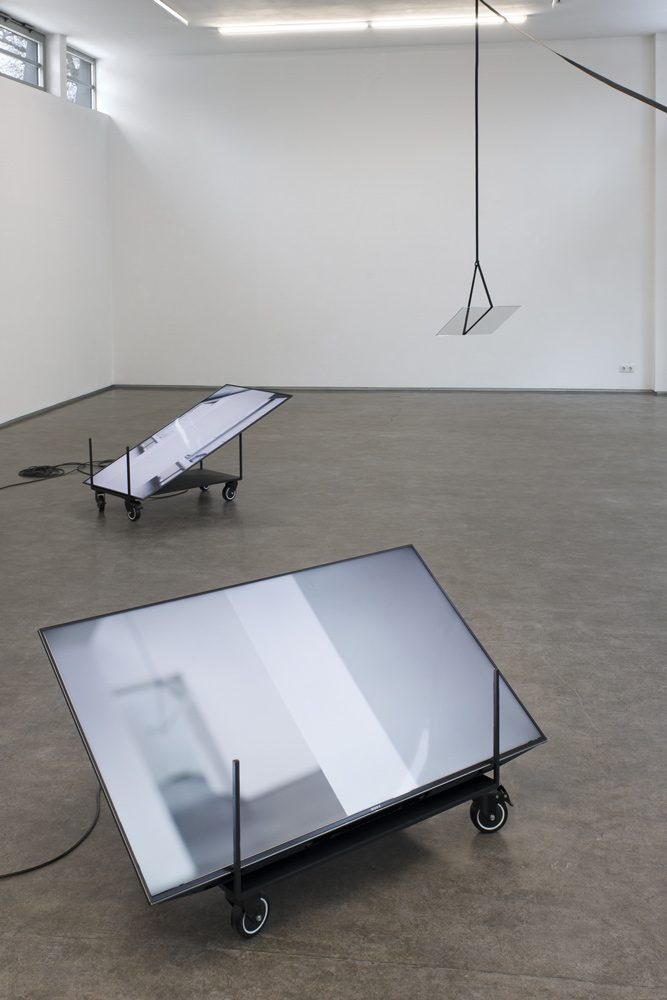
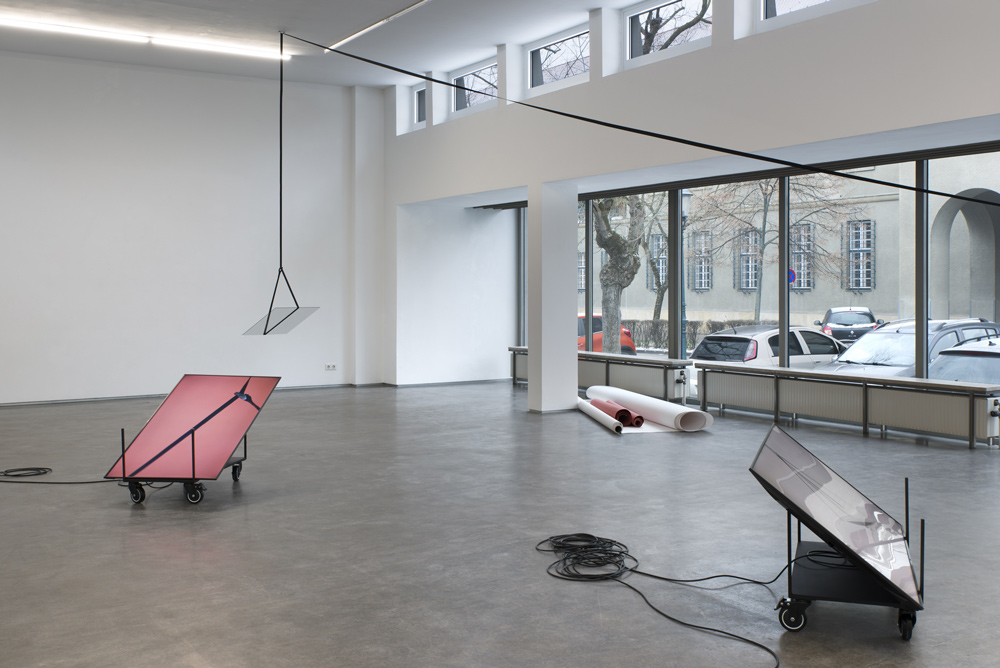
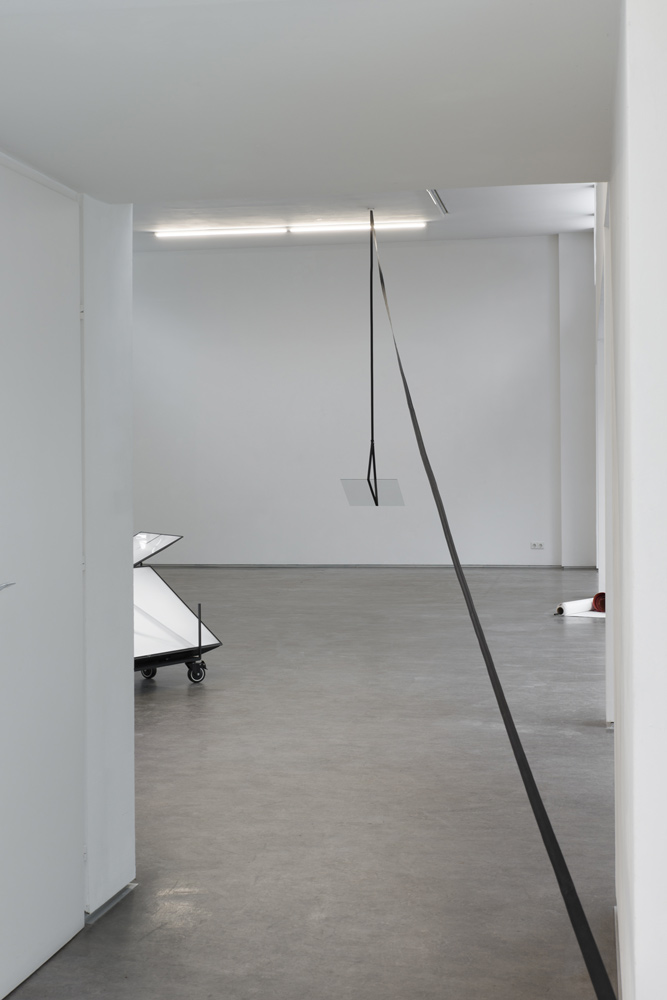
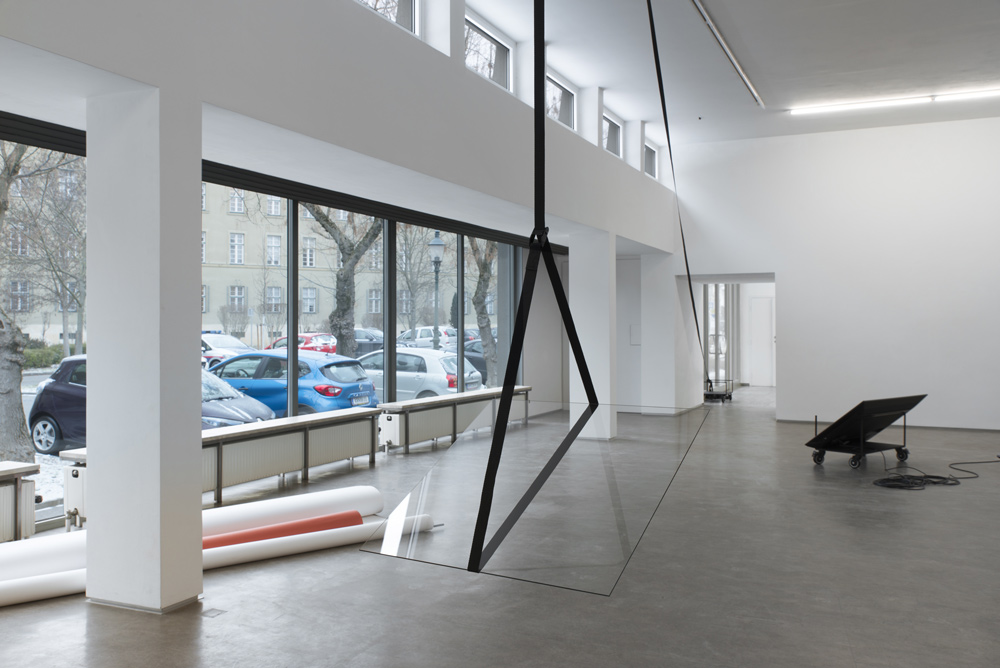
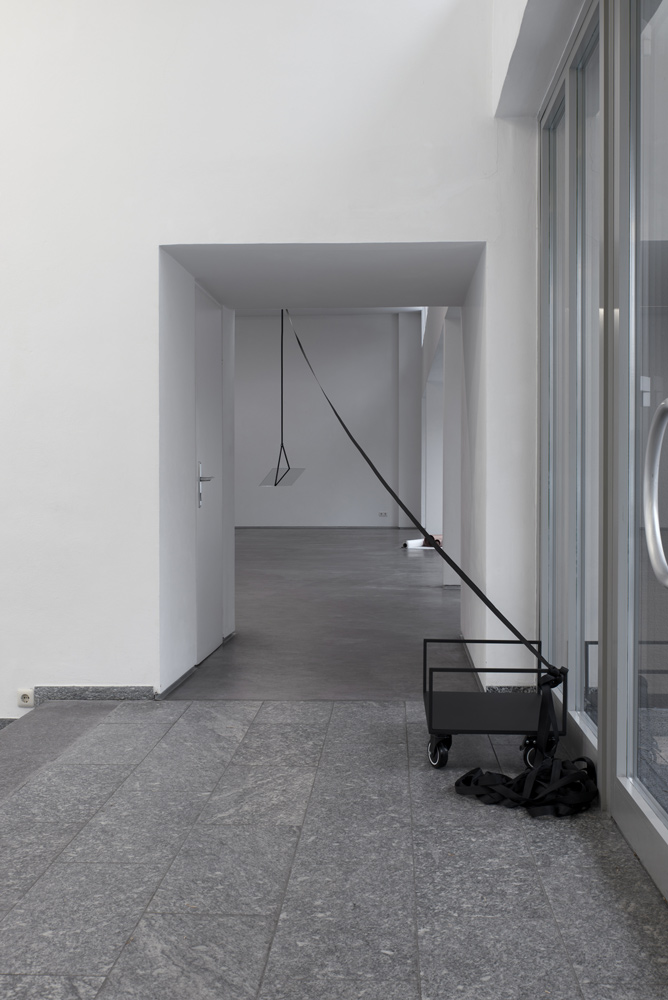
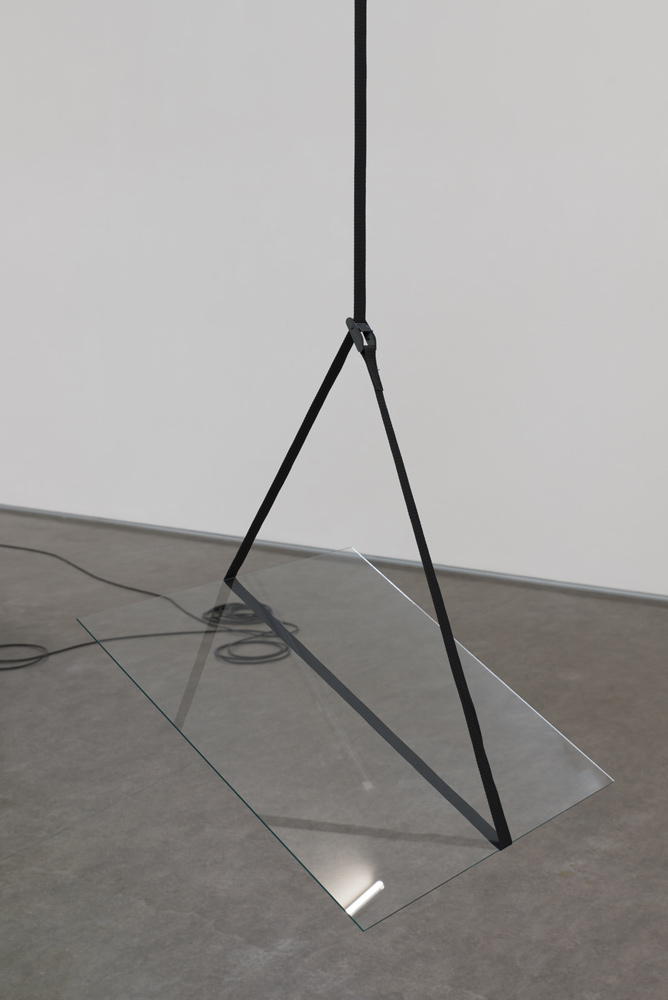
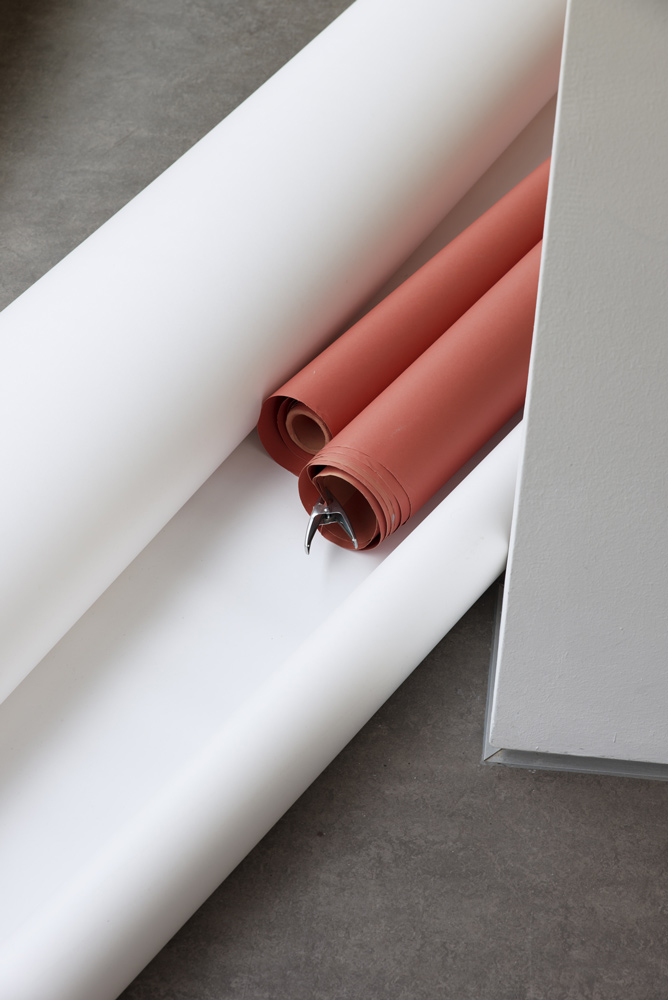
Exhibition view Up to and including, Helen Grogan, Galerie Stadtpark, 2018/19; Photo: Stefan Lux; POEM (with insistence on plurality), 2015/2018; Room installation; Glass, webbing, lashing strap, steel, epoxy resin paint, rolls, photo background paper, 2 LED screens,; 70 x 123 cm each, 2 extension cables, main room of Galerie Stadtpark, 2 single-channel videos with diegetic sound, unsynchronised
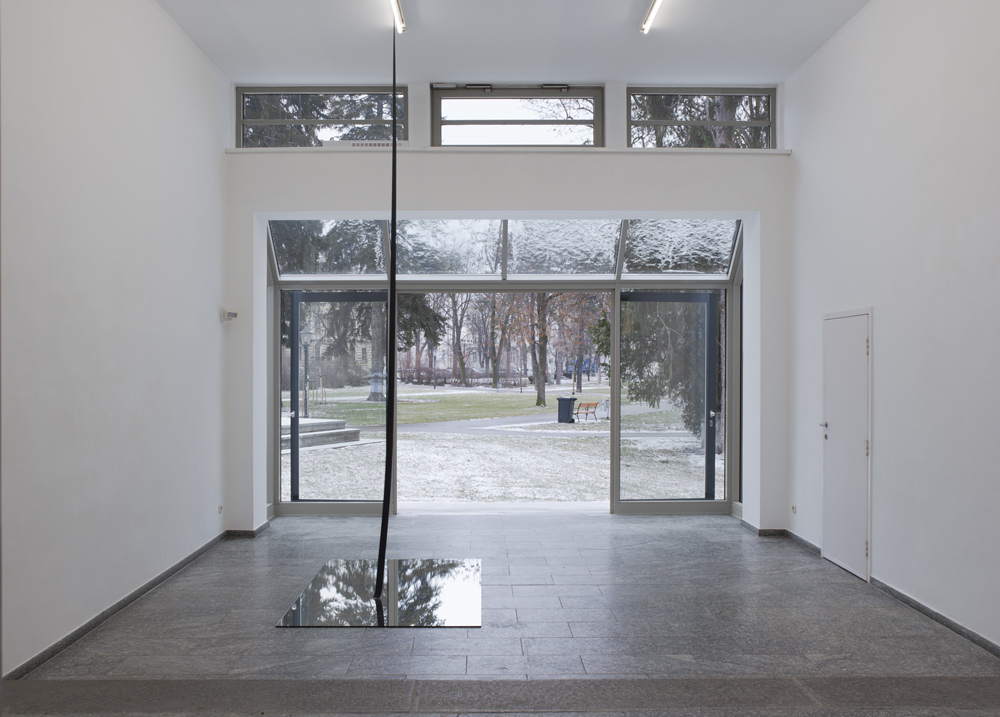
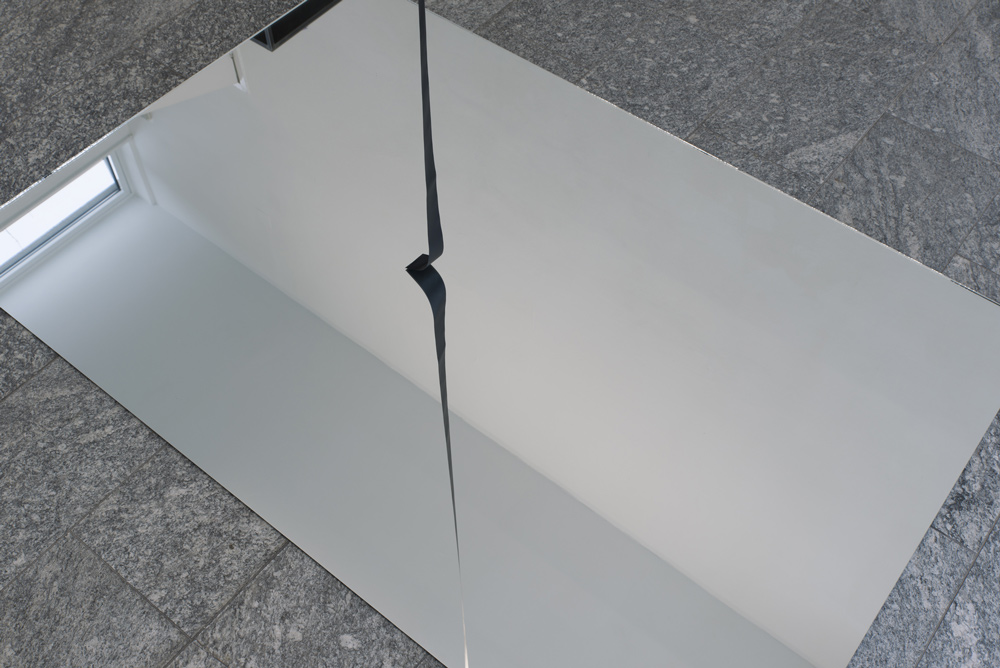
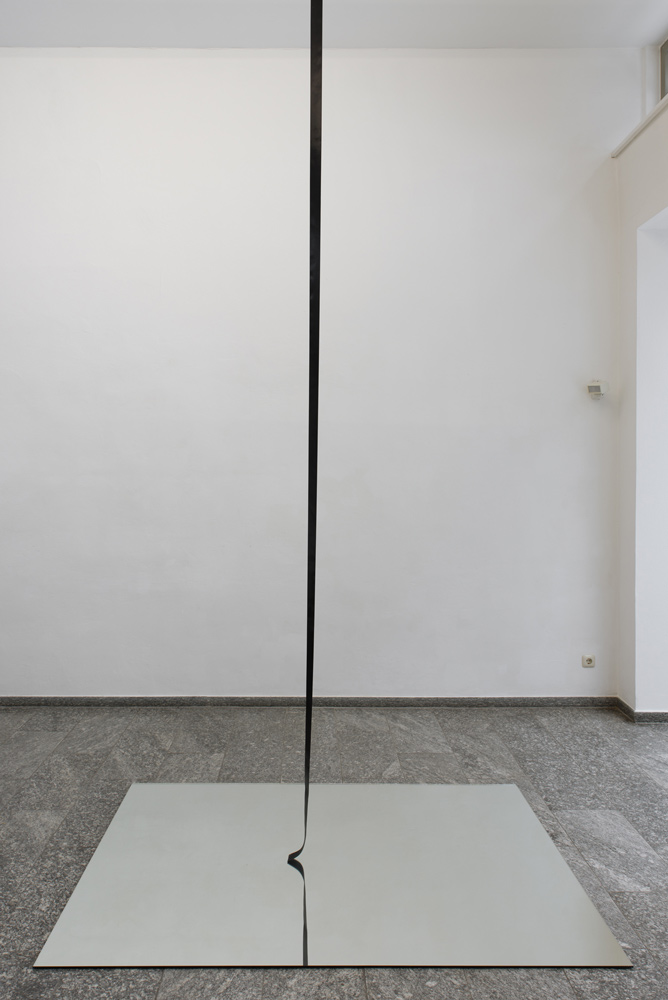
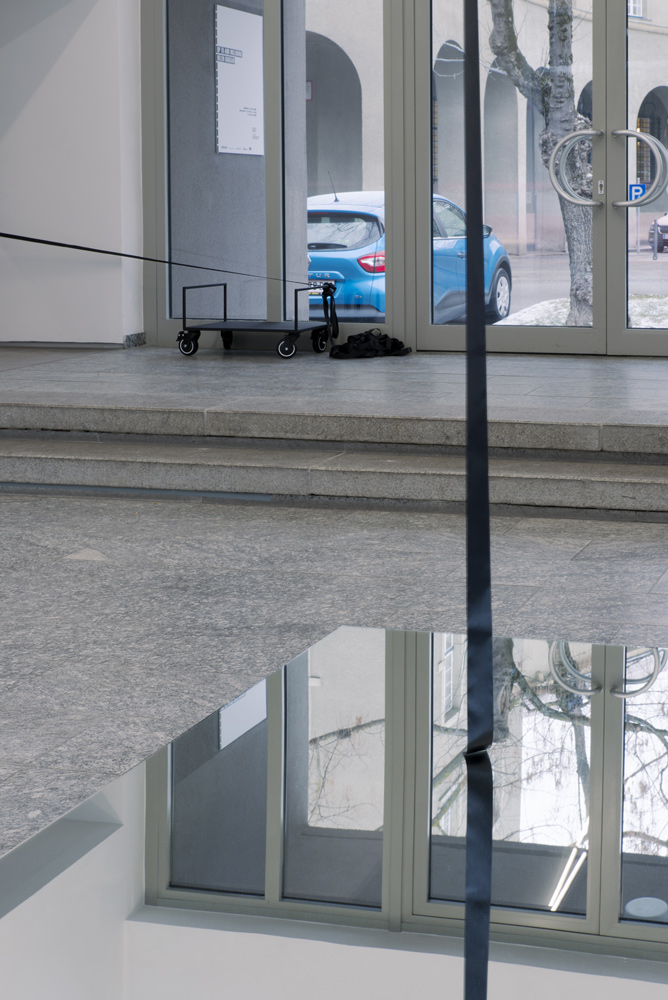
Exhibition view Up to and including, Helen Grogan, Galerie Stadtpark, 2018/19; Photo: Stefan Lux; INSIDE SMALL DANCE (choreography for; this exterior/interior space), 2017/2018; Room installation; Mirror, steel, synthetic adhesive tape,; Foyer of Galerie Stadtpark, 122 x 183 x 392 cm
Legende
Helen Grogan’s aesthetic practice can be described formally as a field of interactions and interferences of sculptural, photographic, and filmic means. The process of observing, of perceiving, plays not only a central role, but is itself turned into “material.” Grogan’s work deals directly and situationally with the given conditions of the exhibition location. The artist questions each location she works with in physical, ontological, but also socio-aesthetic terms. Beyond purely formal and phenomenological components, Grogan’s aesthetic examination involves a subtle critique of the institutional conditions of the exhibition format.

During her stay at the AIR – ARTIST IN RESIDENCE Lower Austria program in fall 2018, an intense exchange developed between the artist and Galerie Stadtpark around themes of perception, space/sculpture, and reality, specifically on the kinesthetic and performative dimensions of spatial perception, which has now culminated in the solo exhibition UP TO AND INCLUDING featuring two room-sized installations.

Grogan’s examination of space takes place in constant relation to the body, to the moving self. Her way of working, or more precisely, her way of thinking about and dealing with space, can be largely understood in relationship to her earlier work in and approach to contemporary dance and conceptual choreography. In her more recent sculptural-installative works, Grogan has long since moved away from notions of expression or even skillfulness. Moreover, the body itself remains unseen in her current work, and indeed seems absent per se, even though it constitutes the de facto addressee and vanishing point. Grogan’s understanding of space can be understood from a spatial-choreographic perspective as the moving self’s condensing and overlaying of various sensory perceptions. The entire perceptual apparatus, the kinaesthetic apparatus, and all senses resonate with the space and play a role in this perceptual act; they interact with one another in such a way that sensorial, reflective, and cognitive thinking is no longer (and cannot be) clearly separated.

In the full-scale installation POEM (with insistence on plurality), the viewer is confronted with an assemblage of objects, mechanisms, and devices that, although they seemingly originate from different contexts, are explicitly related to one other aesthetically and form what appears at first to be a not-immediately conclusive inter-sculptural connection. The constellation of screens (flat-screen televisions), specially designed studio-like steel trolleys, and abstract object-like entities including a glass plate suspended from the ceiling with a belt, are not easy to clearly decipher semantically. On the contrary, it seems as if the constellation of objects is attempting to introduce and involve the viewer in the evolving field of mutual semanticization and meaning-imbuing. The various objects function here as agents of differing spatially constitutive and “performative” potentials. An object within this installation is readily confronted with its own image (shown on one of the two screens), but this doubling can easily lead the viewer to become momentarily overwhelmed and confused. The status of what’s seen in each case seems to be shifted latently, or is even uncertain. The individual object occurrences thereby overcome their mere object status so that “their attention” is focused entirely on the process of mutual semantization.

Visitors are prompted to survey the installation, which begins by subtly choreographing their movements. Almost incidentally and matter-of-factly they also “encounter” two screens—what already count these days as conventional flat screen televisions—which provide fragmentary and excerpt-like shots of the spatial scenario. Presented are film sequences depicting the space in a highly intimate and poetic manner, e.g. a close-up shot of the slowly rotating glass surface suspended from the ceiling. However, viewers are also confronted with picturesque overall views that also repeatedly depict what’s seen and heard on the periphery, i.e. the “aura” of the exhibition space, including objects lying around the exhibition building, doors opening and closing, etc. The imagery makes the individual objects seem like spatial agents, at times even “protagonists” with unique characters and expressions. The presented images, conceived from the outset as essential parts of the installation, are therefore not simply shots of the process of setting up the installation, but call into question the object-protagonists in a pictorial (filmic) manner, investigate how these all “behave” in the space at various times, representing an essential integral component of the installative structure. Grogan examines in a sculptural-spatial, but also a temporal and process-reflexive manner the concurrence of object (s) and exhibition space. This practice and rehearsal in space is a result not only of the interaction and interplay of the objects but also of the variability of their aesthetic status.

The space of diversity and variety, which the various object-manifestations, their visible forms, and inter-sculptural interplay constitute, is ultimately entrusted receptively and aesthetically to the self-observer in POEM (with insistence on plurality). He/she is subjected to an open-ended, polysemic experiential process relative to the objects and the space, whereby the spatial actuality of the here and now forms a kind of media-ontological interference space with the “time-displaced” spaces of the film sequences. At times a kind of doubling of the objects occurs when they appear both as objects in the space and as on-screen presences, which turns them into intermediaries between image- and object-based sculptural beings. However, Grogan is not concerned with relativizing the actual status of the objects: the recorded filmic images also attempt to reflect and make legible the particular here and now, for instance through the specific lighting situation, or the particular time of day when shooting. Instead, the media-encoded image (screen / TV picture) is given a matter-of-fact status; it has long since become “reality” itself. Nevertheless, Grogan challenges the observer to continually examine precisely those categorizations and classifications, the construction of reality. Here, the questioning—the not-knowing and not-yet-knowing resulting from one’s own perception in terms of a precognitive space of potentiality—is the actual central mechanism. The perceiver is indeed very active, but he/she does not act authorially or auctorially in the sense of a cognizant doing that “inscribes” the space, but instead again finds him/herself in the role of a resonator within the existing spatial structure. A more explicit opposition between the exhibition object here and the viewer there cannot be made out with Grogan. Rather the border between these attributions and terrains is permeable, osmotic, and indeed in constant negotiation. As such, POEM (with insistence on plurality) cannot be reduced to a single interpretation, rather the installation shows us insidiously and incessantly the contingency of one’s own perceptions.

The choreographic “renouncing” of all expression, even of anything representational and, in a classical sense, the choreographic, is with Grogan simply a result of this openness and permeability or perhaps even a seismographic notion of perception. Another aspect of deconstruction is evident in the denial and negation of a conventionalized idea and notion of space that, in terms of a Cartesian separation of body and mind, hints at space as an abstract, endless, so to speak seamless and thus also disembodied dimension. Grogan deprives the viewer of such alleged certainties and familiarities in order to direct the focus toward the actually occurring perception. She steers us toward a form of perception that makes possible an open-ended seeing when one is in motion, indeed a synthesis of perception beyond prior knowledge that minimizes complexity. The installation ultimately aims for an idea of freedom (of the subject) that is articulated precisely in this self-empowerment of perception. Of course, this is not about a passive form of perception (in the sense of an “innocent eye”) that would only lead to escapism and visual consumption. Rather, this type of freedom in perception, this openness of aesthetic “judgment,” requires a specific form of awareness, even a form of courage, to engage with/experience the current scenario beyond familiar and / or conventionalized interpretive and perceptual patterns.

In INSIDE SMALL DANCE, the viewer faces a freely hanging, flat, and extremely thin elastic ribbon that extends from the ceiling to the floor. It stops only a few millimeters above a mirror lying on the floor, which elongates the ribbon visually, making it seem almost virtually endless. Due to the close proximity of the vertical ribbon to the ground or mirror, it reacts to the liminal airflows of the space and depicts these in a kinetic-objective fashion. Although the rubber band is in fact only set in motion by these air currents, it nonetheless appears—in the sense of a viewer’s figure-like counterpart—animated and acting of its own accord, i.e. on its own power. The status of the ribbon thus oscillates between that of a resonator, which only reacts to external appearances and an autonomous, indeed “actionable” presence. This animistic moment, the evocative impression of “animation,” turns it into a slender performer, which, in the form of elegant vertical movements, does a small dance, a carefully restrained dance performance.

The mirror lying on the floor also makes the exterior of the gallery, the adjacent city park, an integral part of the exhibition, indeed a space that opens up on the floor, which not only extends the room, but nearly breaks it up and seemingly unfolds it. Viewed this way, the mirror functions less as a purely visual instrument, but also as a medium that expands the clear-ontological status of the space. The room goes from a fixed, delimited entity to a visually permeable, contingent surface-structure capable of changing its “appearance,” its form, when accessed. Here too, Grogan succeeds in transforming the basic parameters of objectivity and spatiality into an aesthetic event of epistemological dimension with the simplest means, by generating a simple sculptural-installative scenario. At what point does an image acquire object status here, where is spatiality transformed into a pictorial event? The viewer is captured, indeed seduced, visually as a result of the simplicity and sublime qualities of the installation, in order to just as quickly find himself/herself again in a spatial situation that challenges reality.

Grogan views the exhibition as fundamentally performative. The artist works with elements of spatial displacement, of shifting and reconfiguring in order to highlight the temporal-procedural dimension of the spatial. Her work seeks to create a kind of awareness of one’s own body, an awareness of the productive potential in the process of perception, and the perception of an incessantly, albeit often imperceptibly shifting presence and reality.

Grogan’s installations alternate between conceptual rigor and an aesthetic openness that can be experienced spatially in a more precise kinaesthetic manner, which at times also permits contemplative, even immersive moments. However, the viewer can never rely too long on one or the respective reading, interpretation, or categorization of what’s seen, he/she can not fall back on a particular viewer’s perspective or way of seeing. The artist works concisely with a provoked immersive or semantic collapse. The observer is confronted with a subtly overwhelming, contingent, but nonetheless non-arbitrary perceptual scenario, which essentially returns the responsibility to him/herself as a perceptual actor. Grogan works with a notion of expanded and conceptual choreography that shifts the clear division between author / artist and perceiver. In so doing she does not seek to create a meta-level superordinate to sensory perception that would merely (re) organize, configure, and therefore simply re-structure the sensory impressions hierarchically. Rather, Grogan aims at a “sensing” thinking, which always connects and relates cognition and understanding to sensory perception. Instead of clarity, assignability, and consumability of spatial perceptual events, the viewer finds him/herself in a deliberately epistemologically blurry perceptual scenario that does not situate cognition (epistemology) and sensory perception in opposition to one another but seeks their connection and reciprocity in order to create space for a kind of aestheticological cognition. (A.G. Baumgarten).
Text: David Komary
Translation: Erik Smith
 
top


Helen Grogan

helengrogan.com

During her stay at the AIR – ARTIST IN RESIDENCE Lower Austria program in fall 2018, an intense exchange developed between Australian artist Helen Grogan (born 1979) and Galerie Stadtpark Krems around themes of perception, space/sculpture, and reality, specifically on the kinesthetic and performative dimension of spatial perception. These discussions will now be culminating in a solo exhibition with Grogan in December featuring two spatial, installation-based works.

Helen Grogan’s aesthetic practice can be described formally and medially as a field of interactions and interferences between sculptural, photographic, and cinematic mediums. The process of observation itself becomes a material. Her work examines directly and situationally the given conditions of the exhibition location. Grogan questions each location she works with in physical, ontological, but also often works specifically with aspects of spatial shifts, rearrangements, and reconfigurations in order to focus attention on the temporal and procedural dimension of the spatial, but also socio-aesthetic, and ultimately also political terms. Beyond purely formal and phenomenological conditions, Grogan’s aesthetic examination involves a subtle critique of the institutional conditions of the exhibition format.

Grogan views the exhibition location as fundamentally performative. The viewer’s process of perception is not simply perception; rather, perception, i.e. the act of perceiving, is what first brings the space into being. The artist to call into question supposed certainties regarding spatial conditions. Her works seek to raise a kind of awareness of one’s own physical being, of the productive potential within the process of perception, and of the perception of an incessantly, albeit often indiscernibly changing present and reality.


born 1979, Australia

Residencies

2018
AIR – ARTIST IN RESIDENCE Niederösterreich, Krems, Austria

2014-16
Gertrude Contemporary, Melbourne

2013-14
c3 Contemporary Art Space

2011
Side, Summer Residency Program

Education

2016-pres.
Master of Fine Art, Visual Art (Research), Victorian College of the Arts, AUS

2007-WD
WD  The University of Melbourne, AUS, Masters of Art Curatorship

2001-05
AHK Amsterdam School for The Arts, SNDO, NL, Bachelor (Art with Choreography Specialisation)

2000/01
City University of New York, USA, Liberal Arts Studies (Contemporary Art Internships, Philosophy)

1997-01
Deakin University, AUS, Bachelor of Arts (Philosophy, The History of Ideas, Contemporary Dance)

Selected Solo Exhibitions

2016
POEMING (with insistence on plurality), Gallery 1, First Draft, Sydney
STUDIO WORK (COMPRESSION WITH OPENING PLANE), Studio 10, Gertrude Contemporary, Melbourne

2015
POEM (with insistence on plurality), Gertrude Glasshouse, Melbourne
THREE ADJOINING ROOMS WITH MANIFOLD EDGES, WestSpace, Melbourne 

2014
THREE PERFORMATIVE STRUCTURES, Slopes Gallery (curated by Helen Hughes + Joel Stern), Melbourne

2013
Under Instructions, in ‘C3 Online Project Lab Commission’, C3 Contemporary Art Spaces, Melbourne

2012
Applications of Occurrence (An Obituary), for ‘Place Of Assembly’, Melbourne International Arts Festival, Melbourne

Selected Group Exhibitions

2018
CONCRETE ROOM, in 'Movement + Art', MADA, Melbourne
Untitled (FIELD RECORDINGS. PART I), in 'INTO THE SPACE', IG Bildende Kunst, Vienna
splitting opening the surface on which its inscribed, in ‘Great Movements of Feeling’, Gertrude Contemporary
CONCRETE ROOM, in ‘Infrastructuralism’, La Trobe Art Institute, Bendigo

2017
INSIDE SMALL DANCE (choreography for this exterior/interior space), in ‘The Score’, Ian Potter Museum
SCENIC FLATS, in ‘Worldbackwards’, Sutton Project Space, Melbourne

2016
OBSTRUCTION DRIFT, in Biennale of Sydney  Choreography and the Gallery, Art Gallery of New South Wales

2015
OBSERVATION PROPOSITION, in 2nd Tbilisi Triennial, Rustavi Block, Georgia
UNTITLED (STUDIO FLOOR WORK), in ‘Gertrude Contemporary Studio Artist Exhibition’, Gertrude Contemporary
HOLLOW AND DENSE OBSTRUCTIONS, in ‘Feeling Material’, C3 Art Space, Melbourne
THREE ADJOINING ROOMS WITH MANIFOLD EDGES, (solo exhibition), WestSpace, Melbourne
ACTION AND FRAME in ‘Object As Score’, Margaret Lawrence Gallery, VCA, Melbourne
CONCRETE ROOM / FACILITATING FORM in ‘Object As Score’, Margaret Lawrence Gallery, VCA, Melbourne
HOLLOWING PLANE (with departing hand), in ‘Contemporary Australian Drawing #5′at SACI, Florence

2014
CHOREOGRAPHY (Gallery 2, ACCA), in ‘Framed Movements’, Australian Centre for Contemporary Art, Melbourne
SETTING FOR RESETTING, in ‘Framed Movements’, Australian Centre for Contemporary Art, Melbourne
CONCRETE ROOM, in ‘Liquid Architecture Festival – The EAR IS A BRAIN’ Arts House Meat Market, Melbourne
SEVERAL OBSERVATIONS, in ‘If This Exhibition Where a Text’ curated by Ash Kilmartin Slopes Gallery, Melbourne
Figure Study (After Bacon), in ‘Melbourne Now’, National Gallery of Victoria International, Melbourne
ACTION AND FRAME (Mobilar Workshop) in ‘Industrial Estate’ curated by Kym Maxwell, Melbourne

2013-14 
INSIDE VIANNE AGAIN (NATIONAL GALLERY OF VICTORIA), 2013, in ‘Melbourne Now’, NGV International
2013
CHOREOGRAPHY FOR AN UNKNOWN SPACE, in KULTURHUSET, Stockholm

2012
Several Departures (Studio 21, Level 8), ‘What Moves Us’ curated by La Mecedora Collective, OVCT, Amsterdam
INSIDE THURSDAY (for VIANNE AGAIN), within Shelley Lasica’s project VIANNE AGAIN, MADA, online

2009
Occurrence Project, Gallery 1, Linden Centre for Contemporary Arts, Melbourne

2008
Simple Projection, Centre for Contemporary Photography, Melbourne
Occurrence (Rehearsal Space), Gertrude Contemporary, Melbourne

2007
Choreography, 2007 Version, Curated South Project Space, Rijksakademie van Beeldende Kunsten, Amsterdam

2005
room Piece 4  actual ghosts, Studio 9, SNDO program, Amsterdam School For the Arts, Amsterdam

Selected Curatorial Projects & Recent Research

2016
Choreography and the Gallery Symposium, in Biennale of Sydney: Art Gallery of New South Wales

2014
SPECIFIC IN-BETWEEN (The choreographic negotiated in 6 parts), curated series for ‘Framed Movements’, Australian Center for Contemporary Art and Melbourne International Arts Festival.
Mass (new dance work by Matthew Day), Curatorial consultant (theory and frames for contextualising dance as art)

2013
CHOREOGRAPHY AND RELATED THINKING (CART), Research series by Helen Grogan and Shelley Lasica

2011-13
OPEN ARCHIVE, Art space and exhibition program Directed and Curated by Helen Grogan and Jared Davis

2011
Feedback Proposals Towards and Exhibition, Group exhibition for Gertrude Contemporary, Melbourne

2009
Melbourne Pavilion, Amsterdam Biennale, Mediamatic Supermarket, Amsterdam
   
top