
EXHIBITIONS
NATURE AS COMMUNITIES
NOT COMMODITIES
Hamish Fulton
July - September 26
Legende
Hamish Fulton’s aesthetic practice (b. 1946) can be situated within the context of British art of the 1960s and 1970s—a period marked by a radical shift in artistic concepts and categories. During this time, the elements constituting an artwork were fundamentally called into question and transformed. The autonomous, self-contained object gave way to the performative act; material form was replaced by a setting defined by time and space; and the produced object was supplanted by pure, irreversible experience. In Fulton’s work, this shift took on a radical ontological dimension that fundamentally reconsidered Western concepts of aesthetics. His art is grounded in the medium of walking itself. This is manifested as a kind of perceptual mode of being, a way of engaging with the world not based on appropriation or possession, but on a pure mode of being.
Since his defining first “art walk” in 1967, Fulton has explored and systematized the most diverse forms of walking over the course of more than half a century. He wanders through urban agglomerations and pristine landscapes, coastlines and river courses, steep mountain regions and expansive deserts. His walks have taken him to every continent on Earth. From these existential forays into unfamiliar terrain emerge photographs, drawings, precise text-based works, and expansive wall murals. Yet these works are never merely material documentation, representations, or mimetic depictions of the walks. Rather, his aesthetic “transcriptions” articulate an experience that cannot itself be depicted or reproduced, nor fully embodied in a material object. Fulton’s central dictum holds that an object can never compete with an experience. Accordingly, his entire practice is governed by a unique, quiet, yet rigorous ontology: “Walking is the constant, the art medium is the variable.”
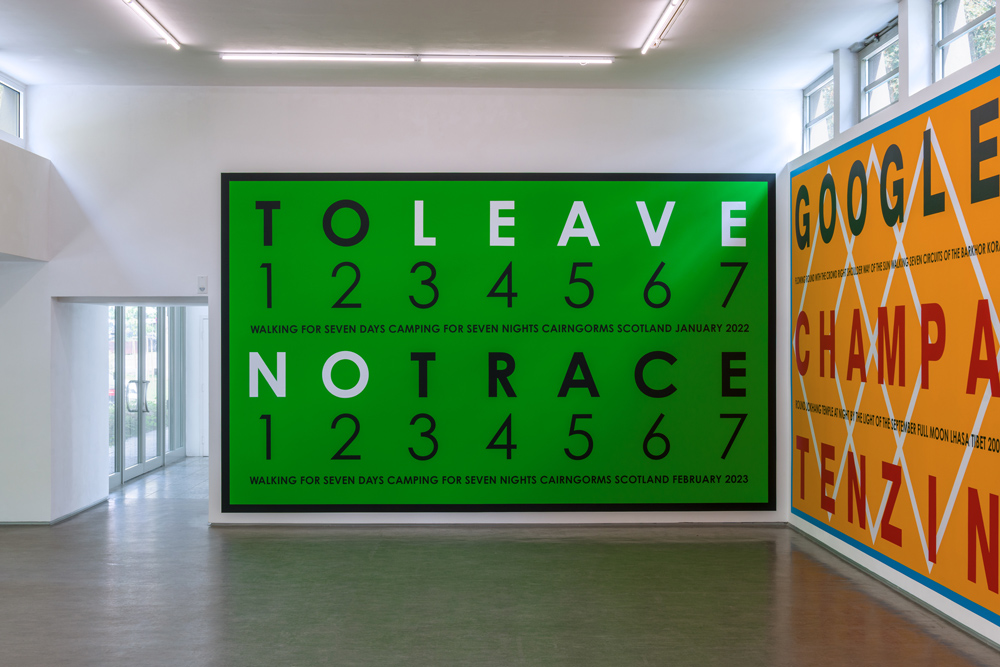
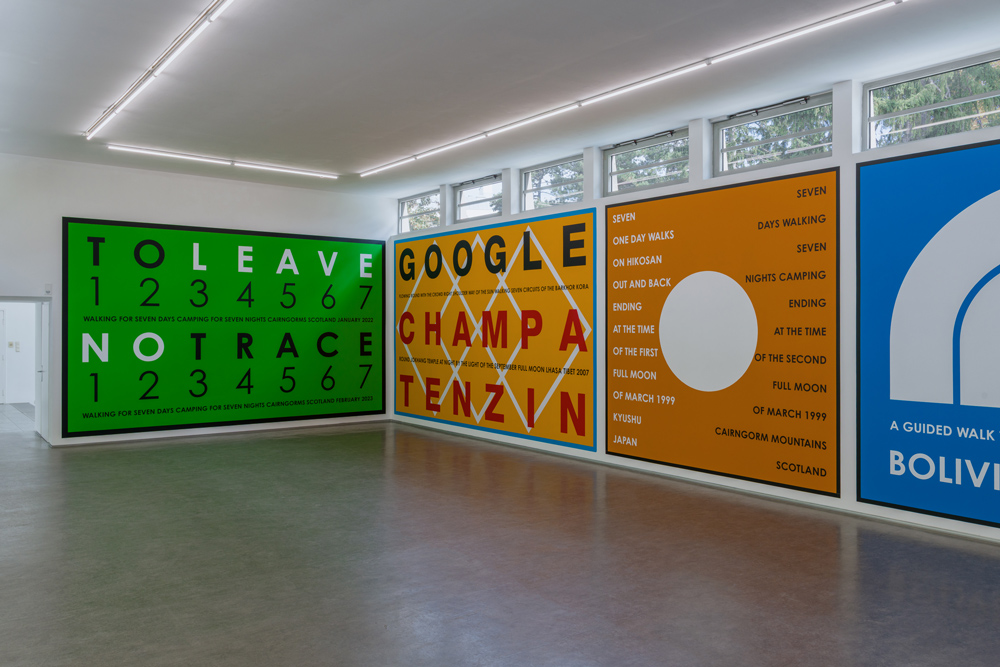
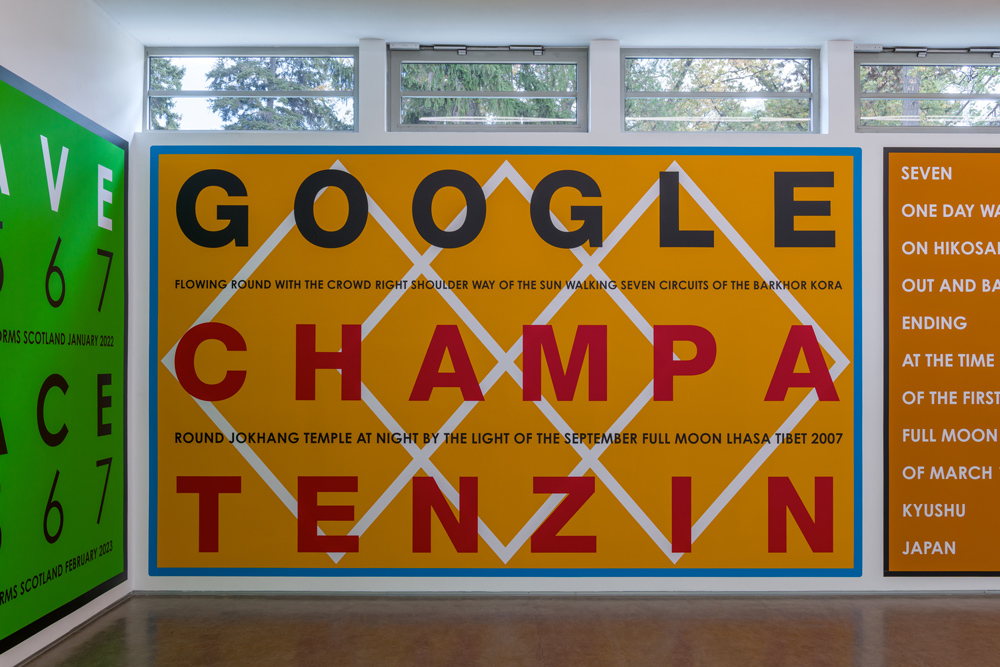
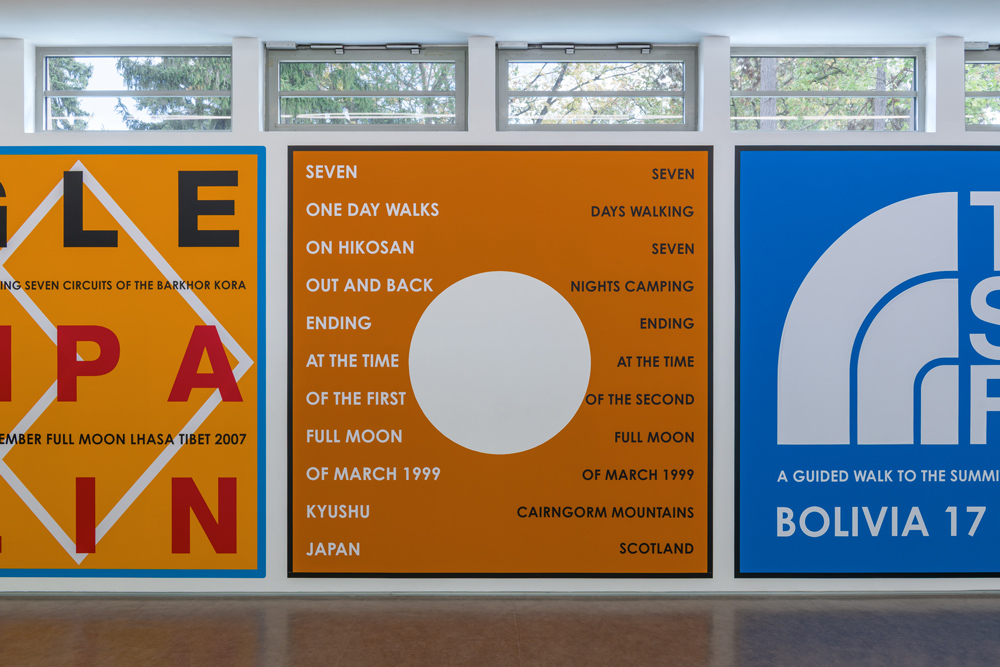
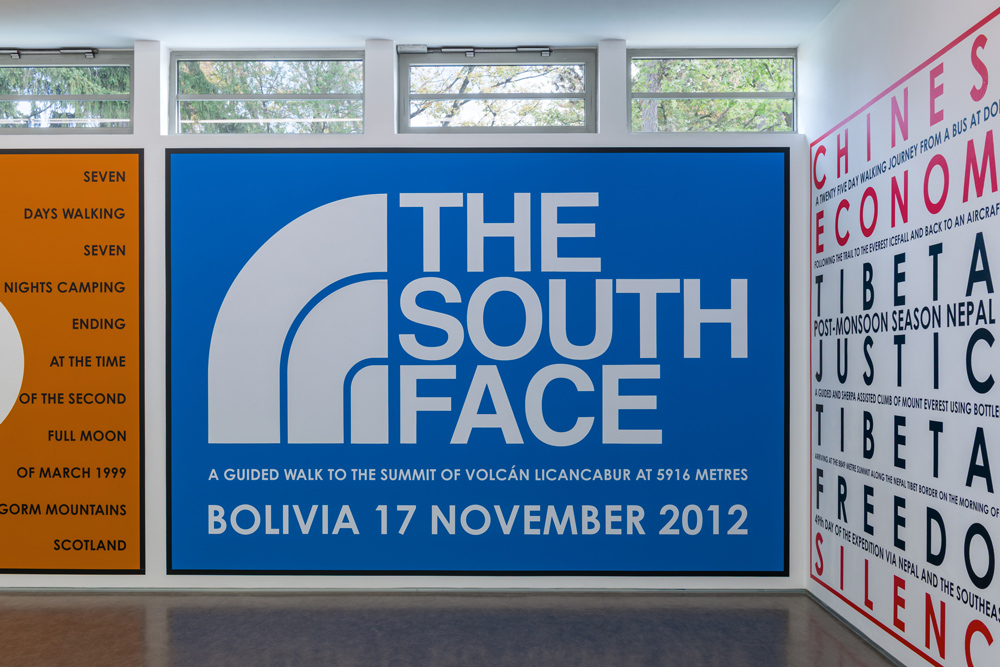
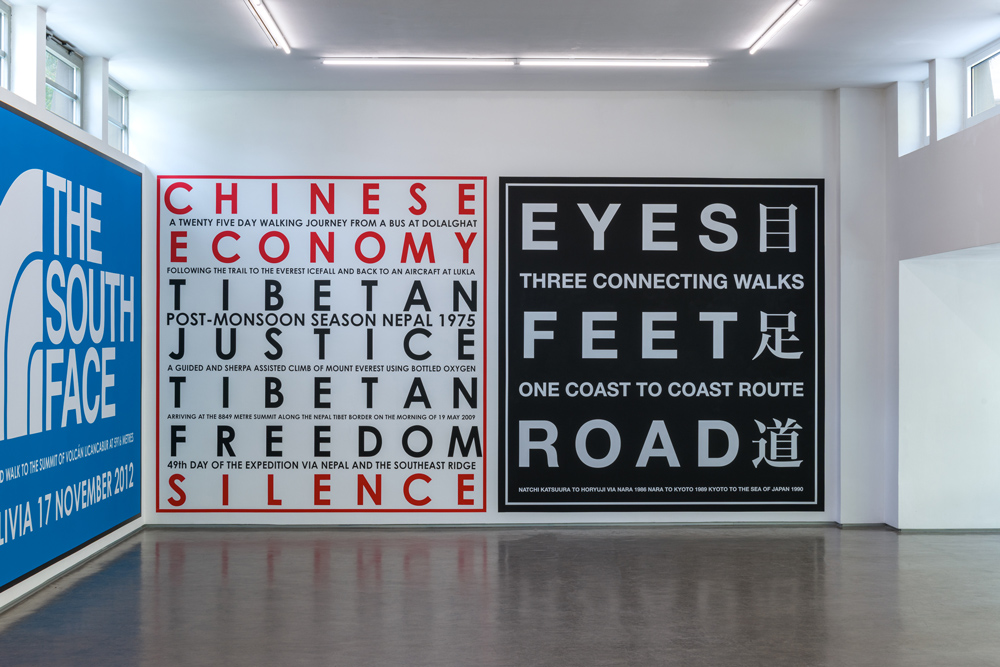
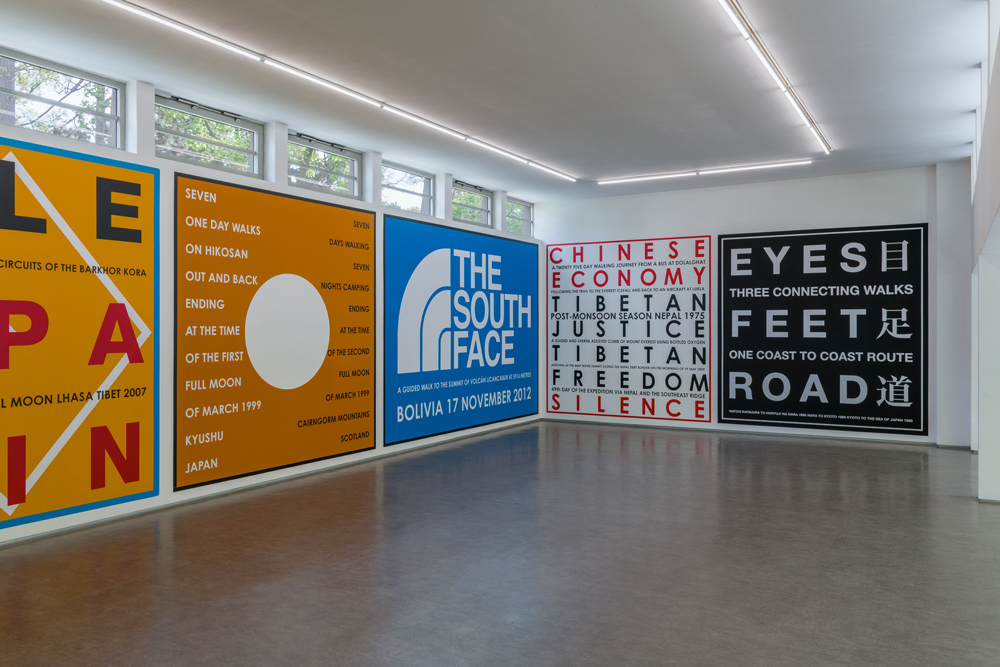
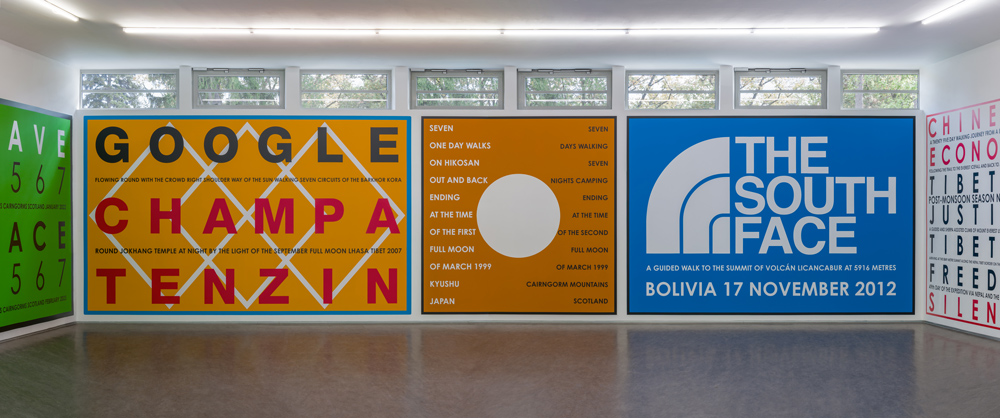
The exhibition Nature as Communities, Not Commodities stands in direct, almost physical continuity with This Is Not Land Art—the expansive exhibition Fulton realized at Galerie Stadtpark in 2019. This connection should be viewed primarily as formal, spatial, and intrinsic to the work itself. As was the case a few years ago, the gallery walls once again feature a comprehensive installation of large-scale graphic tableaux. However, there is a discernible increase in both pictorial and semantic density. Four wall-based works were presented in 2019; there are now six. Paint and precision-cut vinyl lettering are applied directly to the walls. The combination of image, text, and architectural space forms a graphic unity whose clarity achieves a heightened presence within the room, thereby generating a quasi-sculptural dimension.
The essential phenomenological criterion governing the installation of these six graphic tableaux lies in the radical nature of their configuration: there is no neutral space between the individual works. The exhibition thus denies viewers the conventional aesthetic distance that allows the eye to isolate, frame, contemplate, and finally move on from an individual work. The various tableaux span every decade of Fulton’s career, forming a subtle reflection on his body of work and on his practice of walking per se. The gallery wall no longer functions merely as a passive support for visual works but emerges as an active phenomenon that defines the very space of the exhibition. The individual tableaux do not constitute independent entities to be perceived and read in sequence; instead, they overlap, interpenetrate, and intertwine—both rhetorically and physically.
This aesthetic methodology was already central to the exhibition This Is Not Land Art. Fulton’s works represent a synthesis of topographical documentation and matter-of-fact notation. The locations, times, altitudes, cardinal directions, and events they cite have an unequivocal, concrete reference in physical reality, but this reference is not limited to the mere transmission of information. The works’ laconic, almost bureaucratic mode of expression is devoid of narrative depth; reality is referenced without the inclusion of psychological or literary interpretive elements. The personal, lyrical “I” is largely omitted. What is present instead are factual data, mathematical fragments, and the spatiotemporal coordinates of that absolute experience. It is precisely this spatiotemporal radical reduction that evokes a distinctive, quiet, almost metaphysical intensity and presence.
In Fulton’s practice, walking is manifested as a radical form of phenomenological reduction. It is the elementary and repetitive act inherent in walking—familiar to everyone—that in this intensified form is nevertheless capable of inducing a fundamental shift in perception, indeed in the structure of consciousness. While walking, one encounters the world not as an ordered, panoptic image, but as a pure, unpredictable sequence of events. The person in motion traverses a continuum whose unfolding—in an entirely metaphorical and existential sense—eludes human control. Here, the world is not actively constructed or mastered, but comes toward the walker and simply happens.
Fulton describes walking as a continuous, existential form of inquiry. Yet this process does not take place within conventional, object- or research-based contexts—or, more recently, colonial contexts—in which the collection of data, the archiving of objects, the mapping of territories, or the intellectual appropriation of natural phenomena are taken for granted. On the contrary, the artist fundamentally explores walking as a modification of attention. For a specified duration, the walker is removed from the internalized rhythms, economic pressures, and functional orders of the social system. This simplified and sharpened shift in perception thus functions as a mode of ascetic concentration directed toward the ontological coordinates of being. In this context, cold, exhaustion, the darkness of night, and the grueling duration of a trek are not interpreted as negative obstacles or resistances to be overcome. Rather, they are productive conditions for a completely different kind of attention. In this precise sense, walking for Fulton is not merely a pragmatic, utilitarian form of locomotion in the sense of travel. Rather, it constitutes a distinct form of knowledge that is to be understood as a method of encountering the world. It is an ontological instrument that prevents the world from being reduced to anthropocentric categories, concepts, and notions of utility.
This fundamental inaccessibility forms the basis of Fulton’s relationship with what is commonly referred to as “nature.” His artistic and philosophical interest is not rooted in landscape as an aesthetic image—the concept of “landscape” already implies a subjective human perspective and projection. Nature, by contrast, refers to an objective reality—a fullness of being—that is neither created nor legitimized by the human gaze. It exists independently of humanity, on its own terms. From a phenomenological perspective, the category of landscape must always be understood as a cultural, and ultimately ideological, construct. It is based on preconceptions and foregrounds the idea that nature is something to be viewed, contemplated, and enjoyed by humans. It turns nature into the object of an imperial gaze, framing it as a tamed, reified counterpart made available to the human subject and therefore exploitable.
This ontological distinction illuminates Fulton’s lifelong, consistent, and uncompromising rejection of Land Art. The very title of his 2019 exhibition—This Is Not Land Art—marks an unmistakable, radical distinction. Fulton firmly rejects situating his artistic practice within an art-historical lineage whose practitioners transformed the natural world in monumental and irreversible ways. For them, nature ultimately functioned as a gigantic, expanded canvas or as sculptural material for the artist’s own will to power. Fulton’s relationship to nature, by contrast, is based on the opposite premise—one that can be described as an ethos of being and letting-be: adding nothing to nature and taking nothing away from it. He strives to leave no lasting trace, no material monument to his presence. The radical principle of “Leave No Trace” is, in this context, far more than a well-intentioned ecological rule of conduct or an act of environmental conservation. The term denotes a fundamental ontological stance toward all that exists as a whole. An art that withdraws from nature—shifting no stones, digging no trenches, adding no artificial materials—voluntarily renounces the central, centuries-old gesture of traditional Western artistic creation. That form of art reduces the world and all that exists to raw material for human activity informed by notions of supposed genius. Fulton’s practice rejects all forms of appropriation or colonization. Here, the artist does not act as a sovereign producer who encounters passive material and transforms it through his processing and shaping into a higher cultural product. Instead, Fulton enacts a gesture of humility: the artist exposes himself, as an embodied subject, to a world that already exists as radical otherness—a world that does not need humans and does not wait for them to confer meaning upon it.
In the exhibition Nature as Communities, Not Commodities, Fulton’s decades-long phenomenological and ontological practice is distilled into and manifested as an explicit, unambiguous ethical appeal—it might even be called a manifesto articulated through artistic means. The title itself should be understood as a philosophical thesis that captures the central issue of our present era: the Anthropocene. Western modernity has consistently viewed nature as a commodity, a mere resource, an energy supply, an aesthetic backdrop for tourism, or a passive canvas for art. This position reflects the Heideggerian term Gestell (enframing)—a state in which everything in existence is viewed solely in terms of its exploitability, availability, and economic utility. Fulton counters this destructive, alienating approach with the concept of “communities.” In this view, nature is no longer seen as a constellation of objects that stand in opposition to the human subject, but rather as a highly complex, relational web of interdependent communities of beings. Within these complex structures, there is no longer an ontological hierarchy in which humans occupy the highest position. The hypothesis is that stones, rivers, winds, lichens, animals, mountains, and humans coexist and are interwoven in a continuous, embodied dialogue with one another.
For Hamish Fulton, walking represents the only adequate medium for entering these communities without destroying or corrupting their internal order. Walking allows one to become part of these communities, to adapt one’s pace to the rhythm of the surroundings. Experiencing nature as a shared realm—rather than as an idealized image or even a projection—is an essential aspect of this practice. The large-scale wall works at Galerie Stadtpark seek to translate this state of radical immanence and relational interdependence into the realm of experience through and within art. Viewers are prompted to relinquish their sense of sovereignty and engage with the visual—indeed, immersive—graphic structure, sensing that human beings, by their very nature, are never separate from nature.
Fulton’s aesthetic practice offers no finalized representation of nature or the world, nor any finalized knowledge. His artistic practice remains a form of pointing toward that fosters a heightened awareness of place, time, the body, and nature—and of what occurs and unfolds intermittently among them. Perhaps the true radicality of Fulton’s art lies precisely in this open-endedness: it does not represent the world in a way that closes it off, but keeps it open by inviting us to encounter it differently—as the artist’s exhibition title suggests—not as landscape, resource, or commodity, but as a community of which we have long been a part.
Text:David Komary
Translation: Erik Smith
top
Since his defining first “art walk” in 1967, Fulton has explored and systematized the most diverse forms of walking over the course of more than half a century. He wanders through urban agglomerations and pristine landscapes, coastlines and river courses, steep mountain regions and expansive deserts. His walks have taken him to every continent on Earth. From these existential forays into unfamiliar terrain emerge photographs, drawings, precise text-based works, and expansive wall murals. Yet these works are never merely material documentation, representations, or mimetic depictions of the walks. Rather, his aesthetic “transcriptions” articulate an experience that cannot itself be depicted or reproduced, nor fully embodied in a material object. Fulton’s central dictum holds that an object can never compete with an experience. Accordingly, his entire practice is governed by a unique, quiet, yet rigorous ontology: “Walking is the constant, the art medium is the variable.”
The exhibition Nature as Communities, Not Commodities stands in direct, almost physical continuity with This Is Not Land Art—the expansive exhibition Fulton realized at Galerie Stadtpark in 2019. This connection should be viewed primarily as formal, spatial, and intrinsic to the work itself. As was the case a few years ago, the gallery walls once again feature a comprehensive installation of large-scale graphic tableaux. However, there is a discernible increase in both pictorial and semantic density. Four wall-based works were presented in 2019; there are now six. Paint and precision-cut vinyl lettering are applied directly to the walls. The combination of image, text, and architectural space forms a graphic unity whose clarity achieves a heightened presence within the room, thereby generating a quasi-sculptural dimension.
The essential phenomenological criterion governing the installation of these six graphic tableaux lies in the radical nature of their configuration: there is no neutral space between the individual works. The exhibition thus denies viewers the conventional aesthetic distance that allows the eye to isolate, frame, contemplate, and finally move on from an individual work. The various tableaux span every decade of Fulton’s career, forming a subtle reflection on his body of work and on his practice of walking per se. The gallery wall no longer functions merely as a passive support for visual works but emerges as an active phenomenon that defines the very space of the exhibition. The individual tableaux do not constitute independent entities to be perceived and read in sequence; instead, they overlap, interpenetrate, and intertwine—both rhetorically and physically.
This aesthetic methodology was already central to the exhibition This Is Not Land Art. Fulton’s works represent a synthesis of topographical documentation and matter-of-fact notation. The locations, times, altitudes, cardinal directions, and events they cite have an unequivocal, concrete reference in physical reality, but this reference is not limited to the mere transmission of information. The works’ laconic, almost bureaucratic mode of expression is devoid of narrative depth; reality is referenced without the inclusion of psychological or literary interpretive elements. The personal, lyrical “I” is largely omitted. What is present instead are factual data, mathematical fragments, and the spatiotemporal coordinates of that absolute experience. It is precisely this spatiotemporal radical reduction that evokes a distinctive, quiet, almost metaphysical intensity and presence.
In Fulton’s practice, walking is manifested as a radical form of phenomenological reduction. It is the elementary and repetitive act inherent in walking—familiar to everyone—that in this intensified form is nevertheless capable of inducing a fundamental shift in perception, indeed in the structure of consciousness. While walking, one encounters the world not as an ordered, panoptic image, but as a pure, unpredictable sequence of events. The person in motion traverses a continuum whose unfolding—in an entirely metaphorical and existential sense—eludes human control. Here, the world is not actively constructed or mastered, but comes toward the walker and simply happens.
Fulton describes walking as a continuous, existential form of inquiry. Yet this process does not take place within conventional, object- or research-based contexts—or, more recently, colonial contexts—in which the collection of data, the archiving of objects, the mapping of territories, or the intellectual appropriation of natural phenomena are taken for granted. On the contrary, the artist fundamentally explores walking as a modification of attention. For a specified duration, the walker is removed from the internalized rhythms, economic pressures, and functional orders of the social system. This simplified and sharpened shift in perception thus functions as a mode of ascetic concentration directed toward the ontological coordinates of being. In this context, cold, exhaustion, the darkness of night, and the grueling duration of a trek are not interpreted as negative obstacles or resistances to be overcome. Rather, they are productive conditions for a completely different kind of attention. In this precise sense, walking for Fulton is not merely a pragmatic, utilitarian form of locomotion in the sense of travel. Rather, it constitutes a distinct form of knowledge that is to be understood as a method of encountering the world. It is an ontological instrument that prevents the world from being reduced to anthropocentric categories, concepts, and notions of utility.
This fundamental inaccessibility forms the basis of Fulton’s relationship with what is commonly referred to as “nature.” His artistic and philosophical interest is not rooted in landscape as an aesthetic image—the concept of “landscape” already implies a subjective human perspective and projection. Nature, by contrast, refers to an objective reality—a fullness of being—that is neither created nor legitimized by the human gaze. It exists independently of humanity, on its own terms. From a phenomenological perspective, the category of landscape must always be understood as a cultural, and ultimately ideological, construct. It is based on preconceptions and foregrounds the idea that nature is something to be viewed, contemplated, and enjoyed by humans. It turns nature into the object of an imperial gaze, framing it as a tamed, reified counterpart made available to the human subject and therefore exploitable.
This ontological distinction illuminates Fulton’s lifelong, consistent, and uncompromising rejection of Land Art. The very title of his 2019 exhibition—This Is Not Land Art—marks an unmistakable, radical distinction. Fulton firmly rejects situating his artistic practice within an art-historical lineage whose practitioners transformed the natural world in monumental and irreversible ways. For them, nature ultimately functioned as a gigantic, expanded canvas or as sculptural material for the artist’s own will to power. Fulton’s relationship to nature, by contrast, is based on the opposite premise—one that can be described as an ethos of being and letting-be: adding nothing to nature and taking nothing away from it. He strives to leave no lasting trace, no material monument to his presence. The radical principle of “Leave No Trace” is, in this context, far more than a well-intentioned ecological rule of conduct or an act of environmental conservation. The term denotes a fundamental ontological stance toward all that exists as a whole. An art that withdraws from nature—shifting no stones, digging no trenches, adding no artificial materials—voluntarily renounces the central, centuries-old gesture of traditional Western artistic creation. That form of art reduces the world and all that exists to raw material for human activity informed by notions of supposed genius. Fulton’s practice rejects all forms of appropriation or colonization. Here, the artist does not act as a sovereign producer who encounters passive material and transforms it through his processing and shaping into a higher cultural product. Instead, Fulton enacts a gesture of humility: the artist exposes himself, as an embodied subject, to a world that already exists as radical otherness—a world that does not need humans and does not wait for them to confer meaning upon it.
In the exhibition Nature as Communities, Not Commodities, Fulton’s decades-long phenomenological and ontological practice is distilled into and manifested as an explicit, unambiguous ethical appeal—it might even be called a manifesto articulated through artistic means. The title itself should be understood as a philosophical thesis that captures the central issue of our present era: the Anthropocene. Western modernity has consistently viewed nature as a commodity, a mere resource, an energy supply, an aesthetic backdrop for tourism, or a passive canvas for art. This position reflects the Heideggerian term Gestell (enframing)—a state in which everything in existence is viewed solely in terms of its exploitability, availability, and economic utility. Fulton counters this destructive, alienating approach with the concept of “communities.” In this view, nature is no longer seen as a constellation of objects that stand in opposition to the human subject, but rather as a highly complex, relational web of interdependent communities of beings. Within these complex structures, there is no longer an ontological hierarchy in which humans occupy the highest position. The hypothesis is that stones, rivers, winds, lichens, animals, mountains, and humans coexist and are interwoven in a continuous, embodied dialogue with one another.
For Hamish Fulton, walking represents the only adequate medium for entering these communities without destroying or corrupting their internal order. Walking allows one to become part of these communities, to adapt one’s pace to the rhythm of the surroundings. Experiencing nature as a shared realm—rather than as an idealized image or even a projection—is an essential aspect of this practice. The large-scale wall works at Galerie Stadtpark seek to translate this state of radical immanence and relational interdependence into the realm of experience through and within art. Viewers are prompted to relinquish their sense of sovereignty and engage with the visual—indeed, immersive—graphic structure, sensing that human beings, by their very nature, are never separate from nature.
Fulton’s aesthetic practice offers no finalized representation of nature or the world, nor any finalized knowledge. His artistic practice remains a form of pointing toward that fosters a heightened awareness of place, time, the body, and nature—and of what occurs and unfolds intermittently among them. Perhaps the true radicality of Fulton’s art lies precisely in this open-endedness: it does not represent the world in a way that closes it off, but keeps it open by inviting us to encounter it differently—as the artist’s exhibition title suggests—not as landscape, resource, or commodity, but as a community of which we have long been a part.
Text:David Komary
Translation: Erik Smith
top