
EXHIBITIONS

IDEM EST
Paolo Icaro

July – September 2021  
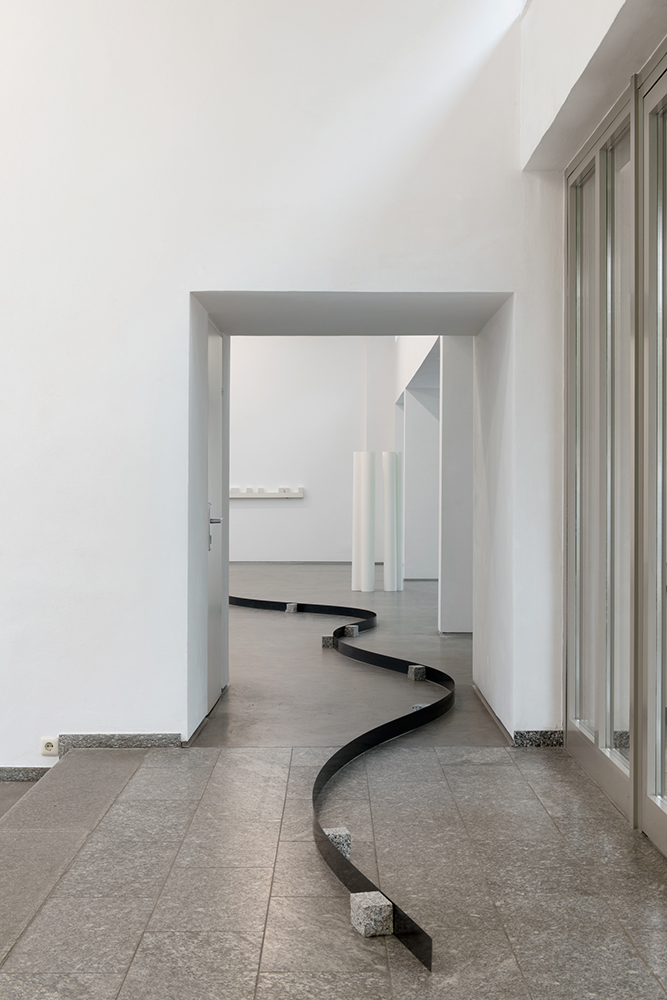
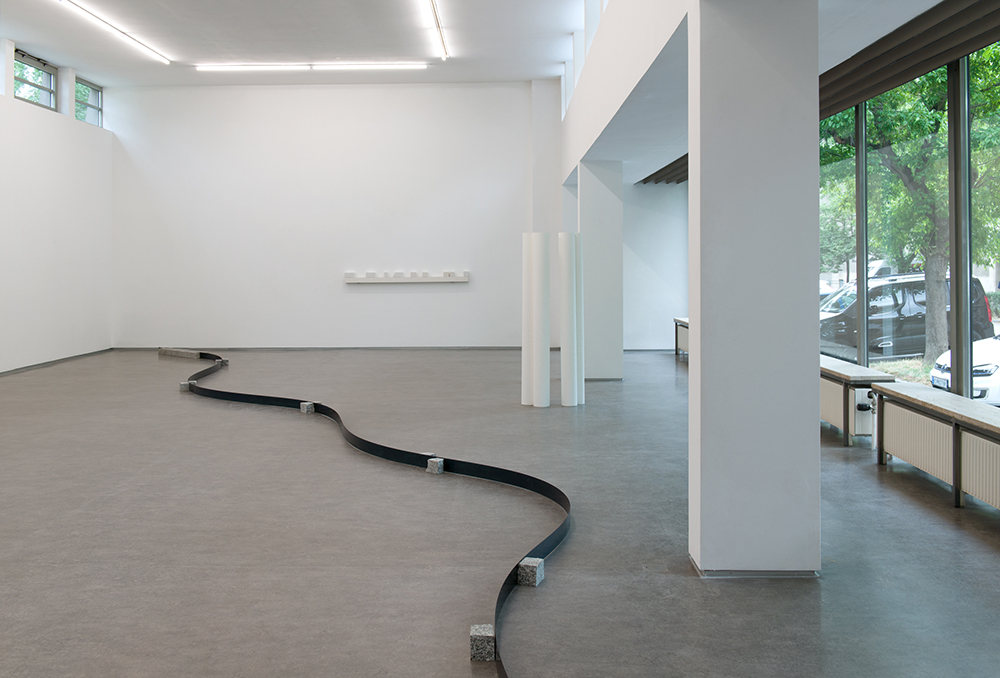
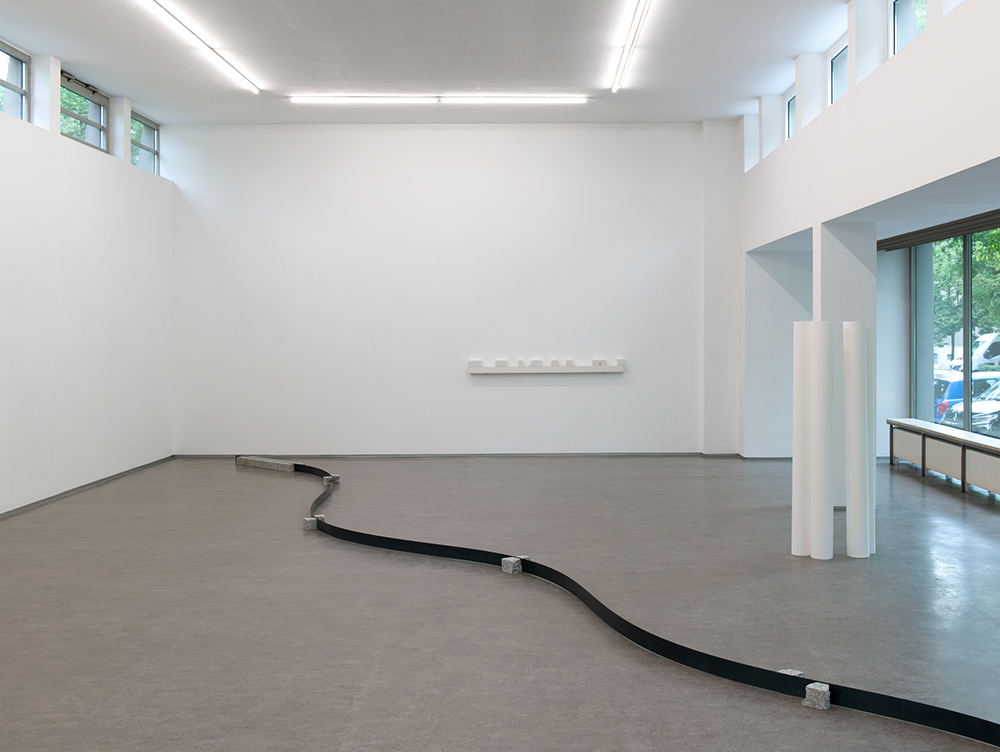
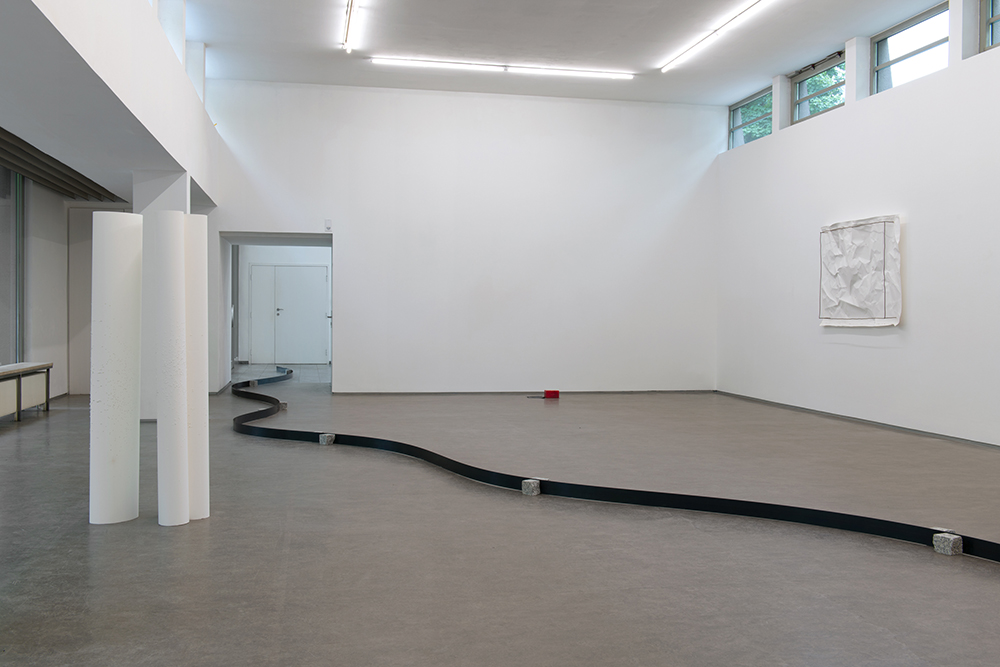
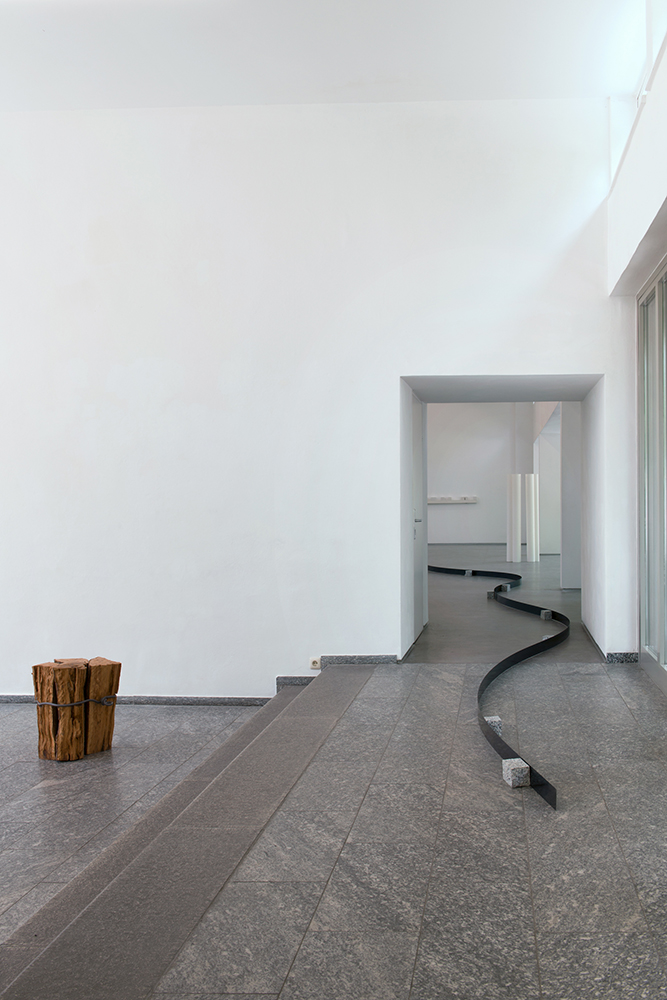
Exhibition view IDEM EST, Paolo Icaro; Galerie Stadtpark Krems, 2021; Photos: Stefan Lux; Linea di equilibrio, 2011; hardened steel, granite, 30 x 2000 cm; Courtesy: Paolo Icaro and P420, Bologna
Exhibition view IDEM EST, Paolo Icaro; Galerie Stadtpark Krems, 2021; Photos: Stefan Lux; Courtesy of all works: Paolo Icaro and P420, Bologna
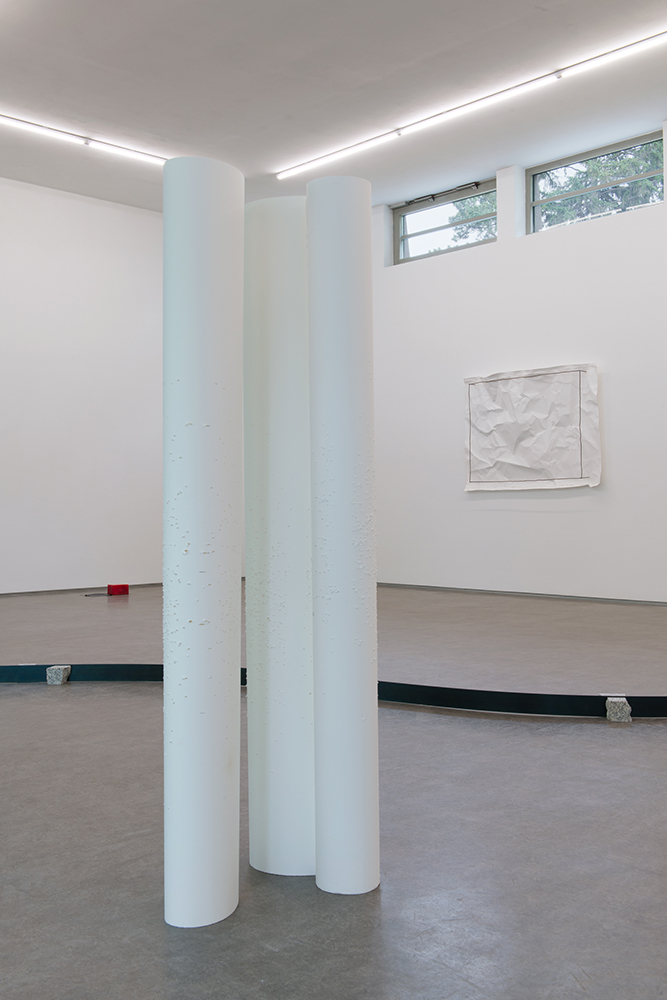
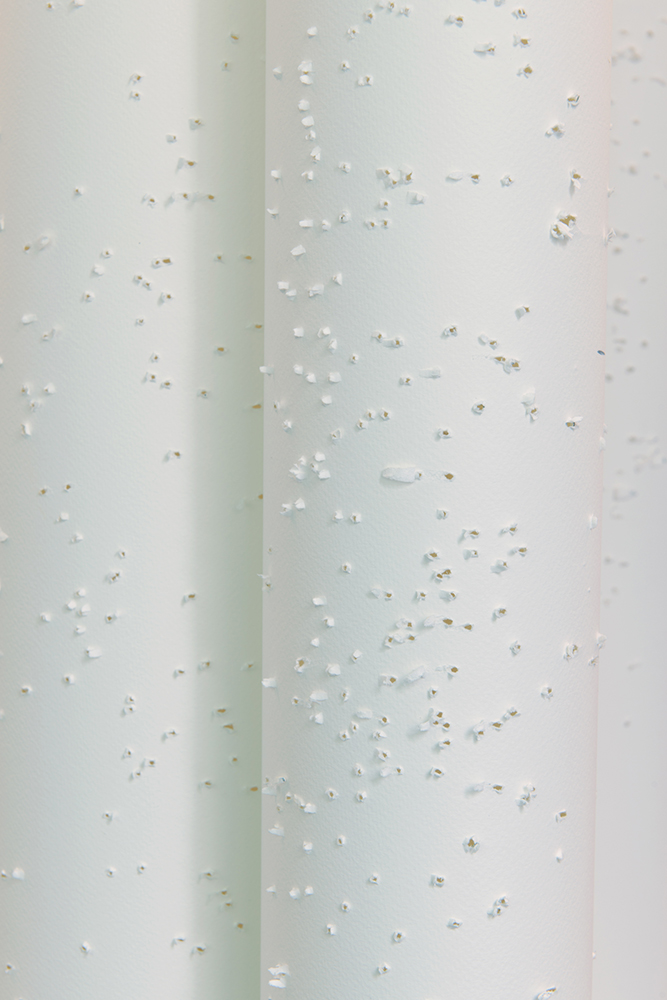
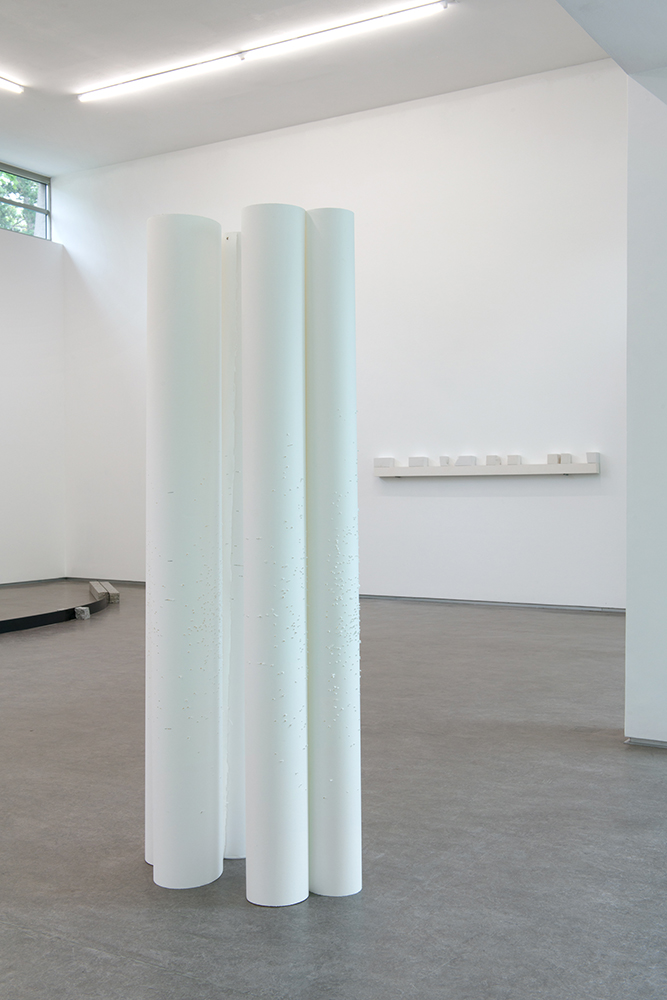
Exhibition view IDEM EST, Paolo Icaro; Galerie Stadtpark Krems, 2021; Photos: Stefan Lux; Shooting, 2020; Fabriano paper, lead, 150 x 25 x 14 cm; Shooting, 2020; Fabriano paper, lead, 150 x 25 x 16 cm; Shooting, 2020; Fabriano paper, lead, 150 x 25 x 15 cm; Courtesy of all works: Paolo Icaro and P420, Bologna
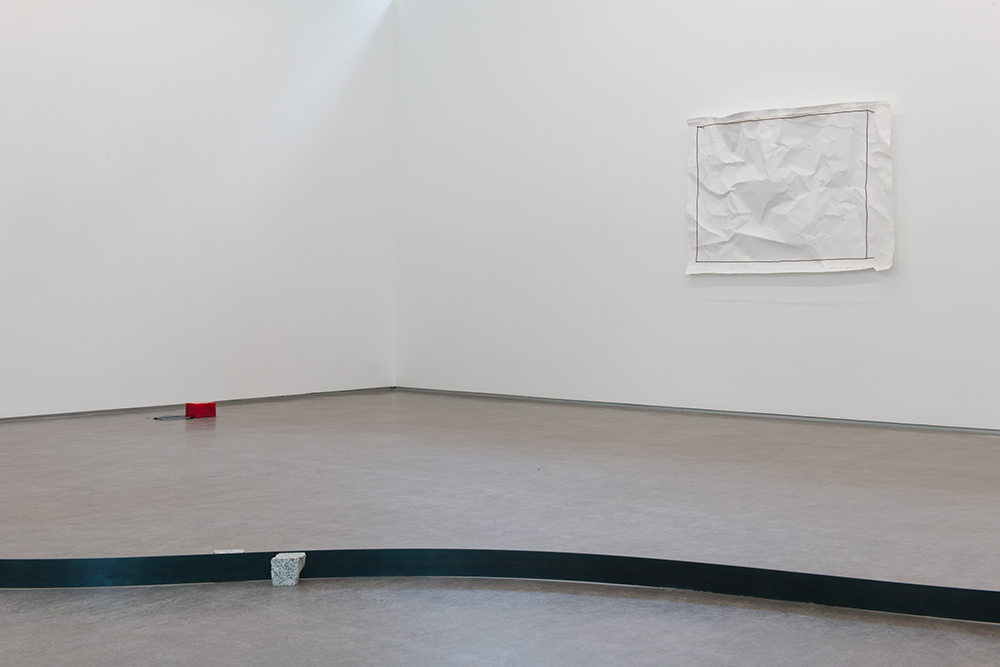
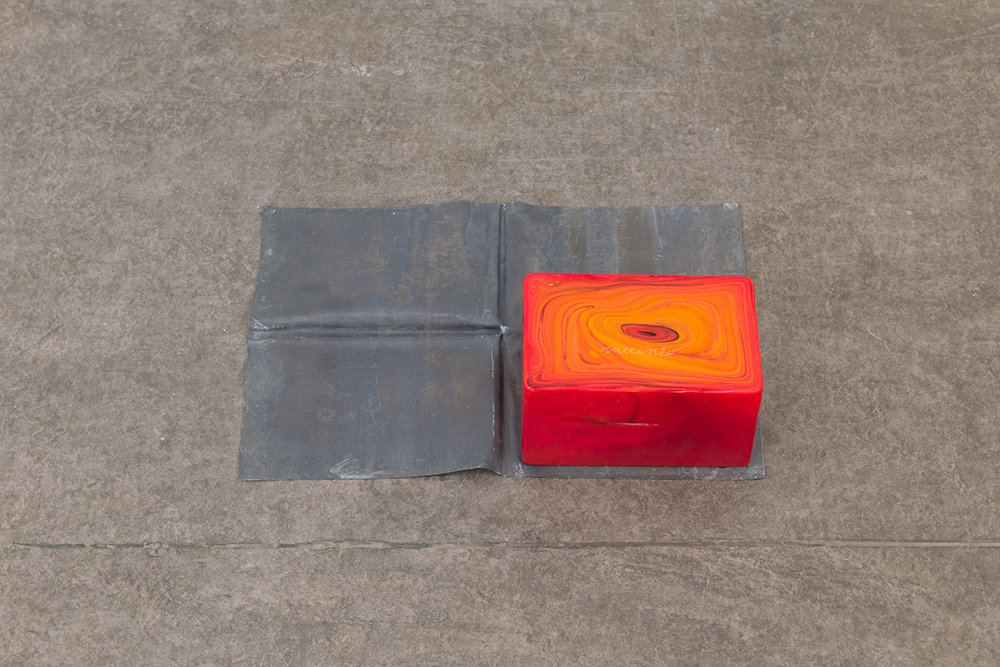
Ausstellungsansicht IDEM EST, Paolo Icaro; Galerie Stadtpark Krems, 2021; Fotos: Stefan Lux; Murano glass tale (red variegated),1969/2018; Muranoglas, Blei, 9 x 16.5 x 10.5 cm;  ;  Courtesy: Paolo Icaro und P420, Bologna
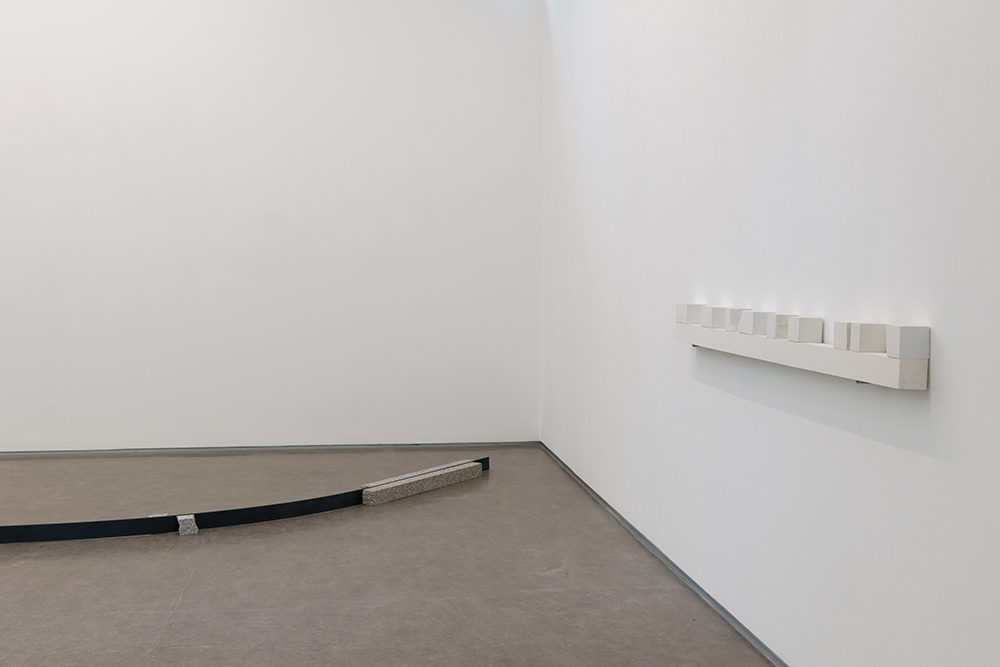
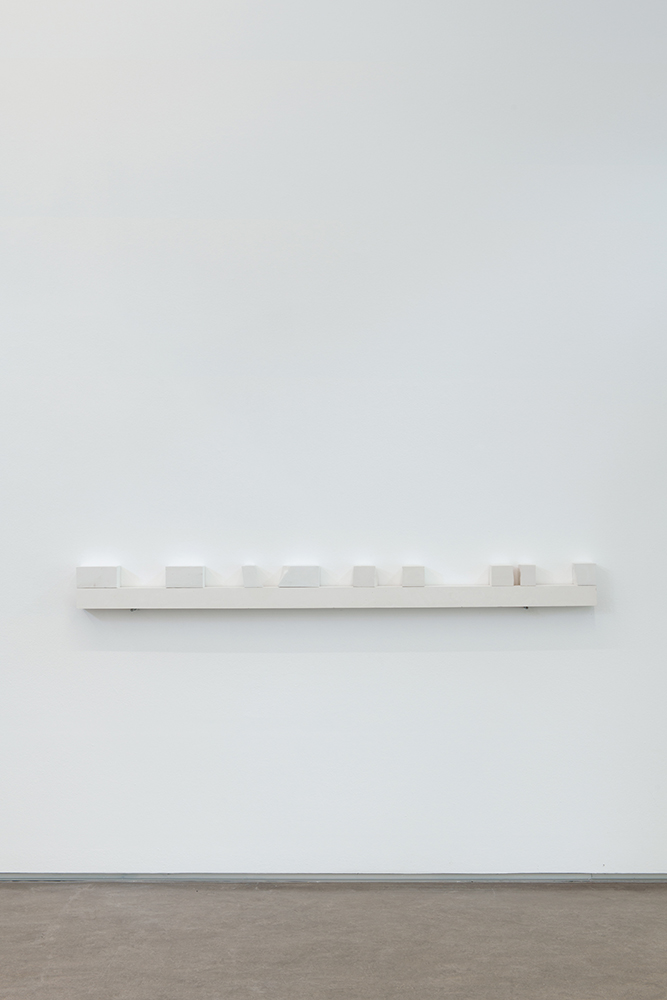
Exhibition view IDEM EST, Paolo Icaro; Galerie Stadtpark Krems, 2021; Photos: Stefan Lux; Morse, 2018; Plaster, 14 x 182 x 7 cm; Courtesy: Paolo Icaro and P420, Bologna
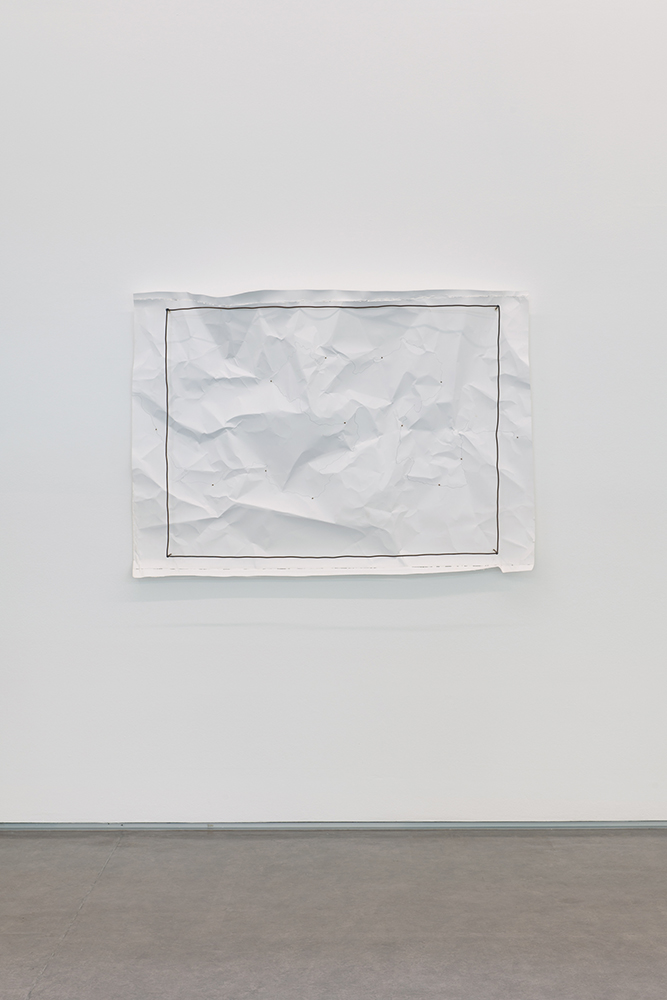
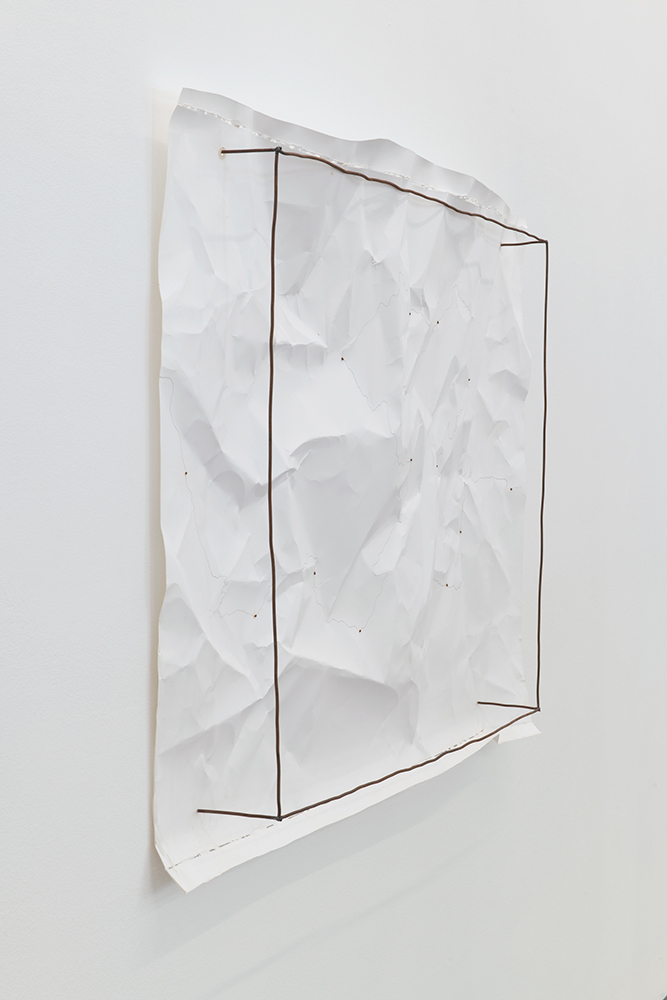
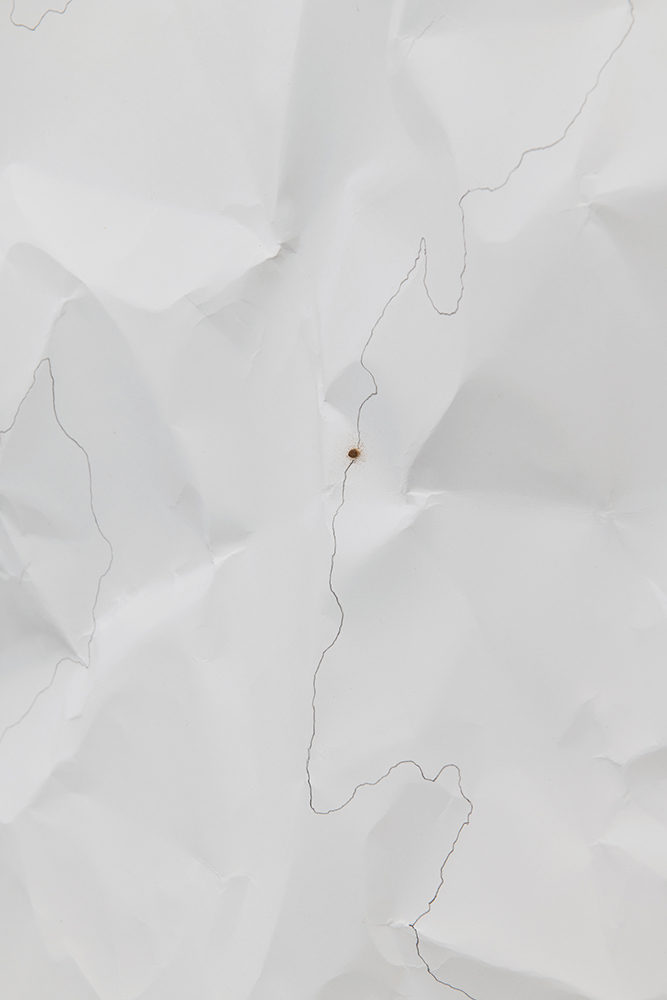
Exhibition view IDEM EST, Paolo Icaro; Galerie Stadtpark Krems, 2021; Photos: Stefan Lux; Mappa, 2010; Paper, ink, passion fruit seeds, oxidised steel,; 150 x 105 x 12 cm; Courtesy: Paolo Icaro and P420, Bologna
Exhibition view IDEM EST, Paolo Icaro; Galerie Stadtpark Krems, 2021; Photos: Stefan Lux; Courtesy: Paolo Icaro and P420, Bologna
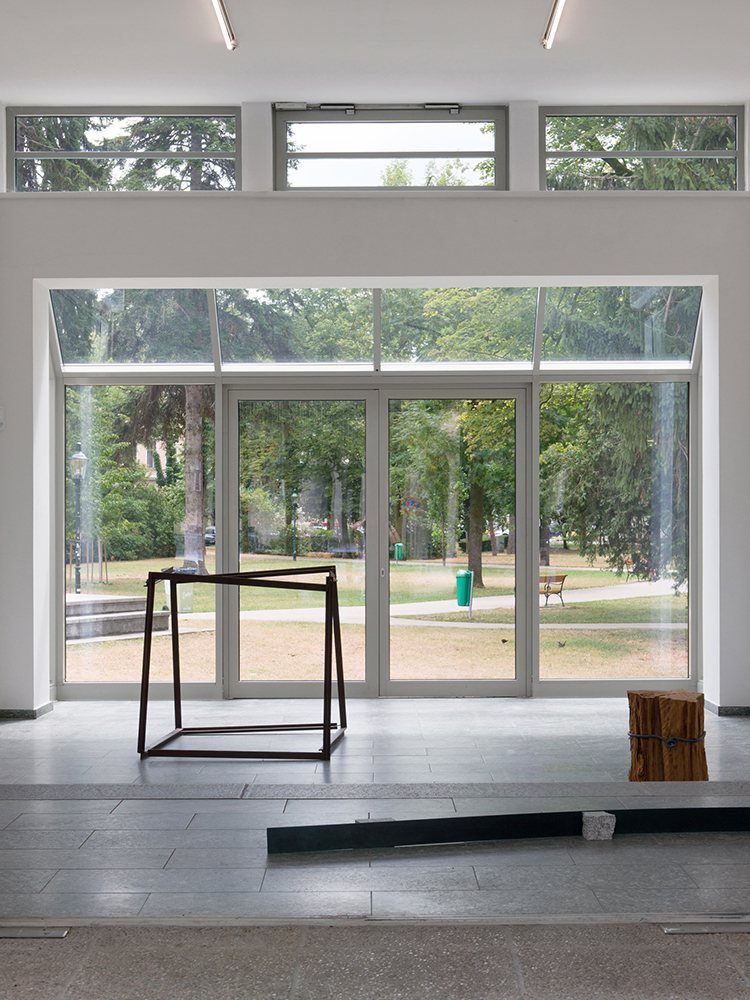
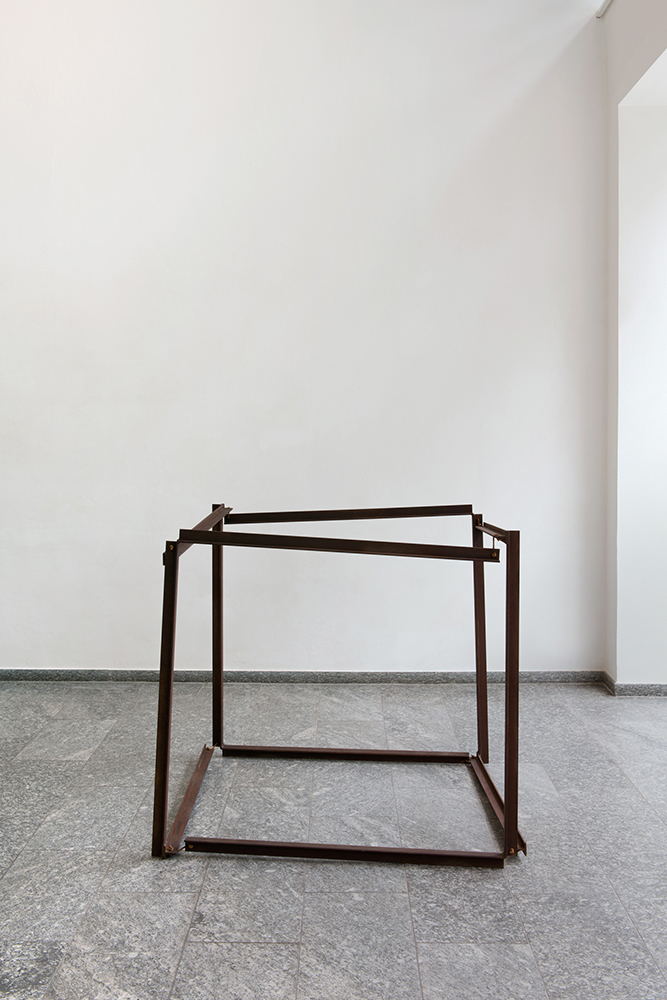
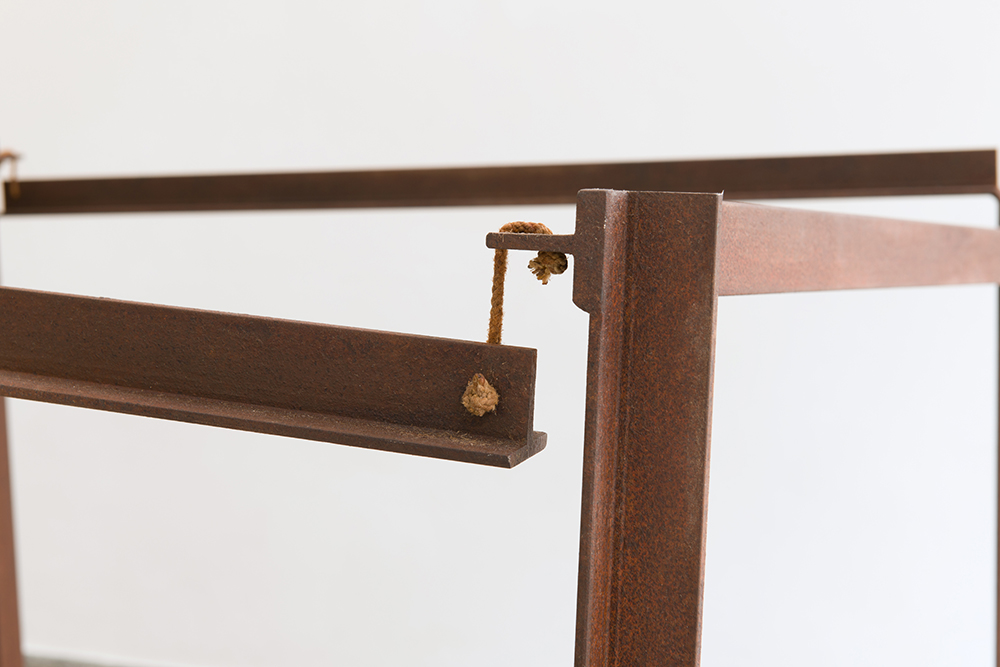
Exhibition view IDEM EST, Paolo Icaro; Galerie Stadtpark Krems, 2021; Photos: Stefan Lux; Cuborto, 1969; Steel, rope, 100 x 100 x 100 cm; Courtesy of all works: Paolo Icaro and P420, Bologna
Exhibition view IDEM EST, Paolo Icaro; Galerie Stadtpark Krems, 2021; Photos: Stefan Lux; Inside out, 2016; Cedar wood, lead, 51 x 47 x 45 cm; Courtesy of all works: Paolo Icaro and P420, Bologna
Legende
The exhibition IDEM EST presents a constellation of sculptural works by Italian artist Paolo Icaro (b. 1936) created between 1969 and 2020. Icaro consistently works with simple materials and forms made of wood, metal, plaster, or stone. Drawing forms a primary medium, a fundamental articulation, in which Icaro’s essential concerns are made legible. The dot as the minutest form of drawing, its execution, and the line are iconic and fundamental sculptural elements reoccurring in Icaro’s work.

Icaro’s works are—although often relying on simple geometric forms such as lines, rectangles, and cubes, and also incorporating material absence, i.e. emptiness and voids, as spatial elements—the opposite of sterile, distant, or austere. The artist works—perhaps this is the most significant connection to Arte Povera, to which he was initially linked—with simple, at times fragile materials that clearly evince the traces of time, with paper, or with iron, which rusts, which is also allowed to rust. His sculptures, however, cannot be reduced to their formal language, materiality, or phenomenological presence. Even if his work exhibits the characteristics of Arte Povera and is often interpreted under the rubric of conceptual art and post-minimalism, these attributions would still be insufficient and reductionist. Rather, one could speak of an independent, poetic-sculptural language that poses spatial-relational questions in order to examine and reflect—through the medium of perception—on the relationship between the self and the world.

Icaro’s works can be described as sculptural scenarios; they are questions concerning the here (self) and there (reality and world), being (space) but also becoming (time), formulated in a precise, simple, poetic, spatial language. In Icaro’s work, the dichotomy of here and there forms a kind of underlying spatial as well as ontological motif. The artist asks, how can I “reach” this external world from the standpoint of my individual here and now, how can I develop a relationship to it? Icaro repeatedly addresses the viewer as a totality, as an individual in his or her own lived reality and experience, history, peculiarities, as well as inabilities. He does not create exclusive spaces or scenarios, but rather inclusive settings that understand perception, cognition, and knowledge as interdependent and also seek to incorporate the subjective, the personal, even each individual’s reality of being and history.

The post-minimalist sculpture Cuborto (1969) is formed from simple steel struts that appear quite old today; the cubic arrangement is presented to the viewer in a latently broken, dislocated, and somewhat out-of-plumb manner. Three struts are welded together forming an XYZ structure while their spatial-axis nodes are simply tied to one another by short pieces of cord. Although the cube is clearly recognizable as such at first glance, on closer inspection it appears quite unstable, even vulnerable. It is not a pure or ideal geometric form, but almost becomes a kind of protagonist or character, striving to preserve its own form. There is no trace of Euclidean orthogonality or of space as an abstract homogeneous expansion, a notion typically associated with the ideal cubic form. It appears as if life, indeed the human, could break into the material world here. And yet it is not about irony or the mere deconstruction of a basic geometric form, eroded down to an authoritative status or form fetish. Here too, in terms of the (broken) object, the relationship that forms between the viewer and the object of perception is the de facto subject of artistic reflection. In engaging with and contemplating Cuborto, cognitive or mental processes of comprehension are as relevant as psychological, relational instances of transference and countertransference, i.e. projective processes of seeing and reading into as forms of perceptive resonance of the perceiving self.

Several of Icaro's sculptures have the expressive abilities of a spatial protagonist; they invite the viewer to enter the sculpture’s sphere of activity in order to co-create its relational space. Apart from this performative-scenic quality, his works also have a linguistic, at times even lyrical aspect, not in a semantic, referential, or even commentary sense, but in the form of an open-ended, albeit intensive dialogical capacity. Icaro’s sculptures speak out of themselves, they articulate themselves—to borrow a term from musical aesthetics, through the art of performing—parlando. They appear informal at first, but over the course of taking them in they actually become subtly and engagingly communicative. Perhaps one could speak of a relational-poetic concept of sculpture, of an attempt to make Icaro's central question of the self’s relationship to the world legible in various ways using the “instrument” of his individual sculptural grammar, articulated in the here and now.

In Inside Out (2016) the viewer is also subtly “choreographed” by the artist. The knee-high sculpture makes it possible for the recipient to approach it, to look at it from above as if could be reduced it to its object status or taken possession of. And yet, on closer inspection, Icaro's undersized protagonist opens up questions of spatial-philosophical dimension. Here as well, Icaro makes use of a radical form of simplicity. The title Inside Out gives away what the sculpture “does” in advance. The artist has simply turned outwards the inside of a section of a tree trunk, divided into four parts, and then tied it back together again with a kind of iron band. In terms of material, it is a simple, almost banal gesture. But if one thinks oneself into the topology of the sculpture, this simple inverted intervention contains significant image-theoretical and relational challenges and questions. Something that was never slated for visibility, is, stated expressively, exposed to the light of day. It is precisely the diminutive presence of the tied-together logs that connects with the viewer, makes an emotional impact. The intimacy of this “conversation” with the undersized performer not only engages the viewer’s gaze, i.e. the eye, but also one’s psychic energy; it arouses empathy, so to speak. As with Cuborto, the material here also takes on character traits. In the psychological transfer of the scenario to the viewer, the latter may perhaps feel invited or challenged to reflect on his or her own inner, hidden aspects that would come to light in such a "turning inside out.”           

In any case, it would be too simplistic to understand Icaro as a deconstructivist; he is not concerned with deconstruction, simply breaking apart familiar perceptual schemes, structures, or dispositifs, such as the orthogonality of the cube. Icaro's works are a perpetual inquiry into the relationship, the connection between the viewer and what is referred to here as the deconstructed. By no means does Icaro understand the space between viewer and work as empty, even neutral, rather it is filled with everyday life, with the personal. Viewed in this way, his sculptures and “spatial scenes” are not about abstraction; instead, they seek to awaken and activate the explorative, relational powers of the perceiver in establishing a relationship to the object. With Icaro, this relationship to the observed is always dynamic; the work of art is able to create a “greater” relationship to (one's own) life, not lead away from this into the abstract or ideal.

In the Racconto series (1968 to today), Icaro developed a self-referential, abstract, albeit “narrative” system based on a geometric, cubic structure. The basic shape of the ongoing Racconto series is a small steel cube that Icaro originally found in a metalsmith’s workshop in Genoa in 1968. Icaro smoothed the lateral surfaces of the steel cube, giving it the atypical dimension of 10.5 x 10.5 x 16.5 cm. Since then, this oddly shaped steel cube has formed the basic building block and metric reference for the Racconto series. At the same time, metaphorically speaking, it serves as a textual building block or even a narrative container.

For his first Racconto (1968), Icaro placed the cube on a base of paper—an “obscuring paper,” which like the steel cube itself cost virtually nothing—integrating it into his “narrative structure” for its metaphorical qualities. He folded the paper into sixty-four fields; the original Racconto could occupy the various positions in a calendar-like manner based on individual choices. Icaro emphasizes that the Racconto series is a work about time, about duration, about beginning and end. The sixty-four fields signify the upper limit of the number of Racconti Icaro intended on creating during his lifetime, making the series an analogy for life and lifetime per se. The Racconto shown in IDEM EST, by contrast, shows a significantly shorter time frame of a “calendar” consisting of four fields. The cube in this Racconto (2018) is not made of steel, but of red Murano glass whose translucent appearance subtly recalls a piece of candy or something pleasant, a moment of enjoyment, a beautiful moment in life. Despite the self-referential rhetoric and elliptical logic, the Racconto series can be read as a calendar transcribed into spatial poetry, which allows one to reflect on one's own life and existence but ultimately also about the beginning and the end, i.e. life (birth) and death.

The floor sculpture Linea di equilibrio (2011) is entirely dedicated to the aleatoric performance of a simple, spatialized line. Upon entering the pavilion-like entrance area, the sculpture on the floor intercepts the visitor, directing him or her into the main space. A ten-centimeter-wide, twenty-meter-long band of hardened steel snakes through the entire exhibition space. Small blocks cut from a cubic section of granite prop up the steel band on the left and right sides, channeling it diagonally through the space in a curvilinear manner. The position of each stone appears to cause a countermovement on the other side of the steel band like a lever. The effect of subtle tensile and compressive forces, seemingly based on a discrete principle of tensional equilibrium, gives the spatial line an individual form and dynamism that responds entirely to the given space, always with the latent implication that it could look differently, perform differently. Linea di equilibrio, however, is not simply a spatial resonator, it also harbors Icaro’s essential and continual question concerning the here and there, which, translated in this case into time, leads to the question of the beginning and the end. Icaro seeks to exemplify how a line is experienced spatially, not only as a movement occuring in relationship to space, but also specifically as a potential continuum whose inherent temporal dimension, metaphysically speaking, perhaps even refers to the notion of ​​infinity. The length of the Linea di equilibrio becomes a route along which the viewer moves, forming, akin to Mappa (2010), an analogue for walking, traveling, exploring, but also for moving forward in general. Ultimately, this spatial aspect is made apparent both in Linea di equilibrio and in Mappa as a perceptual sequence, as a continuum instead of a static, object-bound order. This temporal dimension, which also always takes into account a variety of appearances, deviations, and iterations, is an essential characteristic of Icaro’s sculptural language. Thus, the predominant sculptural medium is not so much space as it is spatiality in a perpetually temporal context, its being and becoming.

The image-object Mappa confronts the viewer with a double-envelope phenomenon. Icaro has crumpled a piece of paper into a ball, so that when uncrumpled, it becomes a kind of mountainous landscape of indeterminate location. On the one hand, Mappa alternates between the pictorial and object-ness, on the other, an inherently limited form is transformed into a section of a potentially endless, expansive, imaginary landscape of sublime proportions. The relatively rapid act of “creating” the landscape is followed by an extremely decelerated form of “traveling” through the relief. Icaro moves, or more precisely the pencil, almost in slow motion, mostly along the edges of summits, but at times also through valleys. The slowed-down lines—the artist required a month of drawing time for the Mappa shown—becomes an analogue for the act of walking, exploring, traveling. Icaro describes this slowed-down drawing as exceedingly challenging. In those places in the relief where he pauses to linger, he places kernels of passion fruit, which he eats while drawing. On its surface, the kernel marks a place, the place of the pause, while the “meter,” formed from the distances between kernels, in turn reflects the time, duration, and course of the drawing journey.

Mappa, like Icaro’s Shootings (2020), is about a journey, about moving oneself, but also metaphorically and more generally about moving forward and on in life. The line marks a possible path, a trip from here to there. Icaro explicitly moves slowly in Mappa, not wanting to complete the journey, but to explore it. “I try to challenge relationships, opening up variety, provocations.” He describes this decelerated, exploratory travel as an instrument for testing, reflecting, and expanding one's own relationship to the outside world. Each of these trips, these moments of entering into a relationship, is also accompanied by substantial doubt, “The artwork mediates the loneliness of the individual with the multitude of the world,” because you can never be sure what one is really seeing, whether the self’s connection to the world succeeds or fails.
 
In contrast to Mappa, Icaro moves in the Shootings as quickly as possible, and overcoming the distance from here to there should be done as quickly as possible. Using a small-caliber gun fired by a friend at Icaro's “direction,” the artist is able to establish the most direct and quickest possible connection to the “image support,” identified here as a vertically positioned roll of paper. The Shootings could be read as a kind of epistemological primal scenario of maximum exaggeration, as an attempt, from one’s own position, to perceive as well as mentally grasp the self and the here, the there, i.e. the object, the space, ultimately the world. “I connect myself from here to there, like flying in space, on an imaginary bullet,” says Icaro. While quick, even this attempt to “build a relationship” to the world by no means guarantees the success of the endeavor. Thus, not hitting or simply glancing off the roll of paper becomes a possible metaphor for non-success, for failure, but also for the impulse to dare to make further attempts.

In Morse (2018) an interplay of object-like presence and absence can be observed and “decoded” along a kind of linear metric. Lying on a horizontally installed cubic plaster beam in a loose, semirhythmic sequence are cubic and cube-like fragments of the same material and crosssections. Some of the cubes have smooth, precisely cut edges, others are broken by hand, “disrupting” the order and rhythm. At first glance, the individual blocks appear to be serial and regular, but closer inspection reveals a lively juxtaposition in the form of a dialogical correspondence, but also instances of repulsion and tension. Icaro also allows the intervals between the cubic protagonists themselves to become inverse volumes that elicit interpretation and meaning from the viewer. Similarities prove to be extremely different, even individual and expressive. Extracted and broken-off individual building blocks also clearly reference the act of their production, the energy and the event of breaking the granite apart. The syntax-like order, discernable as an allusion to binary Morse code, turns into dysfunctionality on closer inspection, into orderly disorder. The system observes its own fallibility and ineptitude in the mirror. In an attempt to distill an inherent logic, the viewer is ultimately referred back to their own way of reading and interpretation, perhaps in the form of a critical grammar. It is possible to discern in this, however, under the guise of critical geometry, a clear analogy to Cuborto. This work also seeks to question a linking structure, the tri-axial spatial order. The artist makes use of the logic of the cube “including what’s disregarded,” so Icaro, in order to disregard, subvert, and undermine this very order.

The title of the exhibition IDEM EST, in English “the same,” “the very same,” might prompt the viewer to assume that it is about sameness, similarity, self-similarity, or even identicality. Yet in creating similarity or what appears similar, deviation and difference occur incessantly, even if only in a liminal manner. Viewed thusly, Icaro’s various works are highly varied, pointed attempts to elucidate the external world, without landing in a constrictive scheme, in “one” way of generating the world. Paolo Icaro understands his aesthetic practice not as purely art-immanent actions and questions but in far more fundamental way: he is concerned with his relationship to the world. “To me” says Icaro, “it is important to connect with this tragic epoch we live in.” Icaro's works are not explanations or models of thought and, viewed in this way, are by no means to be understood in a purely conceptual manner; they are proposals and invitations to connect and relate individually to space, the world. His work can therefore be understood as a variety and diversity of sculptural articulation, but also as a "canon,” as a repeating, fundamental question actually posed and "performed" in various and modulated ways, over the course of his entire life.

“What is disregarded should not be overlooked,” says Icaro, thus emphasizing the necessity of questioning familiar patterns of perception, of conventions of the gaze but also of thought. At the same time, it is simply impossible to be able to achieve a kind of absolute perception or knowledge beyond the dispositifs that co-determine perception and thought, which is ultimately also reflected ontologically in the impossibility of being able to fully comprehend and transcend one's own being. "We cannot explore the beginning and end," says Icaro, because it goes far beyond the familiar framework of perception and thinking. With Icaro, however, this epistemological inability in no way results in nihilism or postmodern sarcasm, but, quite the contrary, in a sculptural philosophy of continuity. Despite all theoretical, meta-pictorial, and ultimately ontological considerations and doubts, Icaro's work never loses sight of what’s simple, immediate, and basic. His sculptures consistently convey themselves in non-linguistic and pre-linguistic ways at the same time; one could almost certainly claim that his works have never forgotten how to give space to the inner child, to the immediacy of exploratory experience and sensual recognition.
 
Text: David Komary
Translation: Eric Smith
 
top


Paolo Icaro

www.p420.it

born 1936, Torino

Recent exhibitions

2021
L’arte al tempo del Coronavirus, MAC, Sau Paulo, BR
141 - Un secolo di disegno in Italia, curated by Claudio Musso and Maura Pozzati, Fondazione del Monte di Bologna e Ravenna, Bologna
Collezione Ghigi, curated by Alessandro Zechini, Museo Licini, Ascoli Piceno

2020
E subito riprende il viaggio, P420, Bologna
SenzaMargine. Passaggi nell’Arte Italiana a cavallo del Millennio, curated by Bartolomeo Pietromarchi, MAXXI, Roma
Biennale Gherdëina 7, Ortisei
Vetro, Studio la Città, Verona

2019
I sei anni di Marcello Rumma 1965-1970, curated by Gabriele Guercio con Andrea Viliani, MADRE, Museo d’Arte Contemporanea Donnaregina, Napoli
Paolo Icaro: Cantiere, P420, Bologna (solo)
Antologia/Anthology 1964-2019,  curated by Elena Volpato, GAM - Galleria Civica d’Arte Moderna e Contemporanea, Turin (solo)
Alla ricerca dell’equilibrio perduto, Galleria Massimo Minini, Brescia (solo)
Straperetana 1019: La luna vicina, curated by S. Verini (a project by P. Capata & D. Durante), Pereto
Incontro a Palazzo: Luigi Carboni, Paolo Icaro, Eliseo Mattiacci, Giovanni Termini, Palazzo Ducale, Urbino
Negative Space, ZKM, Karlsruhe
No habrá nunca una puerta. Estás adentro. Obras de la Coleção Teixeira de Freitas, Santander Fundación, Madrid

2018
100%Italia, curated by Andrea Busto, Luca Beatrice, Lorenzo Canova, Claudio Cerritelli, Marco Meneguzzo, Elena Pontiggia, Luigi Sansone, Giorgio Verzotti, Museo Ettore Fico, Turin
Paolo Icaro. Studio Woodbridge. Plaster Works 1978-1982, P420, Feature, Art Basel, Basel (solo)
De Simples constructions, Kanal Centre Pompidou, Brussel, BE
Men at work/Women work better, Bibo’s place, Roma

2017
Paolo Icaro, Unending Incipit, Pinacoteca Comunale, Città di Castello (solo)
Le Pietre del Cielo: Paolo Icaro e Luigi Ghirri, Fondazione Querini Stampalia, Venezia (solo)
Respiro, all’interno dell’esterno dell’interno…, Fondazione VOLUME!, Roma (solo)
Corners / In Between, curated by Eva Brioschi, Galleria Norma Mangione, Turin
C’era una volta…, Pinacoteca Comunale, Città di Castello (solo)
Segnali di fumo, MACRO Testaccio, Roma
Un Prato in Quattro Tempi, Università degli Studi di Milano, La Statale Arte, Milano (solo)
Hämatli & Patriae, Museion, Bolzano
Violenti Confini, Pinacoteca Comunale, Città di Castello
Selected Artworks #01, MarcoRossi artecontemporanea, Milano
Percorsi d’arte contemporanea, GNAMC Galleria Nazionale d’Arte Moderna e Contemporanea della Repubblica di San Marino, San Marino

2016
Altri tempi, altri miti, XVI Quadriennale d’Arte di Roma, Palazzo delle esposizioni, Roma
Crisis of presence, Pori Art Museum, Pori
VERSUS, La sfida dell’artista al suo modello in un secolo di fotografia e disegno, curated by Andrea Bruciati, Daniele De Luigi, Serena Goldoni, Galleria civica, Palazzo Santa Margherita, Modena
Corale, curated by P420, Monitor, SpazioA, Frigoriferi Milanesi, Milano
L’Inarchiviabile, curated by Marco Scotini, Frigoriferi Milanesi, Milano
Teoria ingenua degli insiemi, curated by Davide Ferri e Cecilia Canziani, P420, Bologna

Solo  exhibitions

2019
Paolo Icaro: Cantiere, P420, Bologna
Antologia/Anthology 1964-2019,  curated by Elena Volpato, GAM - Galleria Civica d’Arte Moderna e Contemporanea, Turin
Alla ricerca dell’equilibrio perduto, Galleria Massimo Minini, Brescia

2018
Paolo Icaro. Studio Woodbridge. Plaster Works 1978-1982, P420, Feature, Art Basel, Basel

2017
Paolo Icaro, Unending Incipit, Pinacoteca Comunale, Città di Castello
Le Pietre del Cielo: Paolo Icaro e Luigi Ghirri, Fondazione Querini Stampalia, Venezia
Respiro, all’interno dell’esterno dell’interno…, Fondazione VOLUME!, Roma
C’era una volta…, Pinacoteca Comunale, Città di Castello
Un Prato in Quattro Tempi, Università degli Studi di Milano, La Statale Arte, Milano (solo)

2016
Teoria ingenua degli insiemi, with Bettina Buck, Marie Lund, David Schutter, P420, Bologna

2014
Appunti di viaggio, 1967-2014, Peep-Hole, Milano

2013
Tensioni, curated by Marco Meneguzzo, Studio La Città, Verona

2012
Paolo Icaro, Fondazione Albizzini, Città di Castello
Paolo Icaro. 1967-1977, P420, Bologna
Living in America. Sculptural events in Woodbridge, Studio G7, Bologna

2011
Paolo Icaro. You Space, CAMeC – Centro Arte e Moderna e Contemporanea della Spezia, La Spezia
I do as I did, Galleria Lorenzelli Arte, Milano
Paolo Icaro. Su misura, Galleria Il Ponte, Milano
Colour moves surface, Galleria Lorenzelli Arte, Milano

2010
Paolo Icaro. 15 Stele 15, Galleria Niccoli, Parma
Paolo Icaro. Su misura, Galleria Il Ponte, Milano

2009
Paolo Icaro, Pinacoteca Comunale Francesco Podesti, Ancona
Paolo Icaro. Biografia ideale, Centro Arti Visive Pescheria, Pesaro

2008
Paolo Icaro. Stanza a Stella 1993-2008, Conventino dei Servi di Maria, Monteccicardo
Paolo Icaro. Faredisfarerifarevedere, Centro d’Arte e Cultura Chiesa di San Paolo, Modena
Paolo Icaro. Le pietre di marmo, Atrio e Giardino Pensile del Palazzo Ducale, Gubbio

2007
Paolo Icaro, Villa Franceschi Galleria d’arte moderna e contemporanea, Riccione
Leggerezze. Paolo Icaro Gianfranco Zappettini, Forum Kunst, Rottweil
Forma tesa liberata, UCLA – University of California at Los Angeles, Royce Hall of Italian department, Los Angeles

2006
Paolo Icaro. Modalità, Lorenzelli Arte, Milano
Paolo Icaro Claudio Olivieri, Galleria White Project, Pescara

2005
Paolo Icaro, Marco Gastini Galleria Spirale Arte, Milano

2004
Paolo Icaro, Neviera e Cassero, Tavullia
Xeno. Sosta nel contemporaneo. Pietre silenti. Paolo Icaro, Ex Chiesa di S. Nicolò, Cormòns

2003
Passaggio ad Aosta. La città vista attraverso gli occhi di due scultori contemporanei, Aosta
On the table, Galleria La Nuova Pesa, Roma

1999
Ineffabile, Galleria Grossetti, Milano

1997
Arredo internet, Studio G7, Bologna

1996
Pensieri di scultura nella città, La Libreria del barbiere, Pesaro

1995
Paolo Icaro, Galleria Civica d’Arte Contemporanea, Trento

1994
La bianca ombra di Paolo Icaro, Galleria L’Isola, Roma

1993
Micce. Come diviene ciò che è. Paolo Icaro. Segnali di fumo, località Pirano, Tavullia

1992
Eduard Habicher. Paolo Icaro, Galleria d’Arte L’incontro, Imola
Paolo Icaro. Sculture e disegni, Galleria Il triangolo nero, Alessandria

1991
Paolo Icaro. Pensiero, nudità dimenticata, Galleria Martano, Turin
Paolo Icaro. Esculturas, Galleria Fucares, Madrid
Ombre di pensiero. Disegni di Paolo Icaro, Galleria Mèta Arte Contemporanea, Bolzano
Paolo Icaro. Opere 1969-1991, Galleria Rossana Ferri, Modena

1990
Paolo Icaro. “Scultura, presenza d’ombra”, Studio G7, Bologna

1989
Paolo Icaro, Galerie Equilibrist, Sint-Niklaas, BE
Paolo Icaro, Jack Tilton Gallery, New York
Paolo Icaro, Galleria Massimo Minini, Brescia

1988
Paolo Icaro, Galleria Valeria Belvedere, Milano
Paolo Icaro, Galleria Martano, Turin

1987
Paolo Icaro. Opere: 1982-1987, Palazzina dei Giardini, Modena

1986
Paolo Icaro, Galerij Micheline Szwajcer, Antwerpen
Paolo Icaro, Jack Tilton Gallery, New York

1985
Paolo Icaro, Jack Tilton Gallery, New York
Paolo Icaro, Galleria Verna, Zurich

1983
Paolo Icaro, Galleria Pero, Milano
Paolo Icaro, Galleria Giuli, Lecco

1982
Paolo Icaro. Gymnasium, Banco/Massimo Minini, Brescia
Paolo Icaro, Padiglione d’Arte Contemporanea, Milano
Palazzo Agudio, Malgrate

1978
Games, Hal Bromm Gallery, New York
Paolo Icaro. New York, Hal Bromm Gallery, New York
Paolo Icaro, Galleria Verna, Zurich
Molecular postcard, Galerie Paul Maenz, Cologne

1977
You, space, Banco/Massimo Minini, Brescia
(auto)biografia ideale, Studio D’Ars, Milano
Icaro. Salvo, Banco/Massimo Minini, Brescia

1976
Paolo Icaro, Galleria Marilena Bonomo, Bari
Paolo Icaro, Galleria Françoise Lambert, Milano
Galleria Il Punto, Calice Ligure

1974
I luoghi del punto: percorsi corporali, Galleria Stefanoni, Lecco
Window show, Studio fotografico Regis, Finale Ligure
Paolo Icaro, Galleria Verna, Zurich

1973
Sites of the line, Galerie Diogenes, Berlin
Paolo Icaro, Galleriaforma, Genova
Galleria Il Punto, Calice Ligure

1972
Paolo Icaro, Gallerie Pourquoi pas?, Genova
Paolo Icaro, Galleria Verna, Zurich
Galleria Rotelli, Finale Ligure

1971
Primo esperimento di ping pong acustico, Galleria LP 220, Calice Ligure
Paolo Icaro, Galleria La Bertesca, Milano

1968
Faredisfarerifarevedere. 0106768, Galleria La Bertesca, Genova

1967
Galleria La Tartaruga, Roma

1966
Galleria 2000, Bologna

1962
Galleria Schneider, Roma  
top