
EXHIBITIONS
BEYOND THE GARDEN
Claudia Losi
April – June 2026
Legende
Claudia Losi's aesthetic practice unfolds within the dynamic interplay between subject and society, as well as within the dialectic of subjective creation and intersubjectivity. Her works often incorporate participatory elements and feature a range of subtly interwoven narrative levels—personal, cultural-historical, anthropological, and philosophical-existential. Losi works with an ever-expanding body of narratives, which she integrates into her ontological reflections on nature and links together. Here, the individual subject does not stand isolated from other entities but appears—articulated through narratives, the imaginary, and memories—in a relational constellation with them.
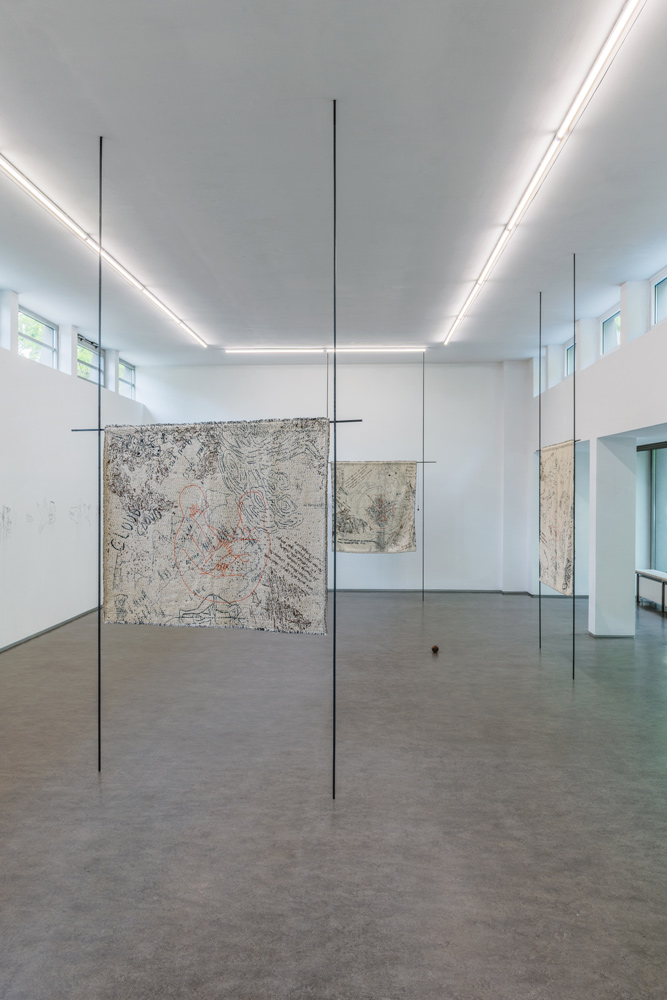
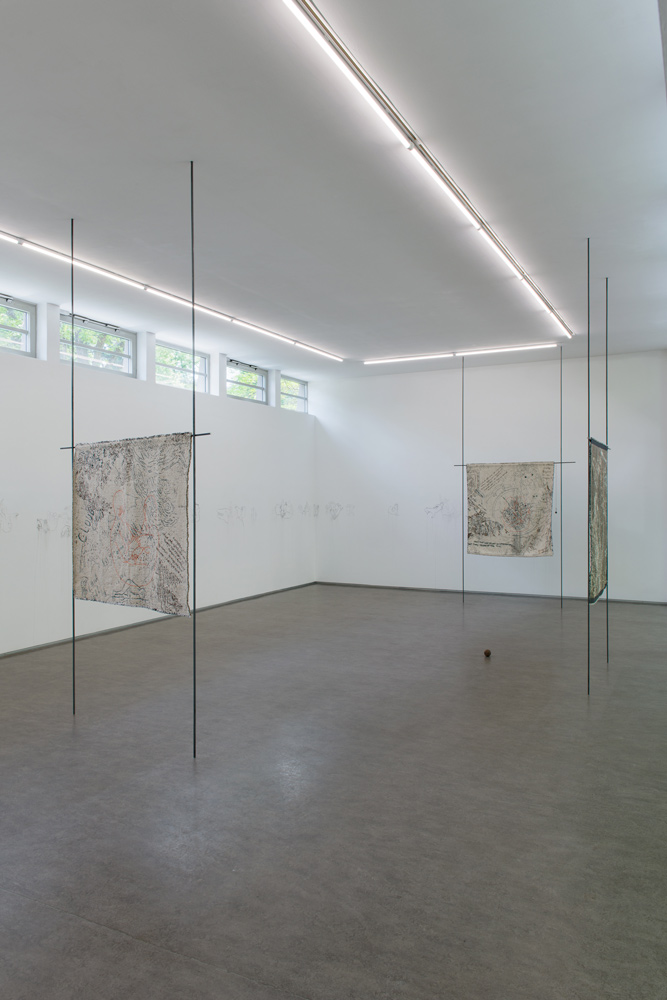
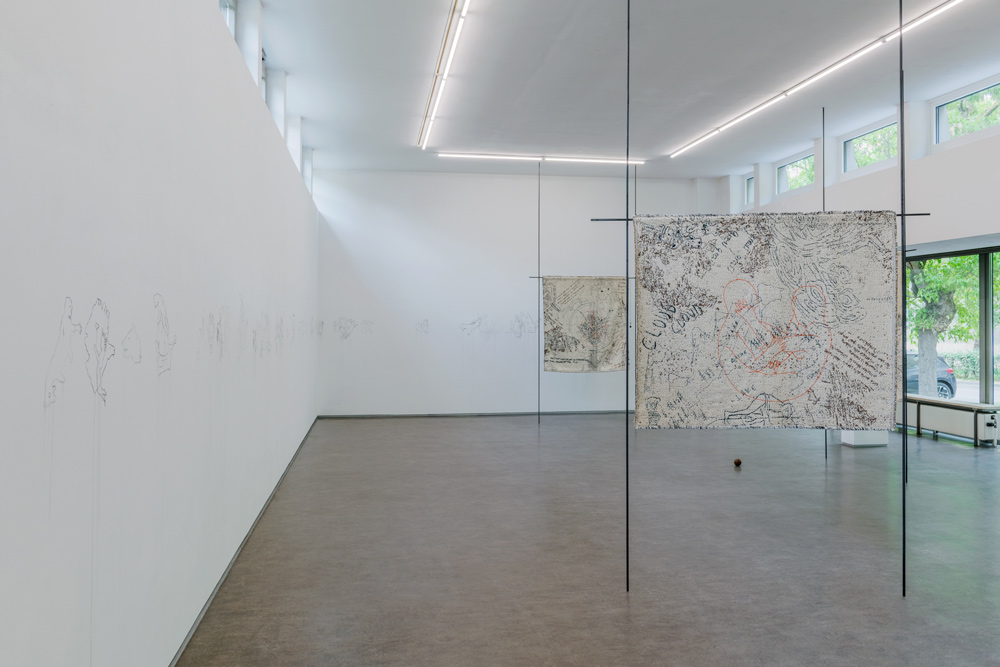
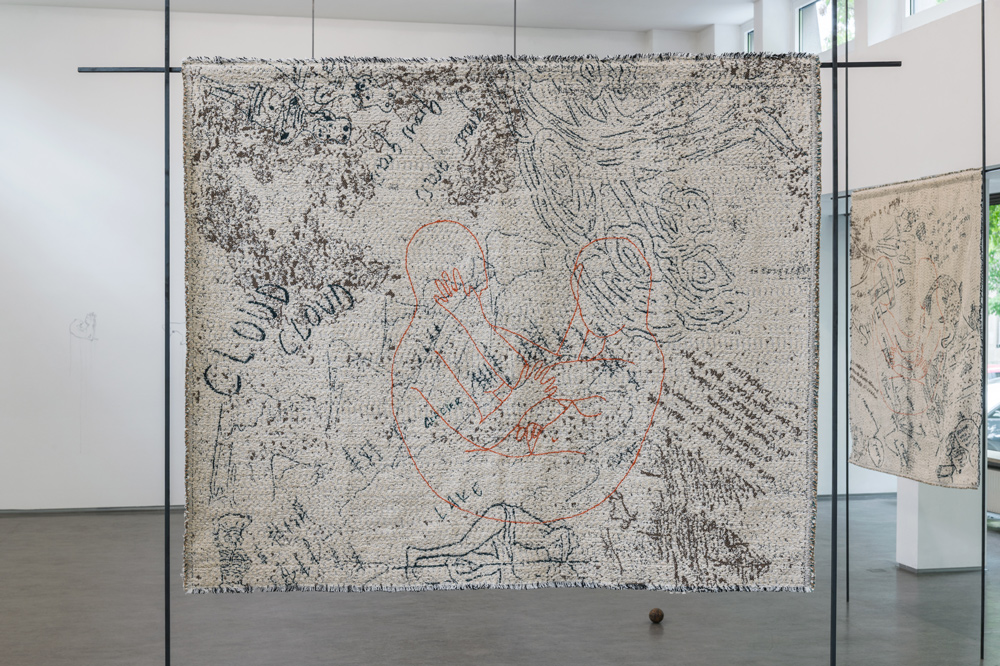
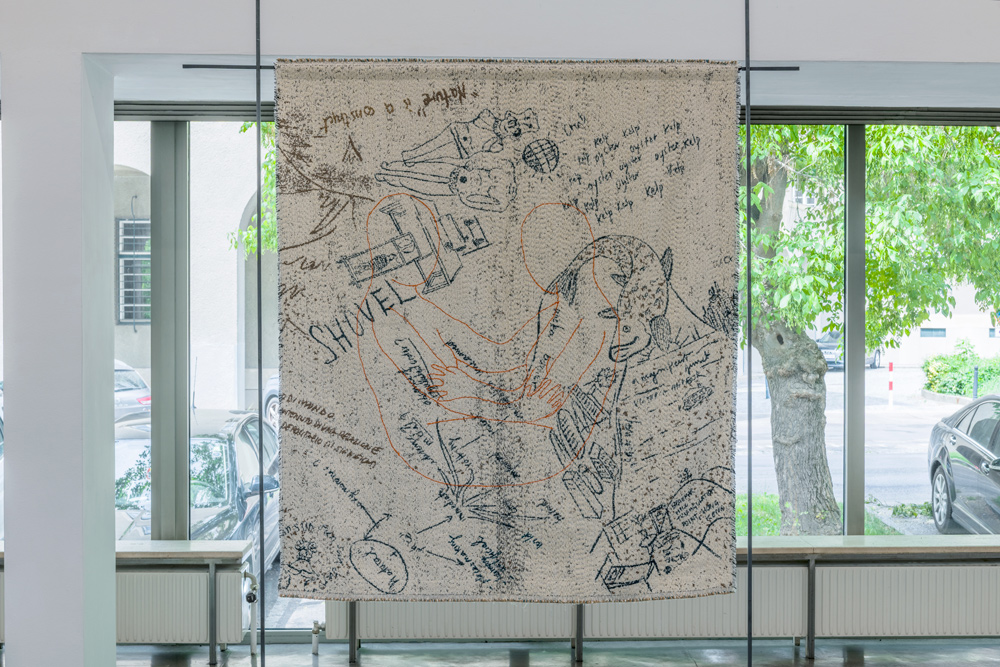
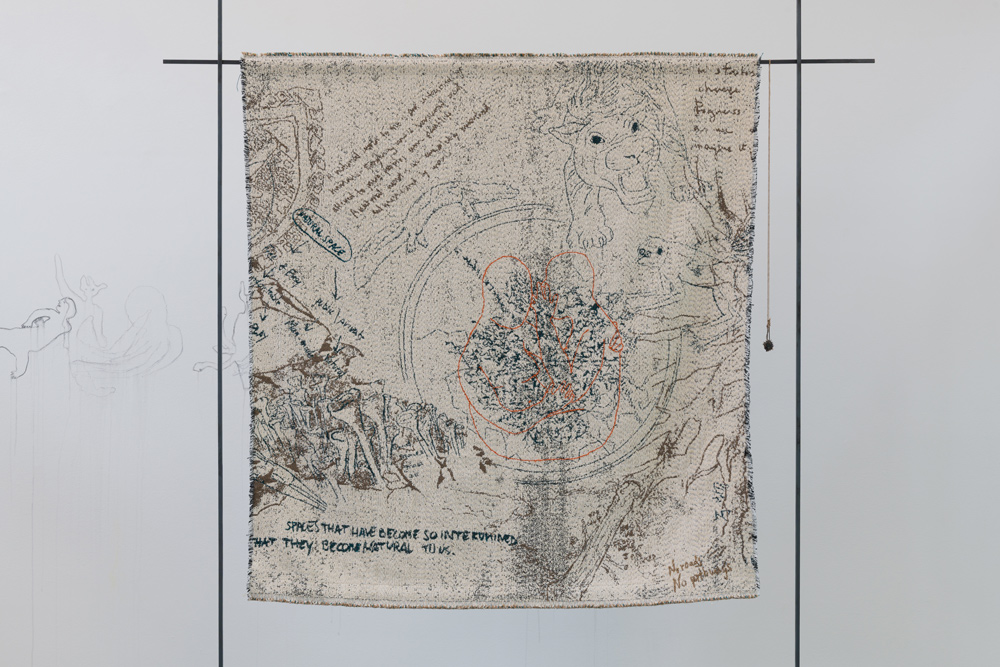
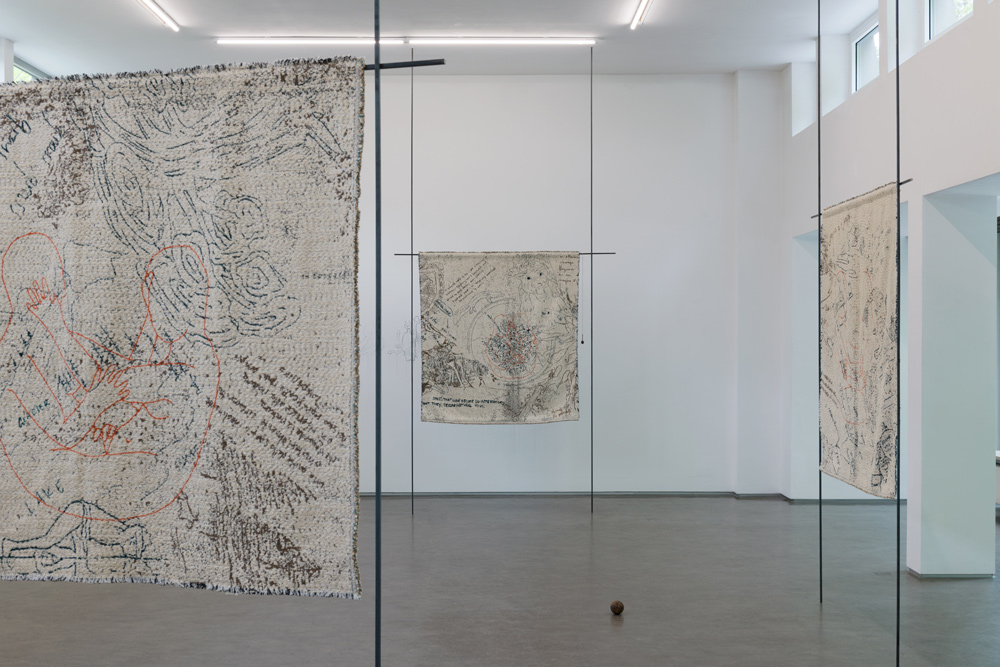
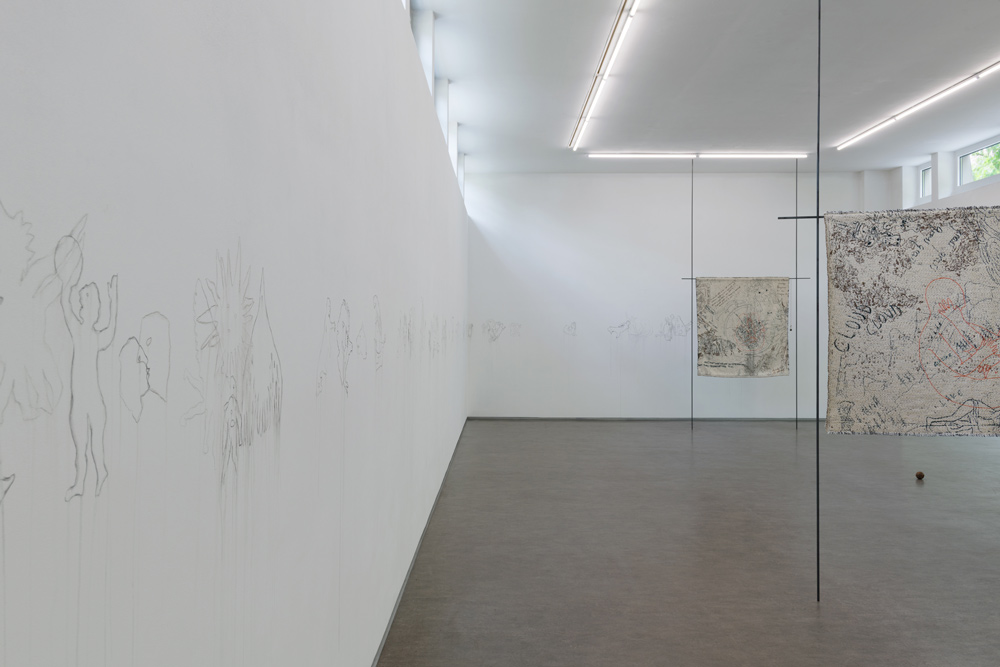
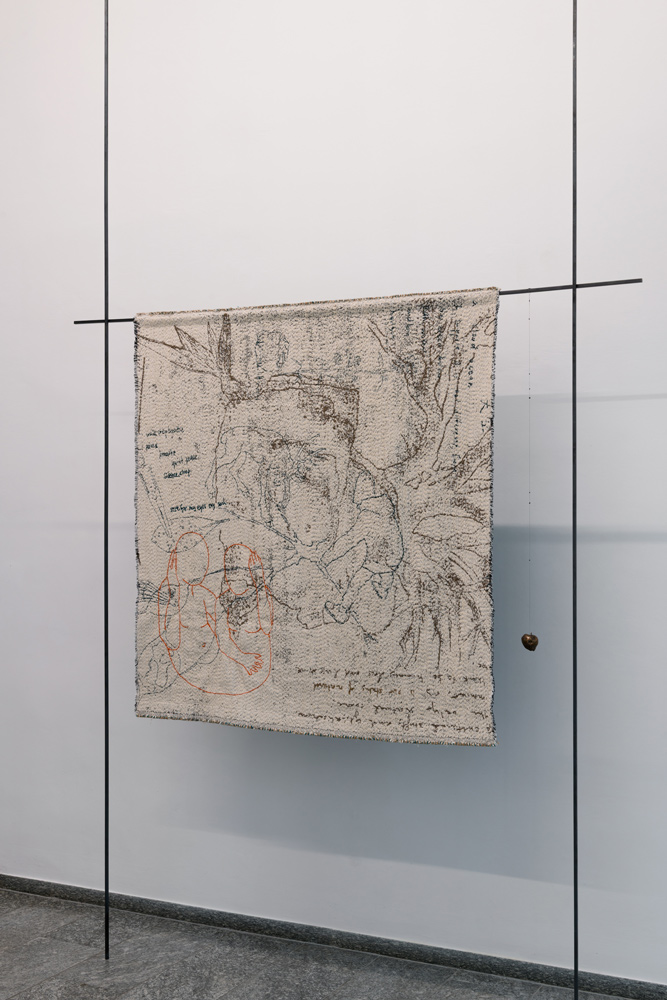
In the multi-part tapestry Like a Forest Garden, the artist interprets and distills thoughts and images compiled over years of interviewing hundreds of people regarding their conception of a “natural place.” Within the work, a dialogue emerges among these narratives and descriptions, while the individual subject subtly and almost naturally transitions into the notion of a collective not bound by time—a community, an exemplary form of “humanity.” In the installation of the work, however, Losi does not simply present the results of her research. Rather, she integrates selected sections of the textile wall piece into a spatial-installative arrangement that coalesces into a kind of biotope. This arrangement appears more naturally grown than constructed and assumes a perceptually open-ended rather than predetermined form. Echoing the dialectic between the subject and the collective or society, Losi establishes, through the exhibition form itself—the installation of the work—a subtle correspondence with the central idea of forest, ecosystem, and nature that underlies her work. Moving beyond essentialist notions of nature and subjectivity, Losi is fundamentally concerned with the interdependence and contingency of those concepts and ideas that are continually rearticulated and reshaped through human existence and action, through interaction and intersubjective exchange, through speaking, writing, remembering, and creating images.
In Losi’s work, the human being thus plays a crucial role as a distinctly active, free, and relational being. In this respect, the artist’s conception of nature does not produce an abstract or escapist counterpart, but rather a field of engaged action that encompasses both appropriation and empathy. Human beings and nature exist in relational tension, although Losi draws on notions of care and empathy that are ultimately grounded in conceptions of harmony and balance in coexistence. In this respect, Losi’s thinking contains a utopian, visionary dimension that has nothing to do with escapism. Rather, the subject—the viewer—is situated not only within an activated, embedded context in relation to our ontological conceptions of nature, but also within an intersubjective context of social coexistence that extends beyond the limited temporal horizons of present action.
The viewer is gently coaxed away from the here and now—from immediate perception, observation, and action—and transported into a perspective beyond temporal constraints. This is not a matter of detachment or control. On the contrary, Losi’s conception of what it means to be human and actively engaged is anthropological in nature. It embodies an attempt to experience the self not as isolated, abstract, and ultimately often passive and consuming, but as an active, intersubjectively connected being capable of thinking and feeling beyond the temporal and spatial confines of the individual.
Losi interweaves (textile) material and the human subject with language and society. Here, action does not simply appear as a reflection of subjectivity, but points to a complex network of relational connections between people, material, space, cultural archives, and history. The subject does not appear in isolation, but as a relational nexus. The traces, gestures, and articulations that define and inform the viewer’s aesthetic experience reveal themselves in relation to these spaces of cultural coding, symbolic charge, and inscription—that is, in tension and difference, but also in connection with them.
In Losi’s work, textiles do not function merely as material. Nor can the treatment and working of textile materials—weaving, embroidery, braiding, and knotting—be reduced to a purely technical or craft-based mode of production. They possess an inherently intersubjective quality. Binding, weaving, and related techniques operate simultaneously as metaphors and ideals of interpersonal action, but also of thought, epistemic inquiry, and understanding. In both cases and contexts, they offer possibilities for integrating, embedding, connecting, and repairing—not only fabric or yarn, but also ideas, images, and narratives. In this sense, both the material handling of the textiles and the conception of the installation/presentation as a forest/nature/biotope function not only as form, but also explicitly as metaphor and as a proposal for an aesthetic mode of action and understanding: a responsible and empathetic way of entering into resonance with the world.
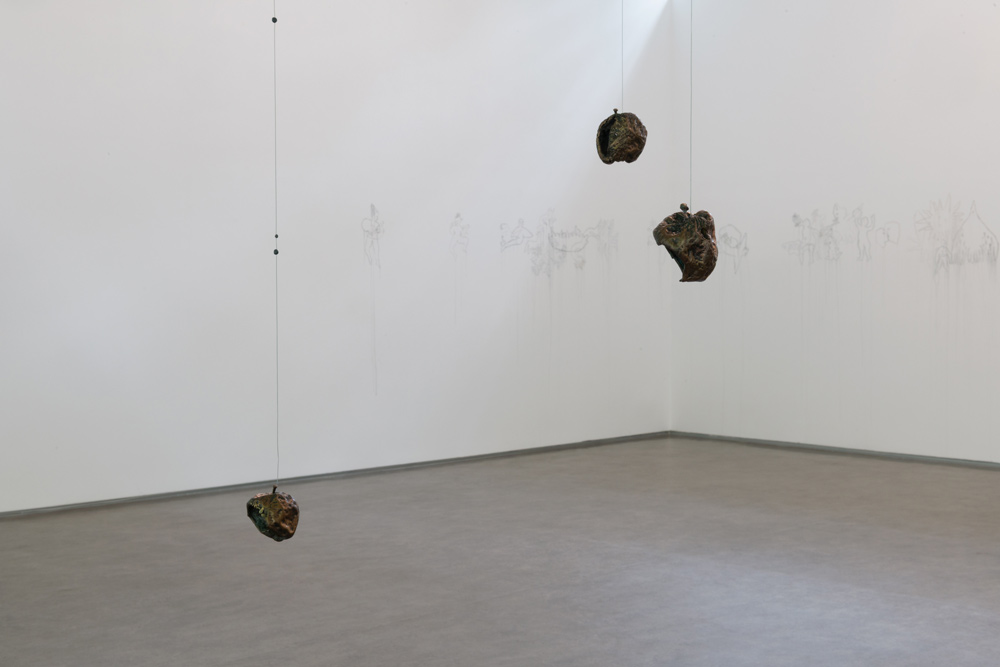
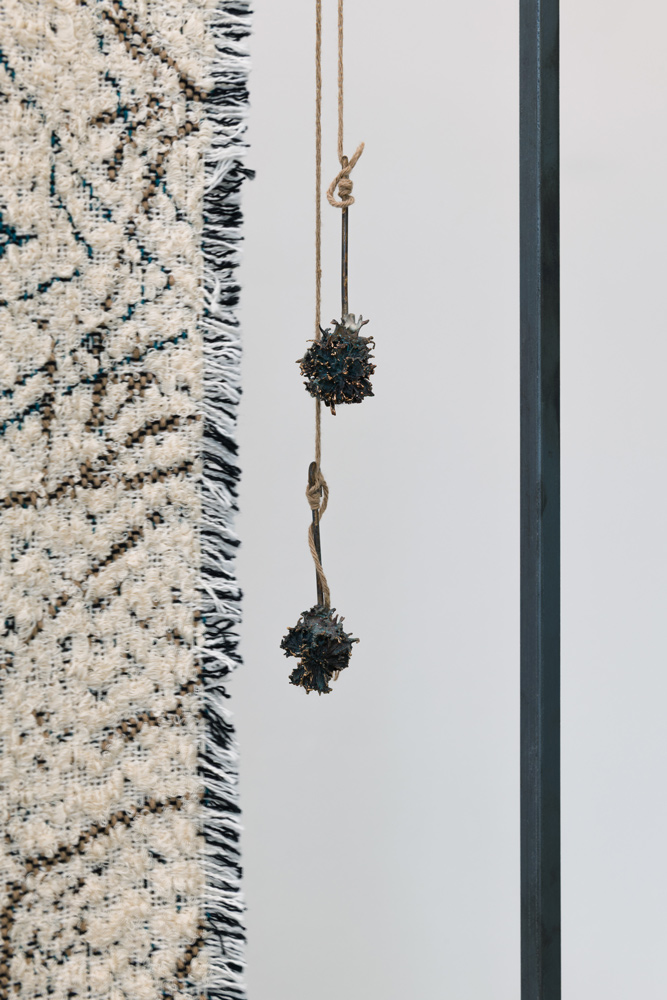
The small bronze sculptures titled Pomi, appearing at various points throughout the exhibition, serve as a kind of narrative supplement while also subverting the two groups of works on display. Their intertweaving and interlocking within the exhibition form a kind of ecosystem, an imaginary “forest garden.” The viewer encounters these small bronze fruits as subtle commentaries or subtexts. They allude to found apples, hollowed out by hornets, which the artist collected in her childhood and preserved for many decades. Losi has now transformed these dried fruits into small metal sculptures. This sculptural transformation is not grounded in any conceptual or narrative intention. Rather, the artist draws on a kinetic-kinesthetic element, a kind of bodily memory. It is about tactility, about protecting and sheltering. The artist has long seen in these forms a kind of prototypical nest, a cave and possible dwelling—forms that convey shelter and protection, while also requiring safeguarding themselves, and thus possessing something profoundly fragile and ephemeral. This act of protecting a safe space or place of refuge may be understood as an early (childhood) metaphor and as the foundation of Losi’s empathy, her ethical sensibility, and her relationship to nature.
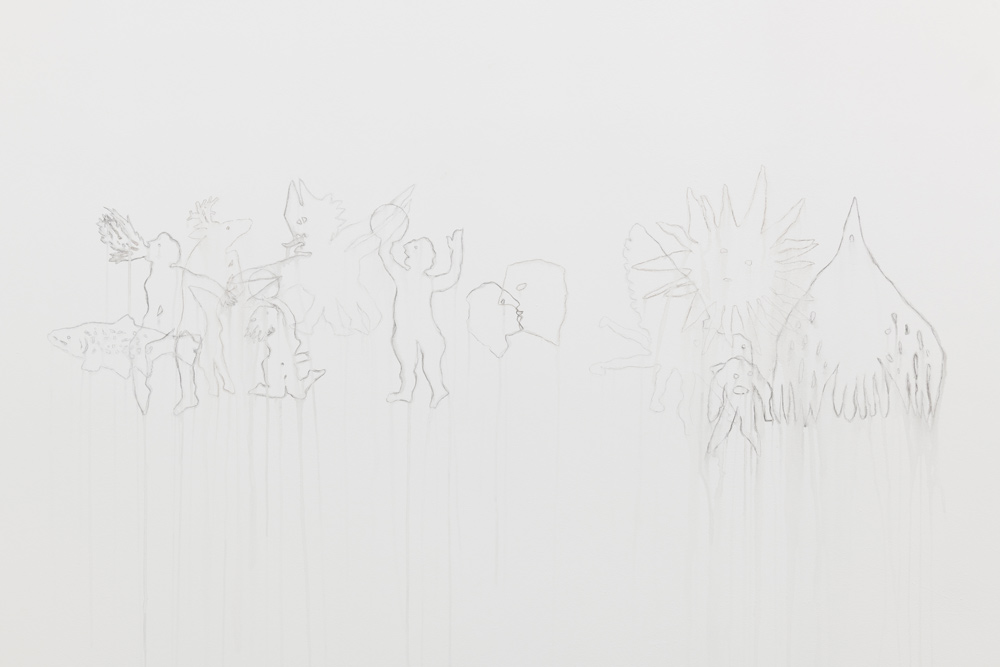
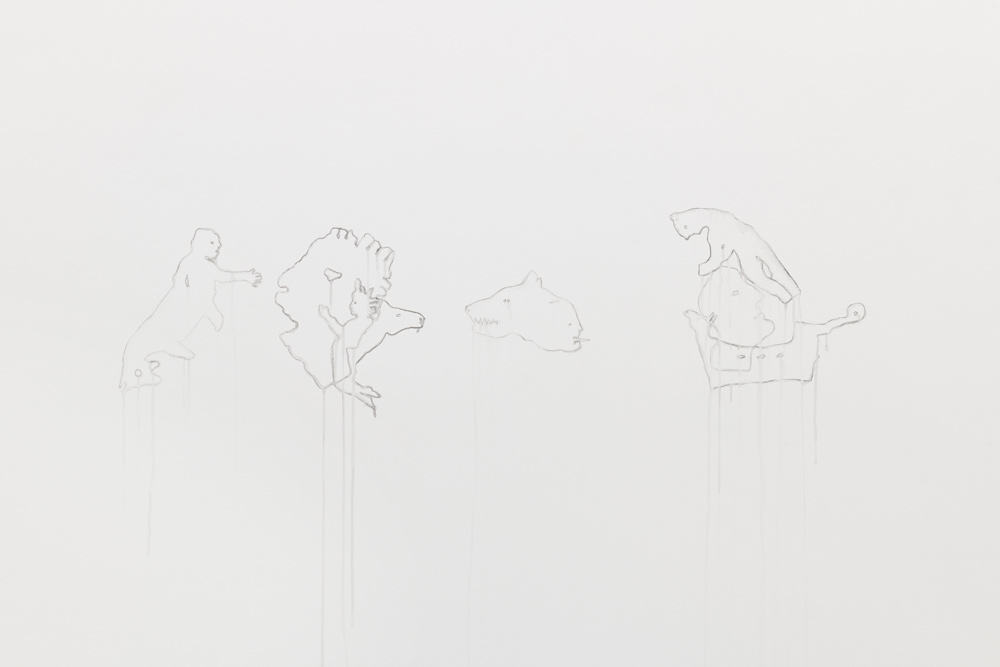
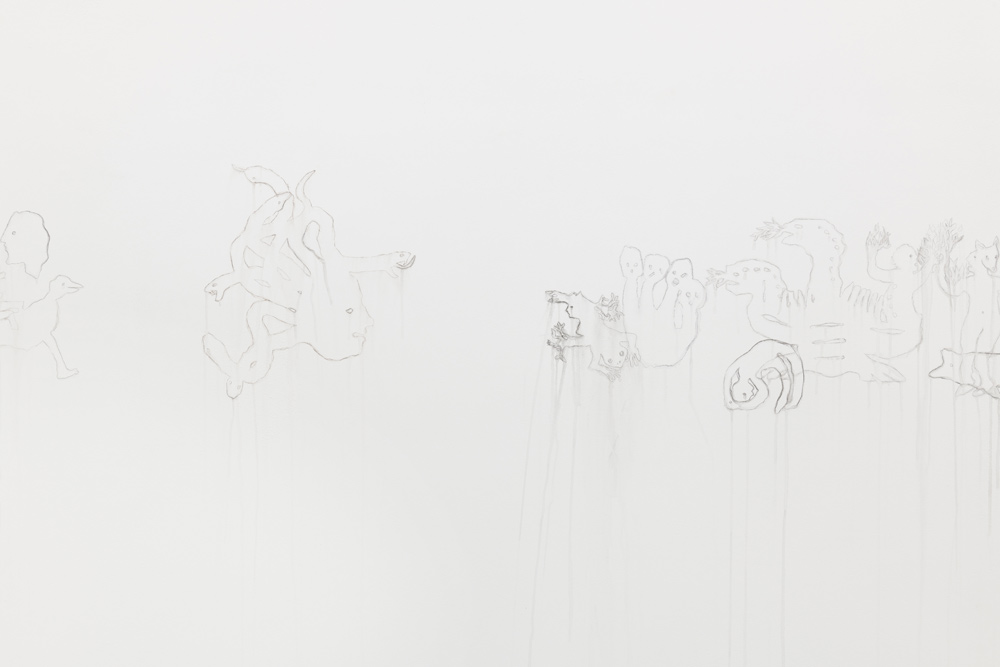
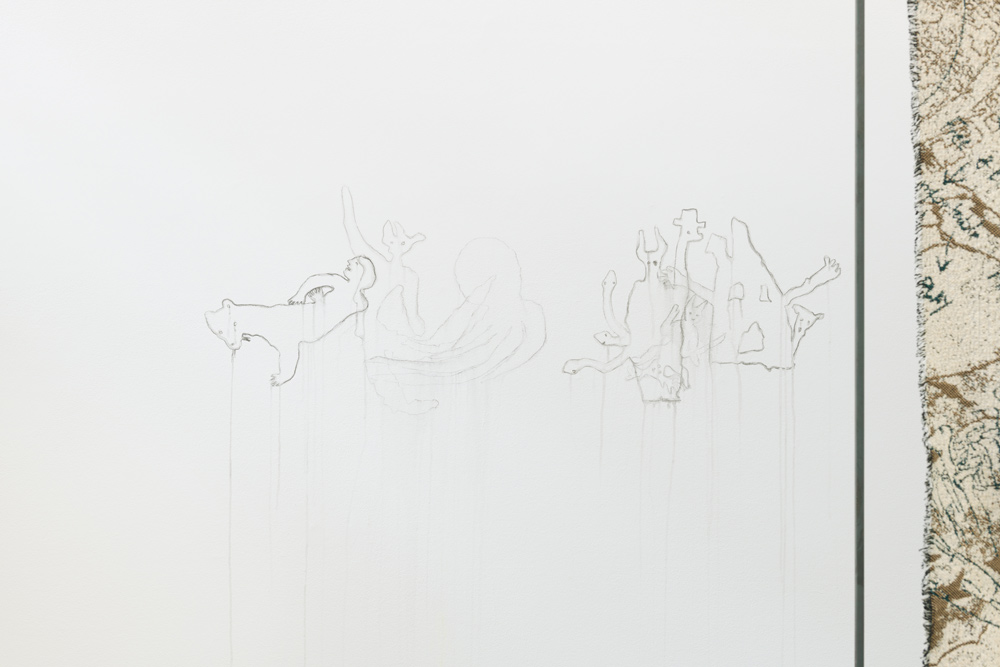
The more than fifteen-meter-long wall piece Anìmule, from the second group of works in the exhibition, can be described as a kind of frieze. It depicts a sequential series of archaic and obscure-looking “scenes” populated by human figures, animals, and other beings. But one should not be misled by first impressions. For the work is in fact neither drawing nor painting. Losi does not work here with drawn forms and figures, but with imprints—with indices that, through a multi-stage process, constitute a kind of multiple transfer and translation of the (collective) imaginary.
The figures and scenes do not originate in drawn imagination. They are torn paper forms—animals, beings, and scenes the artist created in a wide variety of locations with a diverse range of people, in a practice both highly subjective and participatory/intersubjective. The tearing of the paper generates an ongoing process of variation that decisively shapes the appearance and aesthetic character of the animals, figures, and beings. These are free, associative forms characterized by a high degree of aleatoriness, improvisation, and material immanence. This tension between international scope and indeterminacy defines the ambivalent ontological status of Anìmule as artistic works. In this sense, the various forms and beings constitute processual artifacts; they are things that have become more than what was conceived and drawn. The viewer encounters chimeras, disproportionate hybrid creatures, and archaic forms that oscillate between the phantasmatic, the recounted, and the narrated.
Claudia Losi’s works often contain something playful, elementary, accessible, even naive. She employs forms that emerge from playful procedures, such as tearing paper. The principle of pareidolia, a form of apophenia, serves as a fundamental mechanism for the evocation of form. Within the complexity and aleatoric nature of the torn form—the respective creature, animal, etc.—takes shape through the act itself, through the process, and through the gaze of the person tearing the paper. The resulting forms oscillate between drawing and sculpture. In every case, the connection between eye, mind, and hand—that is, the hand itself—plays an essential role. “I am interested in how the hands are intelligent, how they tell, how they think for us.” Here, as with the Pomi, Losi draws on a kind of tactile, haptic knowledge that precedes and underlies conceptual thought.
Losi uses the torn forms and shapes as raw material and templates for a wall piece composed of multiple scenes, representing a hybrid of drawing and mural painting. She translates these forms into drawing and painting, though here, too, these media cannot be understood in their conventional sense. She traces the contours of the torn forms and then washes them with water, so that the flow and bleeding of the pigment becomes central to the “painterly” process. The resulting images appear aged, as though washed out and faded. Read theatrically, however—after all, these are scenes that strongly engage the viewer’s interpretative impulse—the figures, animals, and creatures seem, in places, to be “weeping.”
The condensing and superimposition of figures drawn from entirely different narrative contexts and authorships creates a highly charged, associative, and interpretive (imaginary) field that takes shape and intensifies in the viewer’s eye. Viewed from a timeless perspective and with a certain distance, and read anthropologically, Losi creates here a metanarrative, an overarching narrative. From a multiplicity of stories emerges a story about storytelling itself, about what it means to be human, about encounters with others, and about our relationship to nature and the world. A seemingly simple narrative thus subtly opens up a space for philosophical and existential questions while also simultaneously possessing an archaic dimension. This is a defining characteristic of Losi’s aesthetic approach. She begins with a simple, even elementary visual language, only then to draw the viewer’s perception and thought toward ontological and existential questions.
In her work, Claudia Losi poses fundamental questions about place and situatedness. What does it mean to be in a place? But what does it also mean to exist beyond the garden (forest garden)—to venture “beyond the garden”? The exhibition thus brings together two essential ontological questions of place from Losi’s work. The question of the here and now is juxtaposed with that of venturing out into the world, of overcoming and transcending the familiar. Claudia Losi’s thinking about place and the world is grounded in a fundamental and radical idea of freedom and becoming. She draws on a way of seeing that is always more oriented toward searching than finding. It is by no means concerned with assertions or fixed ideas, but rather with human beings as relational and empathetic beings. The self is presented here not as something given, but in a process of becoming and transformation—in a process of approach and transformation rather than appropriation, categorization, and mutual reification.
Text: David Komary
Translation: Erik Smith
top
In the multi-part tapestry Like a Forest Garden, the artist interprets and distills thoughts and images compiled over years of interviewing hundreds of people regarding their conception of a “natural place.” Within the work, a dialogue emerges among these narratives and descriptions, while the individual subject subtly and almost naturally transitions into the notion of a collective not bound by time—a community, an exemplary form of “humanity.” In the installation of the work, however, Losi does not simply present the results of her research. Rather, she integrates selected sections of the textile wall piece into a spatial-installative arrangement that coalesces into a kind of biotope. This arrangement appears more naturally grown than constructed and assumes a perceptually open-ended rather than predetermined form. Echoing the dialectic between the subject and the collective or society, Losi establishes, through the exhibition form itself—the installation of the work—a subtle correspondence with the central idea of forest, ecosystem, and nature that underlies her work. Moving beyond essentialist notions of nature and subjectivity, Losi is fundamentally concerned with the interdependence and contingency of those concepts and ideas that are continually rearticulated and reshaped through human existence and action, through interaction and intersubjective exchange, through speaking, writing, remembering, and creating images.
In Losi’s work, the human being thus plays a crucial role as a distinctly active, free, and relational being. In this respect, the artist’s conception of nature does not produce an abstract or escapist counterpart, but rather a field of engaged action that encompasses both appropriation and empathy. Human beings and nature exist in relational tension, although Losi draws on notions of care and empathy that are ultimately grounded in conceptions of harmony and balance in coexistence. In this respect, Losi’s thinking contains a utopian, visionary dimension that has nothing to do with escapism. Rather, the subject—the viewer—is situated not only within an activated, embedded context in relation to our ontological conceptions of nature, but also within an intersubjective context of social coexistence that extends beyond the limited temporal horizons of present action.
The viewer is gently coaxed away from the here and now—from immediate perception, observation, and action—and transported into a perspective beyond temporal constraints. This is not a matter of detachment or control. On the contrary, Losi’s conception of what it means to be human and actively engaged is anthropological in nature. It embodies an attempt to experience the self not as isolated, abstract, and ultimately often passive and consuming, but as an active, intersubjectively connected being capable of thinking and feeling beyond the temporal and spatial confines of the individual.
Losi interweaves (textile) material and the human subject with language and society. Here, action does not simply appear as a reflection of subjectivity, but points to a complex network of relational connections between people, material, space, cultural archives, and history. The subject does not appear in isolation, but as a relational nexus. The traces, gestures, and articulations that define and inform the viewer’s aesthetic experience reveal themselves in relation to these spaces of cultural coding, symbolic charge, and inscription—that is, in tension and difference, but also in connection with them.
In Losi’s work, textiles do not function merely as material. Nor can the treatment and working of textile materials—weaving, embroidery, braiding, and knotting—be reduced to a purely technical or craft-based mode of production. They possess an inherently intersubjective quality. Binding, weaving, and related techniques operate simultaneously as metaphors and ideals of interpersonal action, but also of thought, epistemic inquiry, and understanding. In both cases and contexts, they offer possibilities for integrating, embedding, connecting, and repairing—not only fabric or yarn, but also ideas, images, and narratives. In this sense, both the material handling of the textiles and the conception of the installation/presentation as a forest/nature/biotope function not only as form, but also explicitly as metaphor and as a proposal for an aesthetic mode of action and understanding: a responsible and empathetic way of entering into resonance with the world.
The small bronze sculptures titled Pomi, appearing at various points throughout the exhibition, serve as a kind of narrative supplement while also subverting the two groups of works on display. Their intertweaving and interlocking within the exhibition form a kind of ecosystem, an imaginary “forest garden.” The viewer encounters these small bronze fruits as subtle commentaries or subtexts. They allude to found apples, hollowed out by hornets, which the artist collected in her childhood and preserved for many decades. Losi has now transformed these dried fruits into small metal sculptures. This sculptural transformation is not grounded in any conceptual or narrative intention. Rather, the artist draws on a kinetic-kinesthetic element, a kind of bodily memory. It is about tactility, about protecting and sheltering. The artist has long seen in these forms a kind of prototypical nest, a cave and possible dwelling—forms that convey shelter and protection, while also requiring safeguarding themselves, and thus possessing something profoundly fragile and ephemeral. This act of protecting a safe space or place of refuge may be understood as an early (childhood) metaphor and as the foundation of Losi’s empathy, her ethical sensibility, and her relationship to nature.
The more than fifteen-meter-long wall piece Anìmule, from the second group of works in the exhibition, can be described as a kind of frieze. It depicts a sequential series of archaic and obscure-looking “scenes” populated by human figures, animals, and other beings. But one should not be misled by first impressions. For the work is in fact neither drawing nor painting. Losi does not work here with drawn forms and figures, but with imprints—with indices that, through a multi-stage process, constitute a kind of multiple transfer and translation of the (collective) imaginary.
The figures and scenes do not originate in drawn imagination. They are torn paper forms—animals, beings, and scenes the artist created in a wide variety of locations with a diverse range of people, in a practice both highly subjective and participatory/intersubjective. The tearing of the paper generates an ongoing process of variation that decisively shapes the appearance and aesthetic character of the animals, figures, and beings. These are free, associative forms characterized by a high degree of aleatoriness, improvisation, and material immanence. This tension between international scope and indeterminacy defines the ambivalent ontological status of Anìmule as artistic works. In this sense, the various forms and beings constitute processual artifacts; they are things that have become more than what was conceived and drawn. The viewer encounters chimeras, disproportionate hybrid creatures, and archaic forms that oscillate between the phantasmatic, the recounted, and the narrated.
Claudia Losi’s works often contain something playful, elementary, accessible, even naive. She employs forms that emerge from playful procedures, such as tearing paper. The principle of pareidolia, a form of apophenia, serves as a fundamental mechanism for the evocation of form. Within the complexity and aleatoric nature of the torn form—the respective creature, animal, etc.—takes shape through the act itself, through the process, and through the gaze of the person tearing the paper. The resulting forms oscillate between drawing and sculpture. In every case, the connection between eye, mind, and hand—that is, the hand itself—plays an essential role. “I am interested in how the hands are intelligent, how they tell, how they think for us.” Here, as with the Pomi, Losi draws on a kind of tactile, haptic knowledge that precedes and underlies conceptual thought.
Losi uses the torn forms and shapes as raw material and templates for a wall piece composed of multiple scenes, representing a hybrid of drawing and mural painting. She translates these forms into drawing and painting, though here, too, these media cannot be understood in their conventional sense. She traces the contours of the torn forms and then washes them with water, so that the flow and bleeding of the pigment becomes central to the “painterly” process. The resulting images appear aged, as though washed out and faded. Read theatrically, however—after all, these are scenes that strongly engage the viewer’s interpretative impulse—the figures, animals, and creatures seem, in places, to be “weeping.”
The condensing and superimposition of figures drawn from entirely different narrative contexts and authorships creates a highly charged, associative, and interpretive (imaginary) field that takes shape and intensifies in the viewer’s eye. Viewed from a timeless perspective and with a certain distance, and read anthropologically, Losi creates here a metanarrative, an overarching narrative. From a multiplicity of stories emerges a story about storytelling itself, about what it means to be human, about encounters with others, and about our relationship to nature and the world. A seemingly simple narrative thus subtly opens up a space for philosophical and existential questions while also simultaneously possessing an archaic dimension. This is a defining characteristic of Losi’s aesthetic approach. She begins with a simple, even elementary visual language, only then to draw the viewer’s perception and thought toward ontological and existential questions.
In her work, Claudia Losi poses fundamental questions about place and situatedness. What does it mean to be in a place? But what does it also mean to exist beyond the garden (forest garden)—to venture “beyond the garden”? The exhibition thus brings together two essential ontological questions of place from Losi’s work. The question of the here and now is juxtaposed with that of venturing out into the world, of overcoming and transcending the familiar. Claudia Losi’s thinking about place and the world is grounded in a fundamental and radical idea of freedom and becoming. She draws on a way of seeing that is always more oriented toward searching than finding. It is by no means concerned with assertions or fixed ideas, but rather with human beings as relational and empathetic beings. The self is presented here not as something given, but in a process of becoming and transformation—in a process of approach and transformation rather than appropriation, categorization, and mutual reification.
Text: David Komary
Translation: Erik Smith
top
Claudia Losi
Born in Piacenza, 1971. Lives and works in Piacenza, Italy.
Graduated at the Academy of Fine Arts, Bologna, and at the University of Foreign Languages and Literature, Bologna, she was selected in 1998 for the Advanced Course in Visual Arts of the Antonio Ratti Foundation, in Como, Italy; in 2000 Italian shortlisted for the International Studio Program P.S.1-New York. She has been artist in residence at Studio Orta-Les Moulins (France), JCVA, Jerusalem (Israel), Art Omi International, New York (United States), NTU CCA (Singapore), Error-Lenguas hermanas, Mexico City
Selected exhibitions: Monica De Cardenas, Milano (2026); Palazzo Ducale, Genova; La Strozzina, Firenze (2025); Palazzo Te, Mantova; Museo della Montagna, Torino (2024); Obrera Centro / ICC, Città del Messico; AssabOne, Milano (2021); MAMbo, Bologna (2020); Ikon Gallery, Birmingham (2019); Collezione Maramotti, Reggio Emilia; Hangzhou Triennial of Fiber Art (2016); Triennale Design Museum, Milano; MAXXI, Roma (2012, 2010); Royal Academy, Londra (2010); Sharjah Biennial 8 (2007); In 2021, she published The Whale Theory: An Animal Imaginary, Johan & Levi and Voce a vento, (Kunstverein Publishing). Her project Being There. Byond the garden won the Italian Council (9th Edition, 2020), promoted by the Italian Ministry of Culture, in 2022 the homonymous book was published by Viaindustriae.
top